


Star looks to deepen ties with diaspora

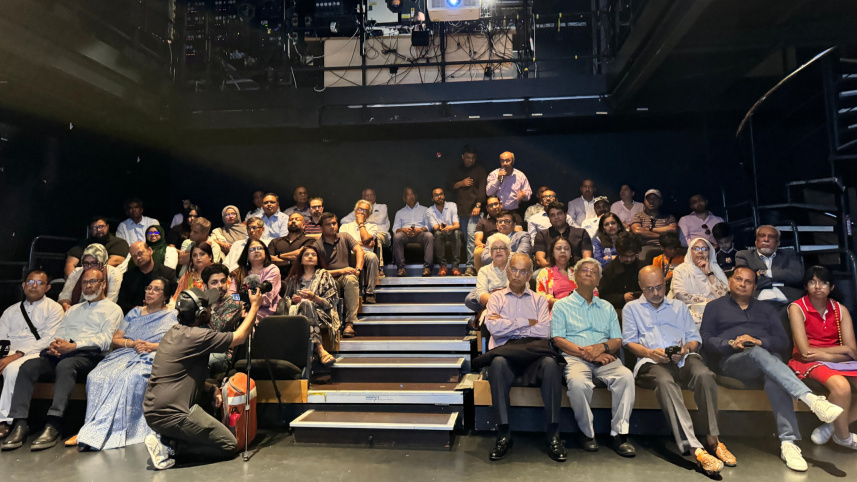
The Daily Star seeks to strengthen its engagement not only with readers in Bangladesh but also with those living abroad, said the newspaper’s Editor and Publisher Mahfuz Anam, on Sunday.
He made the remarks during an interactive conversation hosted by The Daily Star with members of the Bangladeshi diaspora in London, UK.

Titled “How Can We Better Serve You?”, with the subtitle, “Meet the Editor: A London Conversation with the Bangladeshi Diaspora”, the event took place at Queen Mary University of London.
The gathering brought together journalists, researchers, academics, business leaders, lawyers, accountants, cultural activists, students, representatives of mainstream political parties, and members of the wider Bangladeshi community.

Anam said the event marked the beginning of a sustained effort to deepen the newspaper’s engagement with Bangladeshis living overseas.
“The Daily Star is evolving,” he said. “As we embrace digital transformation, we also want to strengthen our global presence. London, with its vibrant Bangladeshi community and enduring connection to Bangladesh, is the ideal place to begin this conversation.”
He said the newspaper wants to hear directly from readers about their expectations and suggestions, adding that such exchanges will help shape its editorial priorities in the years ahead.
“We want this dialogue to continue regularly so that readers’ opinions and experiences are reflected in our work,” he said.
The programme opened with a documentary on The Daily Star’s 35-year journey under the theme “Unbowed: Celebrating 35 Years of Journalism Without Fear or Favour”.
During the interactive conversation,one audience member observed that, as an English-language daily, The Daily Star is often perceived as serving a relatively privileged segment of society and asked how the newspaper planned to broaden its appeal.
In response, Anam said the newsroom was placing greater emphasis on reporting from across the country and amplifying the voices of ordinary people.
“We want to focus more on issues affecting people nationwide,” he said. “The contributions of farmers, rural women, and working people are immense. Their voices deserve greater prominence because they are central to Bangladesh’s economy and society.”
Another participant asked how the newspaper maintains editorial independence while withstanding political pressure.
Anam replied that The Daily Star had remained committed to its journalistic principles regardless of who was in power.
“There have been many instances where we published investigative reports exposing corruption involving influential individuals who enjoyed political backing,” he said. “Our responsibility is to remain faithful to our motto -- journalism without fear or favour.”
One participant asked whether the newspaper would investigate companies that advertise in its pages if credible allegations emerged against them.
“If allegations are supported by evidence and are in the public interest, we have a duty to publish them,” the editor said. “Editorial decisions cannot be influenced by commercial considerations.”
The discussion also touched on a long-standing allegation circulated by some critics that The Daily Star serves “India’s interests”.
Anam firmly rejected the claim.
“Those who make such allegations have never produced a single piece of evidence,” he said. “Whenever someone repeats this accusation, ask them to substantiate it with facts.”
 For all latest news, follow The Daily Star's Google News channel.
 He pointed out that the newspaper had consistently published reports and editorials opposing border killings and advocating fairness, mutual respect, and balanced relations between Bangladesh and its neighbours.
Asked about press freedom and the growing number of journalists facing legal cases, the editor said corruption within journalism should never be tolerated but stressed that due process must be respected.
“If a journalist is found guilty of corruption, they should certainly be punished,” he said. “But keeping journalists in prison for months under serious criminal charges without credible evidence is unacceptable.”
Reflecting on Bangladesh’s democratic journey, Anam said the country’s future depends on remaining true to the ideals of the Liberation War.
“If we want to uphold democracy, we cannot lose sight of the core spirit of our Liberation War,” he said.
“The diaspora played a significant role during our Liberation War, and we believe they continue to have a deep aspiration to contribute to Bangladesh,” he said. “We want to reflect that aspiration.”
Comments