


Presidential polls likely in late Aug

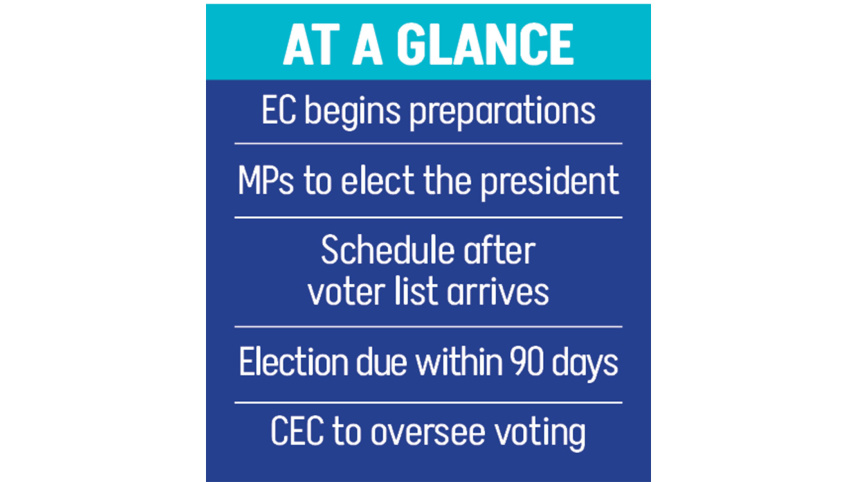
The Election Commission is planning to hold the next presidential election in the last week of August to elect the head of state.
President Mohammed Shahabuddin resigned on July 24. Following his resignation, Speaker Hafiz Uddin Ahmad has been discharging duties as acting president.

Under the constitution, the EC is required to hold the election within 90 days of the vacancy.
The commission has already begun preparations and held preliminary discussions with Acting Speaker Kayser Kamal on Tuesday.
After the meeting, Chief Election Commissioner AMM Nasir Uddin said the election schedule would be announced once the voter list of members of parliament was received from the parliament secretariat.
“If there are multiple candidates, voting will take place openly in the parliament. If there is only one valid candidate, he or she will be declared elected unopposed,” he said.
Under the constitution and the President Election Act 1991, the chief election commissioner acts as the returning officer. The CEC announces the election schedule after consulting the Speaker.
Voting in the presidential election is held during a parliamentary session. If parliament is not in session at the required time, the Election Commission, after consulting the Speaker, issues a notification summoning parliament at least seven days before the voting date.
In such a case, the president does not need to summon parliament as in normal circumstances.
Regarding the matter, EC Abdur Rahmanel Masud said, “If parliament is in session, we will have to coordinate with them. If not, the CEC will call upon the voters, saying the vote will take place on such date at such venue.”
MPs cast votes in the indirect presidential election.
Asked when the election would be held, Masud hinted that it could take place in the last week of next month.
Under the constitution and the President’s Election Act, 1991, any person aged 35 years or above and qualified to be elected as a member of parliament may contest the presidential election.
However, the nomination paper must have a proposer and a seconder who are MPs. When collecting the nomination paper, the candidate must also be accompanied by an MP.
On election day, the CEC presides over the session. No other parliamentary business may take place that day, and voting can begin only after noon.
MPs must cast their votes in the parliament chamber before the election officer using prescribed ballot papers. They must mark the name of their preferred candidate and sign the ballot paper.
To collect a ballot paper, MPs must sign the counterfoil. Each member of parliament has only one vote. The Speaker, as a member of parliament, is also entitled to vote.
After voting ends, the CEC counts the votes publicly. In the event of a tie, the result is determined by lottery among the candidates.
 For all latest news, follow The Daily Star's Google News channel.
Comments