


Men, money and muscle still guard the gates of politics

The vision of an inclusive democracy, forged on the streets during the July uprising, has collided with a formidable structural wall.
While the movement promised to remove discrimination from society, including those enforced by patriarchy, the February 12 election this year has instead exposed a pattern of systemic exclusion.

Initial ambitions for gender parity were incrementally diluted, with demands for 100 direct seats eventually shrinking to just 84 female candidates contesting the election, of whom only seven secured seats -- a disparity that reflects a failure to penetrate the country’s true epicentre of political influence.
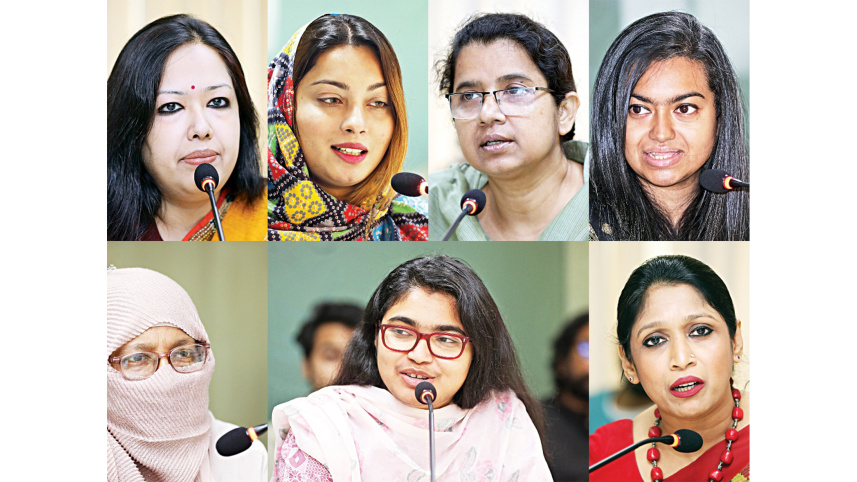
Ahead of International Women’s Day today, The Daily Star sat with five female candidates, a professor of women and gender studies at Dhaka University, and a senior leader from Bangladesh Jamaat-e-Islami.
Their collective experiences surrounding the recent national polls reveal that the structures of power remain guarded by deeply entrenched patriarchy, which manifests through immense capital, systemic muscle power, and coordinated digital warfare.
In the final 10 days, you are forced to spend at least Tk 10 lakh every day just to keep the campaign alive. You cannot even ask where the money goes or whether it reaches voters.
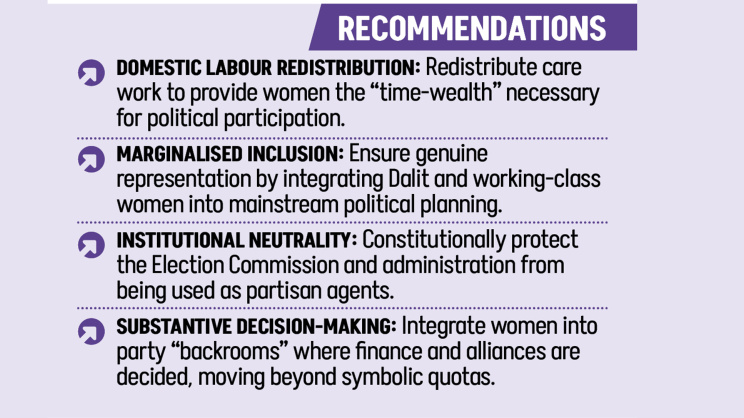
“We use the number of women in Parliament as a ‘convenient metric,’ but it measures presence, not power,” said Tasnim Jara, who was an independent candidate for Dhaka-9. She argued that while parties aggressively court the female electorate -- who comprise 51 percent of voters -- they remain fundamentally resistant to allowing women into the “backrooms” where real decisions are made.
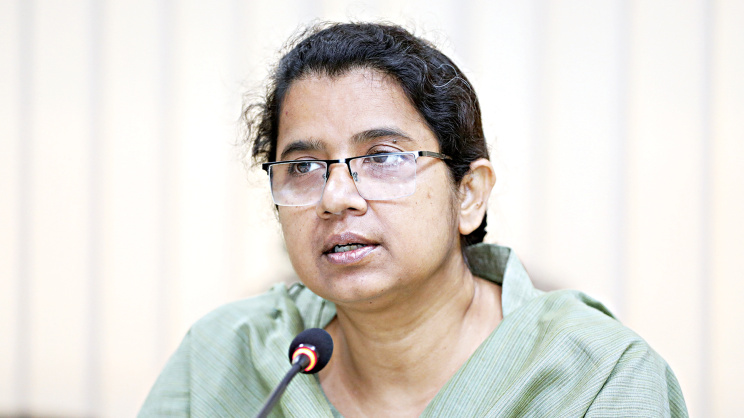
This “calculated erasure” is reinforced by what gender specialist Dr Tania Haque, professor of the women and gender studies department at Dhaka University, described as a “toxic masculinity” that weaponises misinformation.
At the end of the day, political parties legislate in Parliament and shape the path and policies of the state. Yet the mindset within these parties is still not conducive enough for meaningful participation by women.
“Our society is conditioned to view women as liabilities rather than leaders,” she noted, pointing to a persistent narrative that “decent girls don’t do politics.”
As Bangladesh navigates its post-uprising transition, these candidates warn that the “July Spirit” will remain unfulfilled until the political parties’ “Mother-Sister” trope is replaced by genuine political agency, they said.
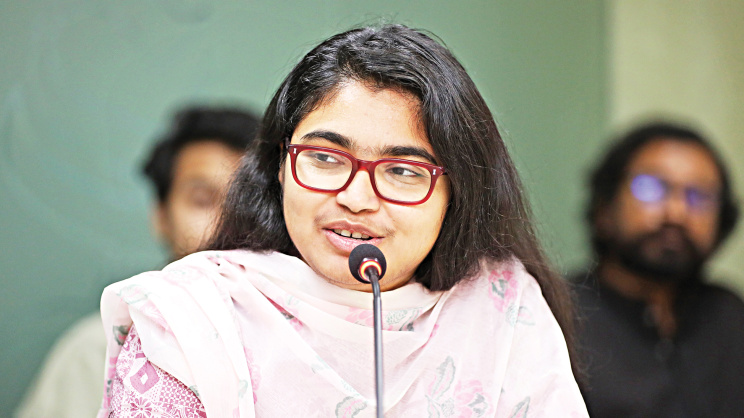
We might have female MPs, but are they in the decision-making seats? No. The number of women may be an ‘convenient metric’ to track, but it does not reflect where real power actually lies.
THE ‘MASTAN’ PHENOMENON
Candidates argued that Bangladeshi politics equates leadership with physical aggression, rebranding criminality as an asset while dismissing feminine traits as inherent weaknesses.
They noted that this culture of “muscle power” creates a formidable barrier, measuring political viability through dominance rather than merit.
“When we imagine a hero, the image of a man still flashes before our eyes,” said Taslima Akhter, a Gonosamhati Andolon candidate for Dhaka-12, highlighting how societal expectations and party biases define women by appearance and demeanour rather than capability.
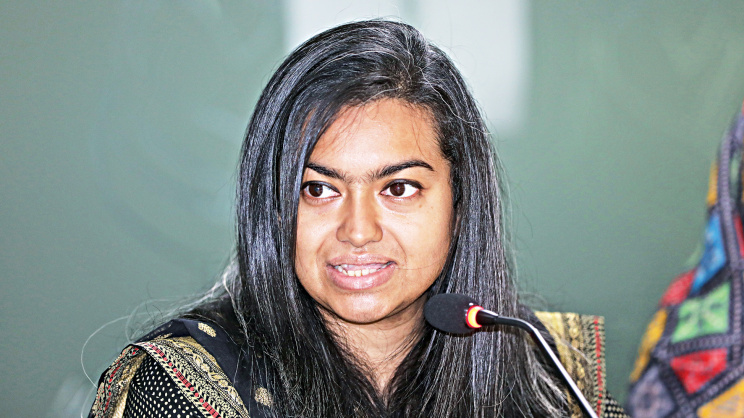
In clusters of joint families, a male mediator approaches political leaders saying, ‘I have 10 NIDs’ or ‘I can supply 20 votes’…. The women don’t even know their identities are being sold.
Meghna Alam, independent candidate for Dhaka-8, exposed a stark double standard: while she faced scrutiny for what she described as a single politically motivated case, her opponent was lauded for having over 200. “People said, ‘He is a mafia boss? That’s exactly who we need,’” she recalled, noting that society often views a “mastan” (thug) or arrogance as the only source of protection.
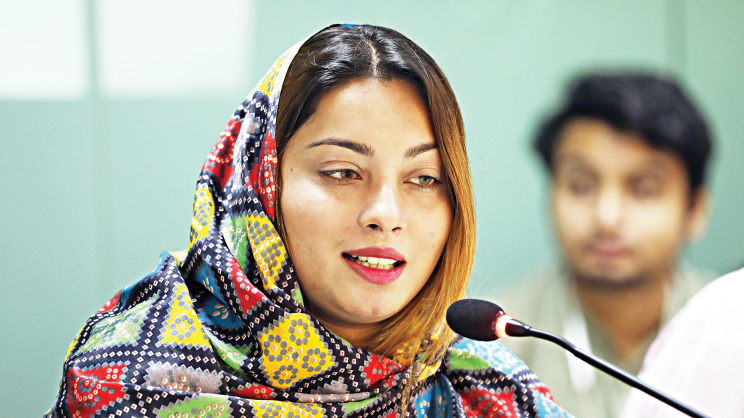
I am a survivor of state repression. The conspiracy and false case against me were engineered by the state. My opponent has over 200 cases -- yet the media focus only on my supposed ‘crimes’.
“Almost always, if a man is beaten, he is a survivor; if a woman is harassed, society asks, ‘Why was she there?’”
 For all latest news, follow The Daily Star's Google News channel.
 Nabila Tasnid, a National Citizen Party candidate for Dhaka-20, described the persistent barriers within party structures.
“Women are constantly forced to re-prove their qualifications,” she said, pointing to internal resistance where some partners of the Jamaat-led 11-party alliance, which the NCP joined, refused to campaign under female leadership, costing her thousands of votes.
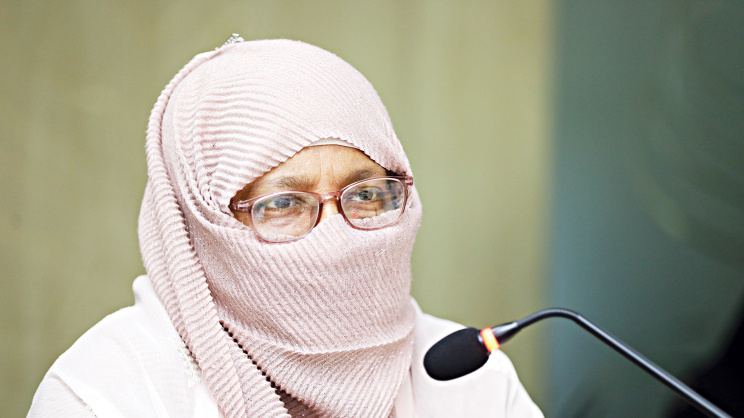
We went to the Election Commission with videos of our sisters being attacked on the streets. We were met with chilling indifference. If we must run to local authorities for everything, why is the commission there?
She said religious narratives and misinformation further marginalise women in rural constituencies, leaving female candidates fighting not only for electoral success but also for basic recognition as capable leaders.
“While many supported me, a significant segment was adamant that they would neither vote for a woman nor campaign for one. These prejudices remain deeply entrenched in our society.”
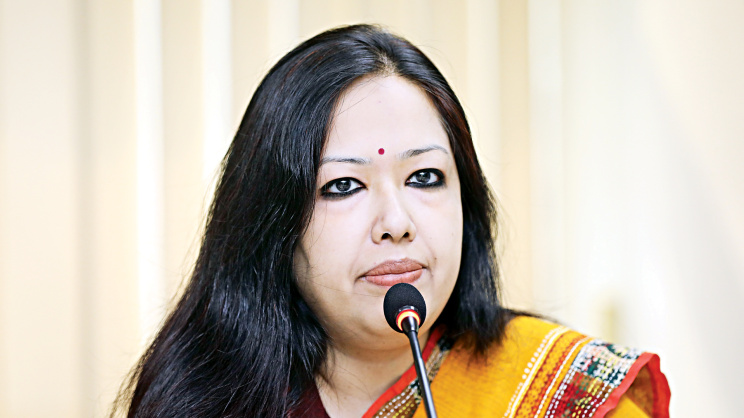
To survive this, Barrister Rumeen Farhana, a member of parliament who contested independently and won in Brahmanbaria-2, described a publicised “outburst” against a biased administration as a strategic shield.
“Had I remained ‘polite,’ I would have lost 50 percent of my votes. I had to show my workers I could protect them… I had to be a ‘mastan’ when it was needed.”
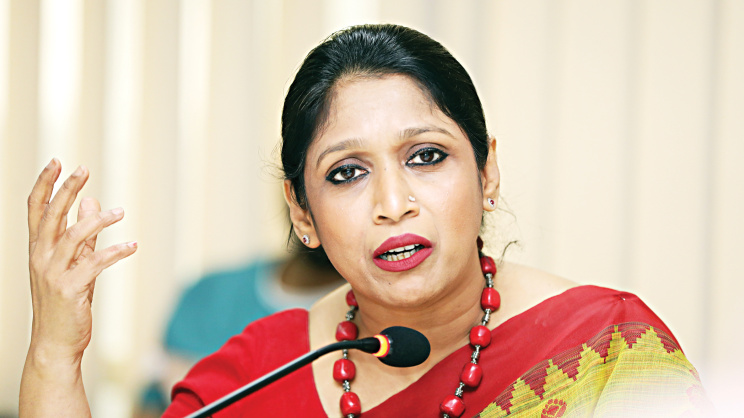
We try to fight our battles in the political arena, but the real battlefield should be the home. Family is the root. When we talk about family policy, it should begin with how we raise children.
WHEN MONEY TALKS
Candidates reported that despite legal spending ceilings, Bangladeshi elections remain a “money game” of financial attrition that structurally excludes women.
Rumeen described the process as “straight-up vote-buying”, noting that contesting effectively for less than several crores is impossible.
“Beyond legalities, we see systemic bribery through direct cash or gifts like soap or oil to voters’ homes… The scale is staggering.”
She revealed that in the final ten days, she had to spend Tk 10 lakh daily, while opponents spent triple that amount.
On the gendered nature of political investment, the MP added that investment follows expected profit.
“Investors back those they believe will win, while confidence in a female candidate is often absent from herself, her family, society, and the business community.”
In this battle of capital, a woman begins the race already handicapped, she said.
Nabila also noted that “investors” prioritise financial returns over ethics, allowing wealthy male candidates to exploit the economic vulnerability of voters.
“This creates an unequal playing field where women are sidelined by the sheer volume of ‘black money’.”
Jara identified this as the “elephant in the room” -- a rigged system that protects the status quo.
“If rules are just decorative and the real game is played with off-the-books money, how do you compete honestly?”
She argued that the system is designed to keep newcomers out, calling for a “cross-partisan commitment” to return people -- not money and muscle -- to the centre of politics.
THE PENALTY FOR COMPLIANCE
Candidates highlighted a paradox: the administration often penalises rule-followers while allowing violators to thrive.
Jara described the system as skewed.
“If there are no consequences for breaking rules, what is the incentive to comply? Rules regarding decibel limits or posters are violated openly because the rewards for breaking the law outweigh the risks.”
Nabila also recounted following the 20-billboard limit precisely, only to see her opponent exceed it in a single union.
When she complained, authorities told her to document the violations herself -- a reflection of systemic bias favouring wealth and influence.
Rumeen highlighted a partisan administration that ignored formal complaints while her opponent engaged in hate speech and personal attacks.
“When the state apparatus shows a step-motherly attitude, the law is reduced to a tool used only against the weak.
“Where is the neutrality when even a UNO [upazila nirbahi officer] visits localities to solicit votes for a major party?”
Dr Habiba Akhtar Chowdhury, member of Central Working Council and campaigner of the Bangladesh Jamaat-e-Islami, reported 13-14 documented cases of physical assaults on female party workers.
“We went to the Election Commission with videos of our sisters being attacked on the streets. We were met with a ‘chilling indifference’. We were heated with urgency; they were cold.”
When they demanded action, the commission simply redirected them to local authorities.
“If we have to go to local authorities for everything, why is the Election Commission even there?”
IDENTITY AS COMMODITY
The candidates also highlighted how economic dependence and low literacy reduce female voters to a “silent vote bank”.
“Despite comprising 52pc of the electorate, women in areas like Dhamrai remain politically invisible,” Nabila said, describing men openly “trading” women’s National ID cards, treating them as commodities rather than citizens.
This systemic theft of agency is reinforced by inadequate voter education: many women do not know the candidates and simply follow instructions from husbands, sons, or fathers.
Jara argued that this lack of female representation in decision-making leads to a catastrophic failure in addressing basic human needs -- issues that disproportionately cripple women’s lives.
In her constituency, she found that utility crises, such as the chronic shortage of cooking gas, were viewed as peripheral by male leaders but were central to women’s survival.
“Systems disproportionately affect women, yet women’s political agency is absent from the rooms where decisions are made -- neither in nominations, nor finance committees, nor the cabinet, nor in policy-making. These issues should not just be ‘women’s burden’; both men and women must treat them as national issues.”
This systemic neglect is further masked by what Meghna described as the “charity mask” of political corruption.
“The public often leans toward a ‘mafia’ candidate because he spends lavishly during festivals -- handing out soap, oil, and blankets.
“The voters often do not stop to think that this money is actually looted or earned unethically. Honest, policy-driven politics is becoming helpless against this manufactured ‘charity’ image.”
THE DIGITAL BATTLEFIELD
Beyond financial and structural barriers, female candidates face a relentless war of coordinated delegitimisation online.
Rumeen, who has endured 15 years of online abuse, calls it a systemic attempt to weaponise women’s identities.
“I started politics 15 years ago as a single woman -- an easy target… Now we see AI and deepfakes, but the motive remains the same: character assassination. I may have developed a resistance overtime. But why should every woman be forced to develop such a thick skin against filth?”
She also criticised agencies like the National Telecommunication Monitoring Centre, whose effectiveness remains unclear.
Jara added, “For women, it is about coordinated character assassination and delegitimisation… Men are attacked too, but for women, the target is always their personal character. It’s subtle and sinister. When these are read or shared at dinner tables, it plants a seed of doubt in voters’ minds.”
CHANGE STILL POSSIBLE
Despite the “cancerous” systemic inertia described by Nabila -- where parts of society instinctively defend a corrupt system -- there remains an undeniable hunger for reform.
Jara offered a defiant note of hope.
“There is an appetite for change. It always seems impossible until it’s done. As long as people hold onto the hope that change is possible, the politics of ‘money and muscle’ will come to an end. The ground is fertile, but we need more agents to act on it.”
Comments