


Primary teachers’ pay edge over lowest grade govt job narrows in five decades

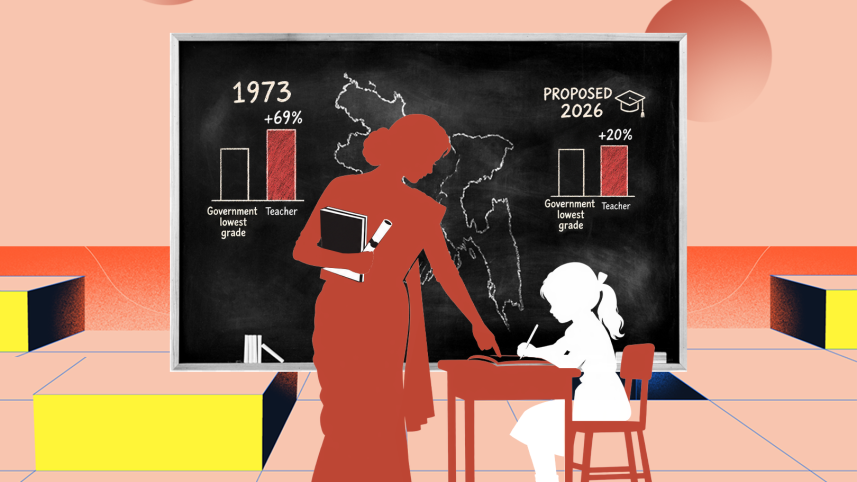
Government primary assistant teachers now enter the service with a university degree, yet their starting basic salary has moved much closer to the bottom of the government pay structure than it was five decades ago.
In 1973, a trained primary teacher with matriculation or higher qualifications started at Tk 220, about 69 percent above the lowest government basic of Tk 130.

Under the proposed National Pay Scale 2026, an assistant teacher in Grade 13 will start at Tk 24,000, only 20 percent above the Grade 20 minimum of Tk 20,000.
Records reviewed by The Daily Star show that the relative pay advantage of primary teachers has widened and then narrowed through successive pay revisions, even as the qualifications required for entry have risen.
A 2007 University of Bergen study by SM Abdul Quddus, based on government pay orders, records trained primary teachers starting at Tk 220 in 1973 against the Tk 130 government minimum.
By 1977, the gap had fallen to about 33 percent, with starting pay at Tk 300 against Tk 225. It widened to 40 percent in 1985, before narrowing to 33 percent in 1991 and 25 percent in 1997.
The gap remained around 25 percent under the 2005 scale. Under the 2009 scale, trained assistant teachers started at Tk 4,900 against the Tk 4,100 minimum, a gap of about 19.5 percent.
Regrading in 2014 moved them to Grade 14, while the 2015 scale set their starting basic at Tk 10,200 against Tk 8,250 at Grade 20.
In 2020, assistant teachers moved to Grade 13, with starting basic rising to Tk 11,000. The proposed 2026 scale would raise it to Tk 24,000, while the Grade 20 minimum would rise to Tk 20,000.
The comparison covers starting basic salaries only, excluding allowances, inflation and purchasing power. A bachelor's degree is now mandatory for direct recruitment, while earlier qualification requirements were lower and differed by gender.
Concerns over primary teachers’ pay predate Bangladesh. Historian Badruddin Umar, in “The Emergence of Bangladesh: Class Struggles in East Pakistan, 1947-1958”, records that around 2,500 primary teachers gathered at Salimullah Muslim Hall in Dhaka on March 27, 1949, with better remuneration among their main demands.
Citing a 1949 report in Sainik, Umar wrote that conference president Abdur Rahman Khan argued that capable teachers could not be secured without proper salaries, noting that an ordinary labourer could earn Rs 2 a day.
Ahead of a planned strike in 1951, the East Bengal government announced new pay scales in areas where compulsory primary education was being introduced. Umar, citing Naobelal, recorded a salary of Rs 45 and 8 annas to Rs 55 and 8 annas for a trained matriculate assistant teacher.
A 2010 study by economist Mohammad Niaz Asadullah in “The Bangladesh Development Studies” found that the average primary teacher in East Pakistan earned about Rs 22 a month in 1956. It also cited research showing that starting salaries in West Pakistan were around three times those in the east in the 1960s.
Primary teachers have continued to demand higher grades and a clearer career path.
Md Mohib Ullah, an assistant teacher at 24 No Jhalgaon Government Primary School in Lalmai, Cumilla, said repeated protests reflected unresolved issues over pay grades, promotion and professional disparities.
“Delays in implementing our demands and the failure to fulfil commitments have created frustration among teachers,” he said.
Earlier, State Minister for Primary and Mass Education Bobby Hajjaj said Grade 13 needs reconsideration as teachers’ qualifications and responsibilities have increased. He said the proposed Grade 12-11-10 structure remains under review.
 For all latest news, follow The Daily Star's Google News channel.
Comments