


‘2,000 killed in Iran unrest’

US President Donald Trump yesterday urged Iranians to continue nationwide protests, promising that help “was on its way,” as the death toll from more than two weeks of violence crossed 2,000.
World condemnation of Iran’s crackdown on protesters also intensified, with the United Kingdom, France, Germany and the European Union summoning Iran’s ambassadors to demand answers over what they described as horrific reports of mass killings.

With the Islamic Republic’s clerical establishment facing its biggest demonstrations since 2022, Trump has repeatedly warned of intervention if force is used against protesters.
He was scheduled to meet his national security team at the White House to discuss options on Iran, as the country’s foreign minister said Tehran was “ready for any action.”
In a Truth Social post, Trump also urged protesters to take over institutions and record the names of “killers and abusers.”
“Iranian Patriots, KEEP PROTESTING,” Trump wrote yesterday. “I have cancelled all meetings with Iranian Officials until the senseless killing of protesters STOPS. HELP IS ON ITS WAY.”
Asked what he meant by “help is on its way” to protesters in Iran, Trump told reporters that they would have to “figure it out”.
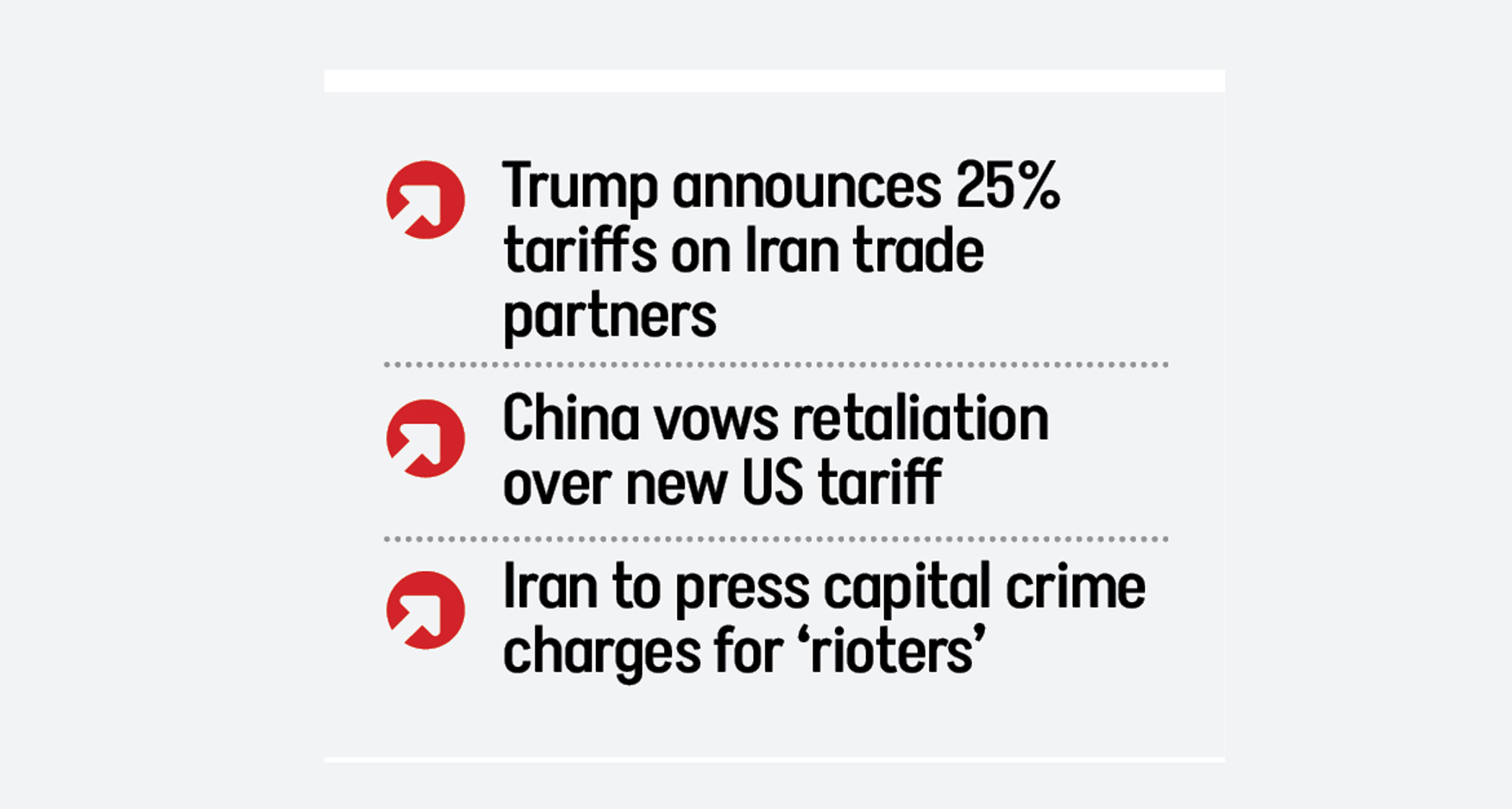
On Monday, Trump announced a 25 percent tariff on any country doing business with Iran, intensifying pressure on nations that import oil from Tehran, including China.
The tariff would “immediately” target the Islamic Republic’s trading partners that also do business with the US, Trump said in a social media post. “This order is final and conclusive.”
The White House said Trump remained “unafraid” to deploy military force against Iran but was pursuing diplomacy as a first resort.
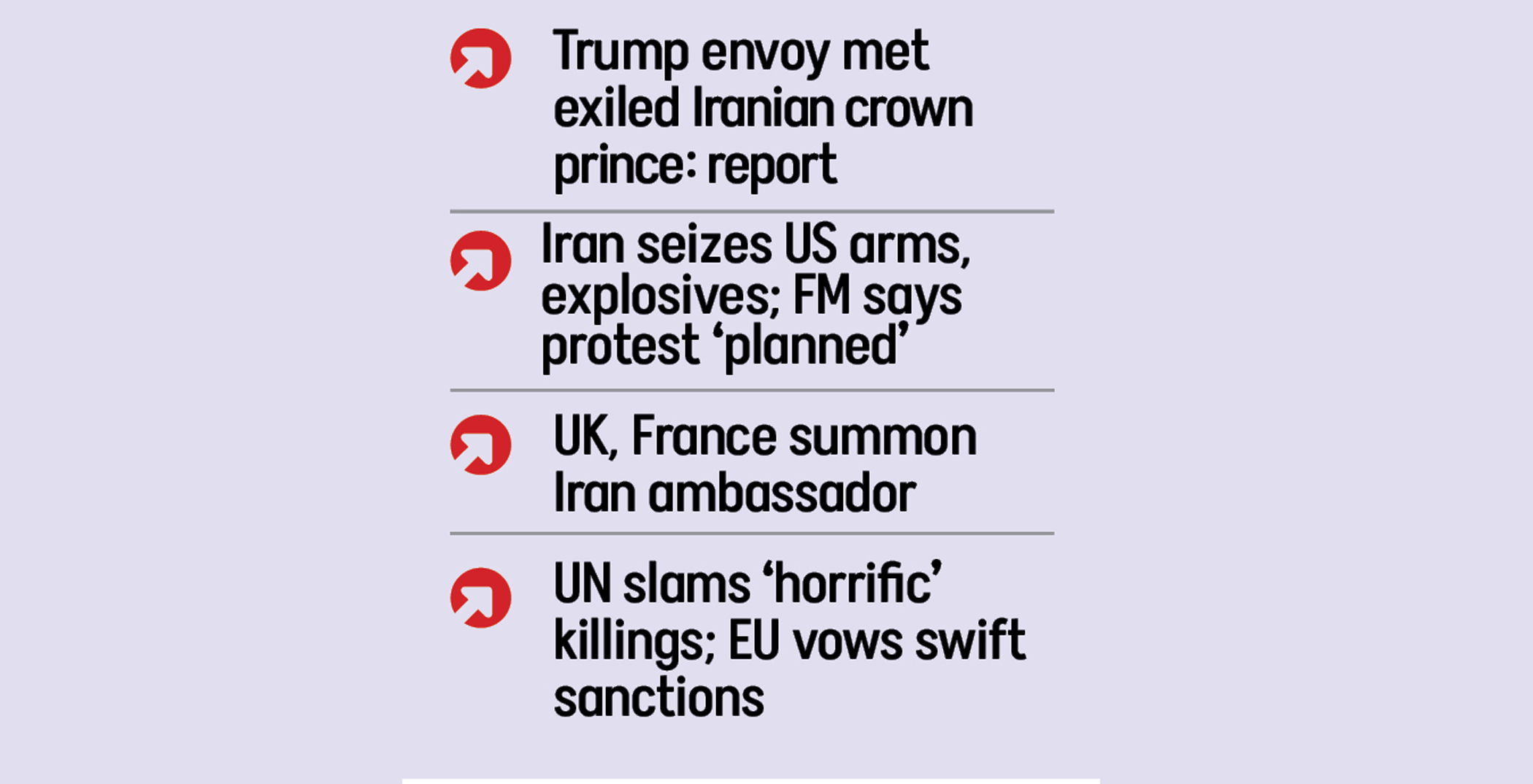
Axios, citing an unidentified senior US official, reported that White House envoy Steve Witkoff over the weekend met with Reza Pahlavi, the exiled son of Iran’s last shah and a prominent voice in the fragmented opposition, to discuss the protests roiling that country.
Iranian authorities have insisted they have regained control after successive nights of nationwide protests since Thursday.
Rights groups, however, accuse the government of using live ammunition against demonstrators and obscuring the scale of the crackdown through an internet blackout that has lasted more than four days.
As international phone calls resumed after days of disruption, an Iranian official yesterday told Reuters that about 2,000 people, including security personnel, had been killed in the unrest.
Later, the US-based HRANA rights group said it had verified the deaths of 2,003 people during Iran’s protests, including 1,850 protesters, 135 government-affiliated individuals, nine people aged under 18, and nine non-protester civilians.
The Norway-based NGO Iran Human Rights estimated that about 10,000 people had been arrested.
Iranian state media reported that dozens of security force members had been killed. Authorities have declared three days of national mourning.
The protests, which began on December 28, have spread across all provinces of Iran, according to the BBC and other international media. Protesters are now calling for an end to the clerical rule of Supreme Leader Ayatollah Ali Khamenei.
Meanwhile, the Tehran prosecutor’s office said authorities would seek capital charges against some suspects arrested over the demonstrations.
State television quoted prosecutors as saying an unspecified number would be charged with “moharebeh,” or “waging war against God,” a Sharia law offence that carries the death penalty.
 For all latest news, follow The Daily Star's Google News channel.
 Foreign Minister Abbas Araghchi told Al Jazeera that the government had been “in dialogue” with protesters in the early phase of the movement and that the internet was cut only after authorities confronted what he described as “terrorist operations” directed from abroad.
Addressing Trump’s threats, he said: “We are prepared for any eventuality, and we hope Washington will choose a wise option. It doesn’t matter which option they choose—we are ready for it.”
On Monday, the government sought to reassert control with mass nationwide rallies that Khamenei hailed as proof the protest movement had been defeated, issuing what he called a “warning” to the US.
Rising deaths drew condemnation alongside calls for restraint from regional and global powers.
The UN human rights chief said he was “horrified” by mounting violence against peaceful protesters.
“This cycle of horrific violence cannot continue. The Iranian people and their demands for fairness, equality and justice must be heard,” Volker Turk said, also voicing concern that the death penalty could be used against thousands of detainees.
His remarks came amid reports that Erfan Soltani, a 26-year-old protester detained last Thursday, could be executed as early as tomorrow.
The EU said it stood “ready to propose new sanctions,” adding to measures already in place.
“When a regime can only hold on to power through violence, it is effectively finished,” German Chancellor Friedrich Merz said during a visit to India. “I believe we are witnessing the last days and weeks of this regime.”
Reza Pahlavi, the US-based son of Iran’s ousted shah, said Trump was a leader who “means what he says and says what he means.”
“The red line has definitely been surpassed by this regime,” he said.
Some countries, however, urged caution amid threats of US intervention.
Qatar called for restraint and said it was working to mediate rising tensions. “Any escalation would have catastrophic results in the region and beyond,” Foreign Ministry spokesperson Majed al-Ansari said.
Russia’s Security Council Secretary Sergei Shoigu condemned what he called “foreign interference” in Iran’s internal affairs following talks with Iran’s National Security Council.
US TARIFF IRKS CHINA
China threatened retaliation after Trump announced the new tariffs.
Liu Pengyu, spokesperson for the Chinese embassy in Washington, said Beijing would “take all necessary measures” to safeguard its interests.
China is Iran’s largest trading partner, purchasing 77 percent of its oil exports in 2024, according to Kpler. Other major partners include India, the UAE, Japan and South Korea.
It remains unclear how the tariff would be applied and whether it would be imposed in addition to existing US import taxes. China already faces tariffs of up to 45 percent, while India faces a 40 percent levy over Russian oil imports.
REGIME STILL FORMIDABLE
Analysts caution that despite the scale of protests, predicting the regime’s immediate collapse would be premature.
Iran’s security apparatus—anchored by the Revolutionary Guards and Basij forces numbering nearly one million—makes external pressure without internal fracture difficult, said Vali Nasr.
“For this to succeed, crowds must stay in the streets much longer, and parts of the state, particularly security forces, must defect,” he said.
Supreme Leader Khamenei, 86, has weathered several uprisings since 2009, said Paul Salem of the Middle East Institute, calling this the fifth major challenge to the regime.
Alan Eyre, a former US diplomat, said protesters would need to overcome entrenched institutions, loyal constituencies and the scale of a country of 90 million people.
IRAN SEIZES US ARMS, AMMO
Iran’s intelligence agency said it seized US-made weapons and explosives from “militants” who allegedly planned assassinations and sabotage. State television reported arrests of suspected “terrorist groups” linked to Israel in Zahedan.
Separately, Iran’s top military commander accused the US and Israel of deploying ISIL fighters inside Iran, without presenting evidence.
Araghchi claimed authorities possessed recordings of foreign voices directing “terrorist agents” to fire on police and protesters.
TRUMP MULLS IRAN OPTIONS
The office of US Vice President JD Vance said senior officials were preparing diplomatic and military options for Trump.
“Vice President Vance and Secretary of State Marco Rubio are presenting a suite of options ranging from diplomacy to military action,” said Vance’s communications director William Martin.
The remarks came as Senator Lindsey Graham urged Trump to escalate pressure, calling the collapse of Iran’s clerical leadership the “biggest prize” of his presidency.
He said US action should target “the infrastructure that allows the killing,” while warning that deploying US ground forces would risk heavy casualties.
The US last year bombed Iranian nuclear sites after joining Israel’s 12-day war with Iran.
Comments