


‘Time poverty’ limiting Bangladesh's growth: experts
Bangladesh’s economic growth is being slowed down by a “time poverty crisis”, with women contributing nearly five to seven times more hours than men on unpaid care and domestic work, experts and policymakers said at a seminar today.
Citing the data of the Bangladesh Bureau of Statistics (BBS) Time Use Survey 2022, presented at the seminar, they said that despite this massive contribution, women’s work remains largely unrecognised, limiting their participation in the formal workforce.

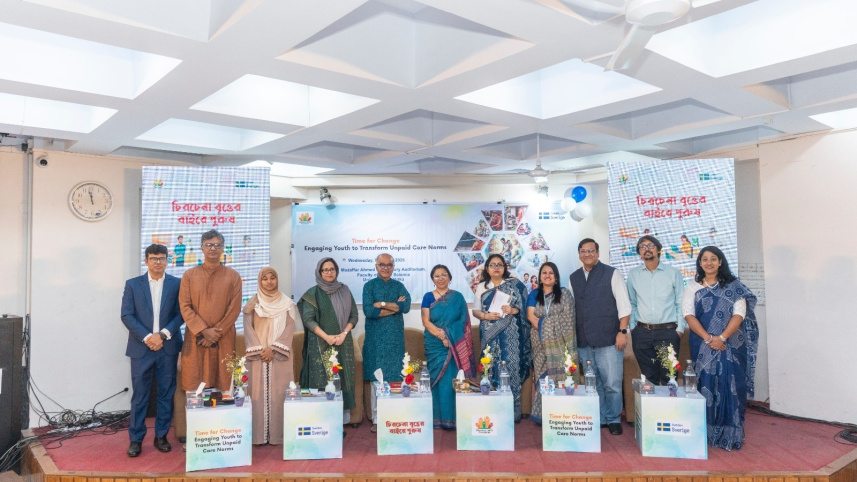
The seminar, titled “Time for Change: Engaging Youth to Transform Unpaid Care Norms”, was organised by Manusher Jonno Foundation (MJF) at Dhaka University’s Muzaffar Ahmed Chowdhury Auditorium, targeting university students to challenge entrenched gender norms.
Chairing and moderating the opening session, MJF Executive Director Shaheen Anam, said, “Women often have no time of their own and cannot pursue their ambitions because of the burden of unpaid work.
"We are talking about change through the redistribution of work.”
Deputy Director and Focal Point (MEWGC Phase) at the Bangladesh Bureau of Statistics (BBS), Asma Akhter, described time poverty as a lack of opportunity for education, income generation, and civic participation.
Towfiqul Islam Khan, co-ordinator at the Centre for Policy Dialogue (CPD), highlighted that female labour participation in Bangladesh is only 35%, compared to 60-70% in Southeast Asia, with women spending seven times more time on household chores than men.
Dr Sayema Haque Bidisha, pro‑vice chancellor (administration) of Dhaka University, said unpaid care hinders women’s professional growth and health, noting that women hold only 6% of high‑level decision‑making roles.
Dr Selim Jahan, economist and professorial fellow at the Brac Institute of Governance and Development (BIGD), urged youth to embrace “mindset formation”, challenging men to stop being “shirkers” and women to allow men space to learn household tasks.
“The home does not belong only to girls; it belongs to both,” he said.
Other speakers, including Rehana Khan, Senior Programme Officer at the Embassy of Sweden in Dhaka; and Kazi Rabeya Ame, programme analyst - gender and climate change and coordinator of the GiHA Working Group, emphasised the impact of climate change, rural infrastructure gaps, and lack of state‑provided care facilities on women’s workload.
Fifty four percent of women suffer from time poverty compared to only 7% of men, noted Rabia.
The seminar adopted interactive discussions, storytelling, performances, photo and art exhibition to promote caregiving as a shared social responsibility.
Participants called for formal recognition of unpaid care in national statistics, equal sharing of household duties, and investment in care infrastructure to reduce rural women’s burdens.
The programme was attended by gender researchers, youth activists, and journalists, all stressing that transforming unpaid care norms is essential for achieving UNDP’s human development goals.
 For all latest news, follow The Daily Star's Google News channel.
Comments