


What can the price of an iPhone Duo buy in Bangladesh?

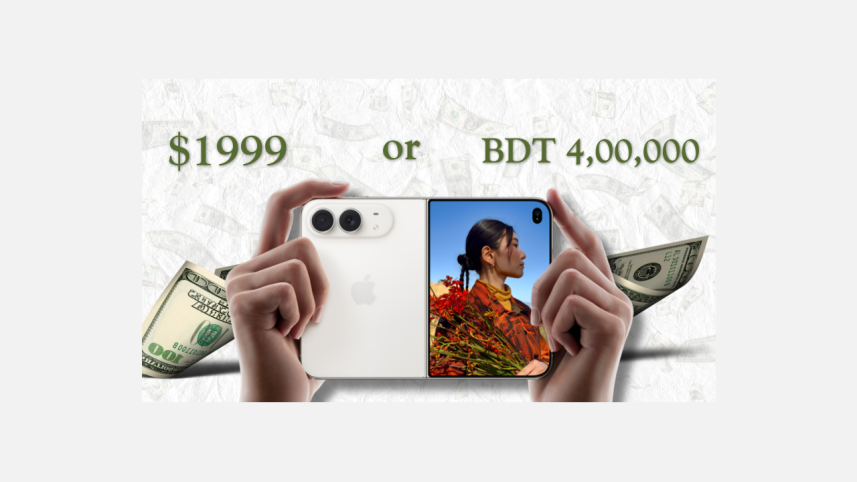
The iPhone Duo may be an impressive piece of technology, but at nearly Tk 4 lakh in Bangladesh, its price raises a bigger question: what else could that money do?
I’ll admit it, the iPhone Duo is exciting. For years, foldable phones have felt like clever experiments that asked the user to tolerate a few rough edges. Apple arriving late and producing something this refined is worth appreciating. The phone opens into a 7.6-inch display, supports proper multitasking and still folds down into something that fits inside a pocket. Even the simple act of opening it has an appeal that a regular slab of glass no longer provides. And it has no crease!

Then comes the price. The iPhone Duo starts at $1,999 internationally. Bangladesh is not among its initial official markets, but early local estimates place the base model somewhere between Tk 3.2 lakh and Tk 3.8 lakh. The higher-storage versions will, naturally, go well beyond that.
At this point, the mind begins doing its own math. For around Tk 3.5 lakh, a young couple moving into their first flat could buy a refrigerator, washing machine, air conditioner, television, microwave oven and several smaller kitchen appliances. With sensible choices rather than showroom fantasies, there may still be room for a bed, wardrobe or modest dining table.
Not the entire Pinterest home, certainly. But enough to turn a collection of empty rooms into a place where two people can begin living.
The same amount looks completely different in the hands of someone trying to become a content creator. A capable mirrorless camera, a useful lens, wireless microphones, lights, a tripod, memory cards and spare batteries can all fit within that budget. It will not build a film studio, but it can build a working production kit. More importantly, it can give someone the means to practise, take assignments and perhaps earn the money back.
Speaking of making money with money, one can also use the four-lakh taka as seed money to start a business or invest it along with other investors to buy land. The possibilities can be brighter if one manages and plans in a smart and creative way.
For another household, the amount may not be spent at all. It can remain in the bank as an emergency fund, quietly covering rent, groceries, school fees and medicine if a job disappears or something goes wrong. Recent household figures suggest it represents roughly a year of spending for many middle-income Bangladeshi families.
There is also the medical calculation. Depending on the condition, Tk 3 lakh to Tk 4 lakh could fund flights, accommodation, consultations and diagnostic tests for a patient and attendant travelling to India or Thailand. It won’t pay for every treatment, of course, and major procedures can cost much more. Still, for a family waiting for a second opinion or specialist care, that money can create options.
None of this makes buying the Duo immoral. That would be an unnecessarily bitter way of looking at it.
People do not purchase everything according to its strict usefulness. We buy mechanical watches that tell time less accurately than phones. We travel when videos of the same places are available online. We pay for design, novelty and the small pleasure of owning something beautifully made. If someone can comfortably afford the Duo and genuinely enjoys the form, the larger screen or the experience of using it, that pleasure has value too.
The fold may also be genuinely useful for people who read documents, edit photographs, manage several conversations, or consume a great deal of content while moving around. It is a phone and a small tablet sharing one body. For the right person, that convenience will not be imaginary.
But in Bangladesh, its price pushes it beyond the normal conversation about upgrading a phone. It becomes a question of priorities.
The real line between indulgence and vanity is not the folding screen. It is whether we want the device itself or what carrying it appears to say about us. There is nothing wrong with wanting an expensive phone. The discomfort begins when we rename that want as a need, stretch an EMI beyond comfort or buy it mainly to be seen buying it.
The iPhone Duo is an impressive object. It may even be the first foldable that makes many long-time iPhone users seriously want one.
At nearly four lakh takas, the question is no longer simply whether we want the phone, but whether we want it more than everything else the money could do.
 For all latest news, follow The Daily Star's Google News channel.
Comments