


Rising costs push Dhamrai bell metal industry toward decline
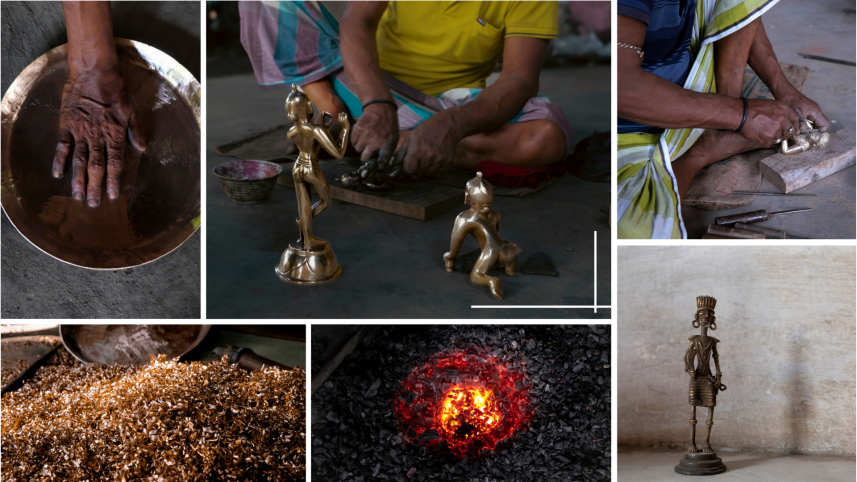
Abu Taleb has spent a lifetime working with bell metal, but he speaks about the trade without nostalgia. Now 57, the craft came to him through family and not through choice.
“My brother, my grandfather, my father,” he says, tracing the line of inheritance in a matter-of-fact tone. “We have been doing this for generations.” Then comes the part that defines the present. “Our whole family was in it, but now everyone has opted for other professions. I am the only one left.”

That single statement says more about the condition of Dhamrai’s metal craft than any official label of heritage ever could.
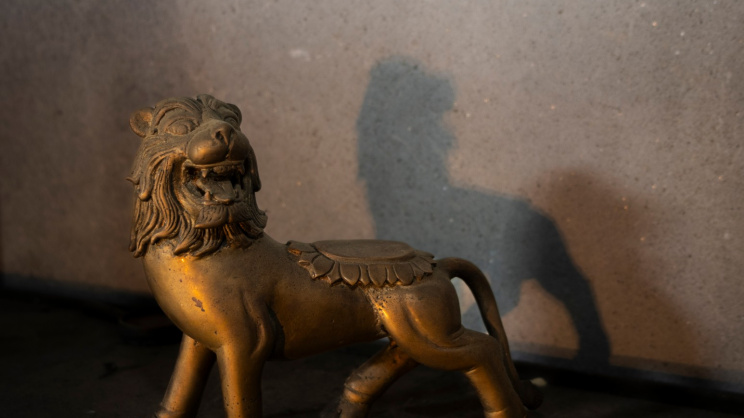
Dhamrai remains one of the places in Bangladesh still associated with kasha-pitol — bell metal and brass objects made for dining, ritual, and domestic use. Plates, bowls, cups, bells, cymbals, and utensils continue to be produced here through labour-intensive, materially exacting techniques. However, the industry no longer holds the social or economic position it once did. It survives through a handful of workshops, ageing craftsmen, and a shrinking network of merchants.
Working with a difficult metal
Bell metal is not an easy material. It is hard, brittle, and unforgiving. That is also what gives it value.
Taleb explains the logic of the material in practical terms. He buys metal, burns it, and works from there. “When you burn it with fire, it breaks like glass,” he says. That brittleness is not treated as a flaw but as proof of authenticity.
In his view, the metal has to remain pure. If brass or other mixed material gets into the process, it has to be separated immediately. “It won’t work if it’s impure,” he says. “It has to be grade one.”
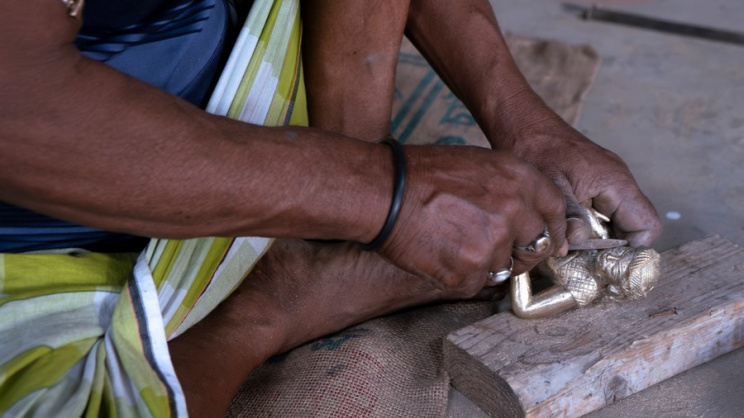
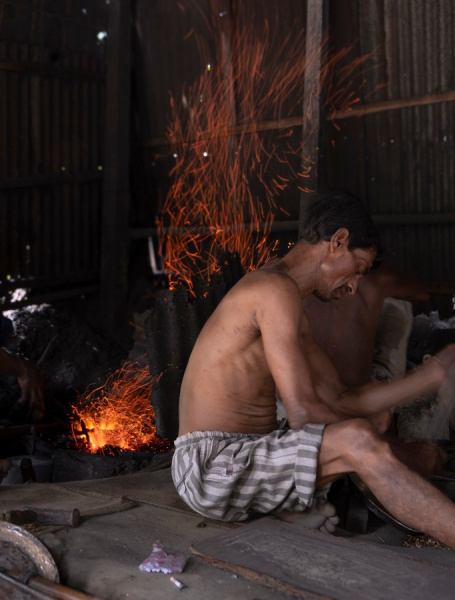
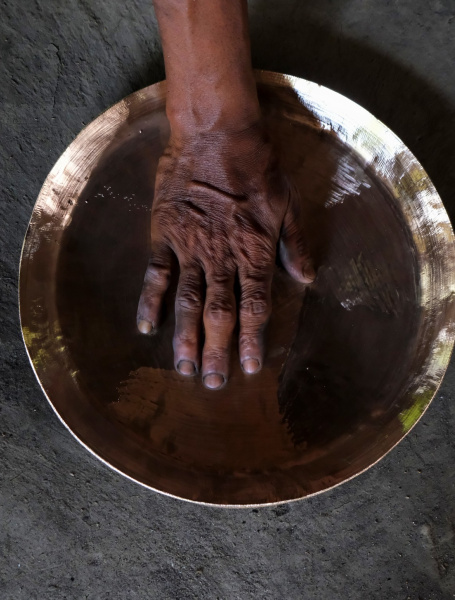
The process is physical from the outset. Metal is heated, broken down, reworked, cast into an initial form, and then hammered outward. Taleb describes making a small mould first and then hammering it out until it reaches the desired size. From there, artisans add shape and design according to the merchant’s order.
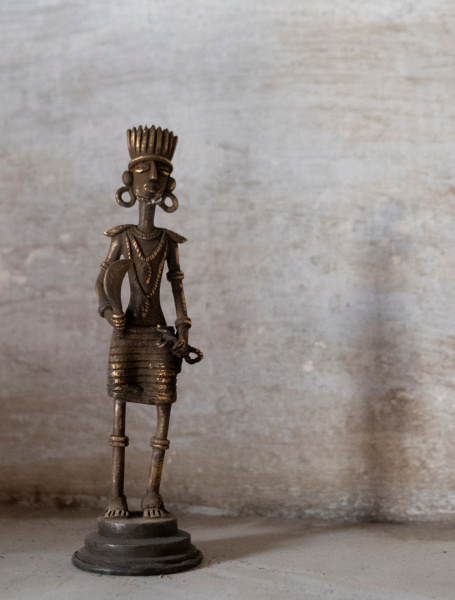
The products vary: plates, bowls, bells, temple cymbals, cups, and other utensils. Unlike brass showpieces or cast decorative items made elsewhere, his work is rooted in original bell metal and functional use.
That distinction matters to him. He is careful about separating his trade from adjacent ones. Brass statues, he notes, are also made in Dhamrai. Brass plates are produced in another nearby factory. His own work, based in Shimulia, is “strictly bell metal.”
The workers behind the craft
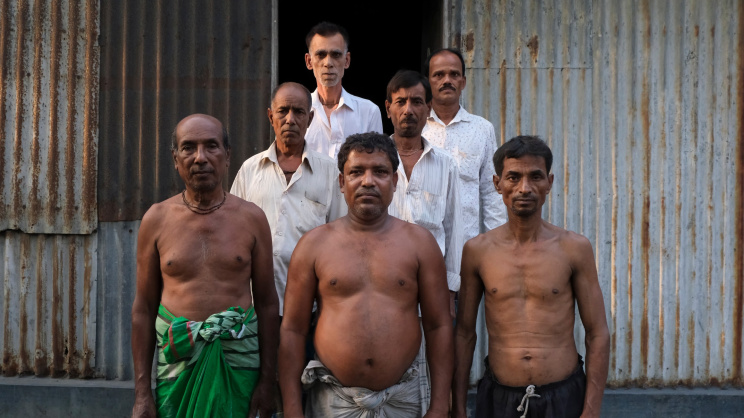
If Abu Taleb represents ownership and continuity, workers like Niranjan Sarkar and Noyon Sarkar reveal the economics underneath it.
Niranjan is 50 and has been in this line of work for more than three decades. He began as a child and now works at Abu Taleb’s factory, primarily doing design work.
“Whatever design the merchant wants, I create that design,” he says.
His phrasing is simple, but it captures the structure of the trade. Craftsmen rarely work for artistic autonomy. They produce to order, according to market demand.
Asked about income, Niranjan does not dramatise the situation.
“The household runs somehow,” he says.
There are five people to feed. The income is just enough to keep things moving. Then he puts a number to the threshold of survival: “If we don’t earn at least five hundred taka, we struggle.”
Noyon Sarkar, another artisan, describes a similar reality from a different angle. He says he can do every stage of the work rather than just one specialised task. That flexibility, however, has not translated into security. “There is no daily income anymore,” he says bluntly. His wage was fixed at Tk 500, but even that is eroded by expenses. “We are in a complete crisis.”
 For all latest news, follow The Daily Star's Google News channel.
 Together, their accounts show that the fading of the craft is not just about cultural loss. It is about wages that no longer match labour, and labour that no longer guarantees continuity.
The rising cost
One of the clearest reasons the trade is under strain is the cost of materials.
Abu Taleb remembers when copper could be bought for Tk 160 per kilogram. Today, depending on quality, it can cost ten times that amount. He mentions a thicker, higher-quality variety that now sells for Tk 1,700. That kind of increase changes the entire structure of production.
He also points to another difficulty: tin is no longer easy to source and has become too expensive to rely on comfortably. As a result, he often buys old bell metal or brass items from shops and recycles them into new products.
Hawkers and traders bring material into the chain, and he reworks it into finished goods. This recycling economy keeps the workshops alive, but it is also a sign of pressure. The price of material affects not only profit but also risk. If a product does not sell, the loss is heavier than before. If electricity fails in the middle of production, that loss compounds.
When power cuts stop production
Bell metal work is often described in terms of tradition, but its present-day survival depends on something much less romantic: fuel, electricity, and supply access.
Abu Taleb speaks plainly about the electricity crisis. On some days, announcements are made that there will be no power, and the factory work stops. A generator exists, but that only shifts the problem. Fuel is difficult to find. He once managed to run the generator for a few days with five litres collected from a bus driver’s stock. After that, the search continued. “There are all sorts of problems,” he informs.
This is where the language of heritage often fails. Craft survival is not just about preserving techniques. It is also about ensuring that artisans can actually keep their workshops running.
A market that still survives
Despite the challenges, Dhamrai’s metal craft has not vanished. Products still move through wholesale channels and urban shops.
Abu Taleb delivers finished goods to Mitford in Dhaka to a cluster of shops. Merchants there sell wholesale across Bangladesh. The system is old and functional: merchants give orders, artisans produce, and the goods circulate. He also has a shop in Shimulia Bazaar and another retail outlet in Dhaka.
There are still customers for original bell metal. Some buy it because of its association with health. Abu Taleb says well-off buyers from nearby areas, including the EPZ zone, come directly to purchase utensils because they believe eating from bell metal is beneficial.
Others seek out specific ritual items. School bells and temple cymbals remain part of his production line. In larger temples, he says, pure bell metal cymbals can sell for several thousand takas.
So, the market has not disappeared. It has narrowed. It now depends more on niche demand, selective buyers, and merchant networks than on widespread household use.
What remains
The fading of Dhamrai’s metal craft is not a dramatic collapse. It is a slow reduction. Fewer families stay in it. Fewer sons inherit it. Costs rise. Infrastructure falters. Demand becomes selective. Workshops continue, but with less assurance.
Still, the craft is not gone. It persists in the measured force of hammering, in the care taken over purity, in the ability of workers like Niranjan to shape designs according to a merchant’s request, and in Abu Taleb’s insistence that he does not compromise on quality.
That is what makes the situation difficult to read. Dhamrai’s bell metal tradition is both alive and endangered at the same time. The objects are still being made. The knowledge is still present. However, the social system that once reproduced that knowledge is thinning out.
Abu Taleb does not dress this up as a tragedy. He states it as the condition of his life and work. He is still here. The furnace still burns when fuel can be found. The hammer still falls. The merchants still come. But, around that continuity is an unmistakable silence: the absence of those who would have taken the work forward next.
Readers interested in buying bell metal products or placing an order may reach Abu Taleb at 01969369325.
Comments