


Innovation helps Bangladeshi katan weaving break free from repetition
The problem began with repetition. For years, Katan and Benarasi saree weaving in Bangladesh have been constrained not only by market demand but by the mechanics of the loom itself. Creating larger motifs, changing placement, or designing fabric beyond the usual saree format was expensive and cumbersome. The old punch-card system relied on graphing, cutting, and hardboard cards, making experimentation difficult.
The result was predictable: the same motifs repeated at the same scale. Now, after a year of research and close collaboration with weavers, a new device is trying to change that.

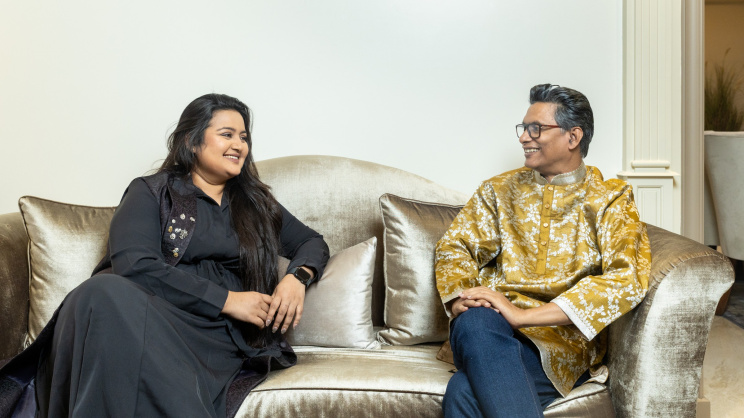
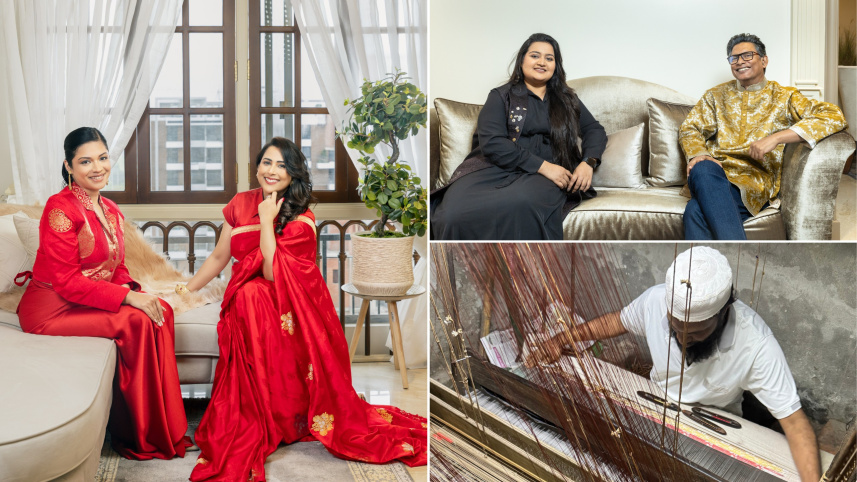
The innovation, developed through the collaboration of architect and designer Tanwy Kabir of Canvas and Sheikh Saifur Rahman, consultant at Haal Fashion, Prothom Alo and heritage textile expert, does not replace handloom weaving. Instead, it intervenes at one of the most difficult and limiting stages of the process — Jacquard preparation. In doing so, it opens up new design possibilities, reduces material waste, and creates room for handloom Katan to move beyond repetition without ceasing to be handmade. It is a success story of collaboration among a researcher, a designer, and weavers.
Rahman is precise about what this innovation is and is not. “It’s not a machine; it’s a small device – an innovation,” he says. “It’s like a hearing aid; it just assists the process.” The weaving, he stresses, remains entirely manual. “The weaving is still done by hand, thread by thread, on a pit loom. The loom remains the same.”

Rethinking the Jacquard process
Handloom weaving may appear straightforward from the outside, but it involves a long chain of work. As Rahman points out, “There are usually 13 steps involved, from buying the yarn to degumming it.” One of the most difficult stages is preparing the Jacquard.
Traditionally, the design has to be drawn, graphed, computerised, and then translated into hardboard cards known as “patti or mala.” Those cards are installed into the Jacquard through hooks.
The process is slow, labour-intensive, and restrictive. Under this system, a design usually repeats every 3.5 inches. “That’s why you see very repetitive motifs in Katan,” Rahman explains. “There are very few unique designs because each one requires a huge investment. A single original design could cost around Tk 1,00,000.”
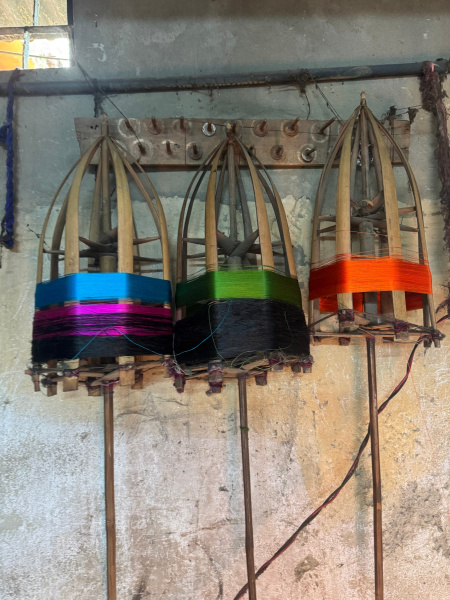
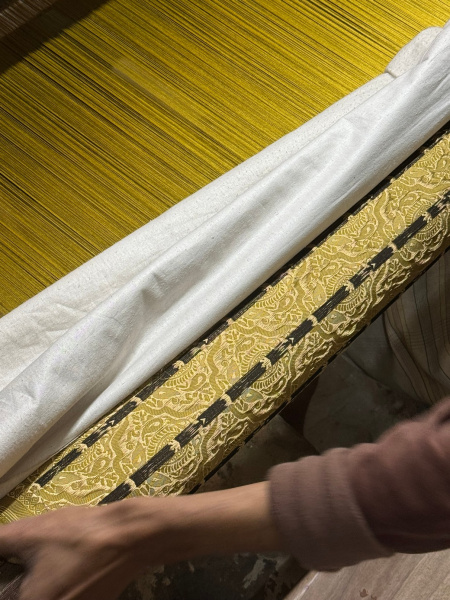
The new device does not remove this stage, but simplifies it. “We have not omitted a step, but we have made it technologically easier,” Kabir, adding, “That shift allows much larger motifs. With our designs, you can make a 30-inch or even a 40-inch design if you want.”
In practical terms, this breaks the old size barrier and makes it possible to create more varied anchals, larger motifs, and custom placements.
Kabir describes it as “a small device” with a screen “much like a mobile phone screen.” But its effect reaches beyond design flexibility. Since the old system depends heavily on graph paper and hardboard cards, reducing those materials also lowers waste. “We are reducing the use of this paper,” Kabir says.
Rahman adds, “This means we are reducing our carbon footprint.” The change does not simply remove labour from the process. It redirects it. He notes that those who once worked on punch cards are also skilled in other areas, such as loom work and Jacquard building. In fact, their system now requires larger Jacquard machines with 2,400 hooks instead of the usual 600 or 1,200.
“That requires a larger machine, which means more man-hours and higher wages for the builders,” he elaborates.
Working with weavers, not above them
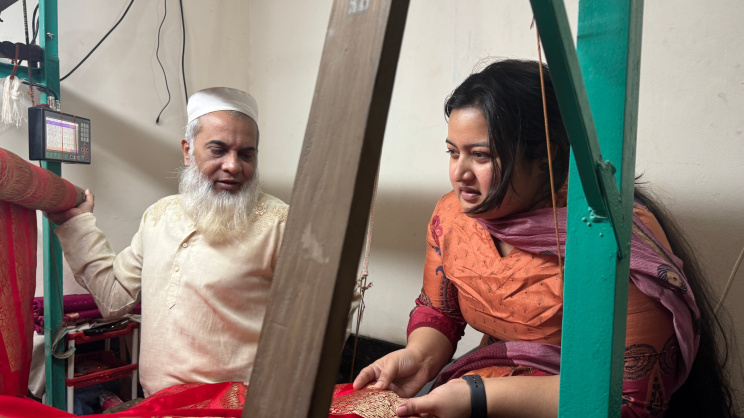
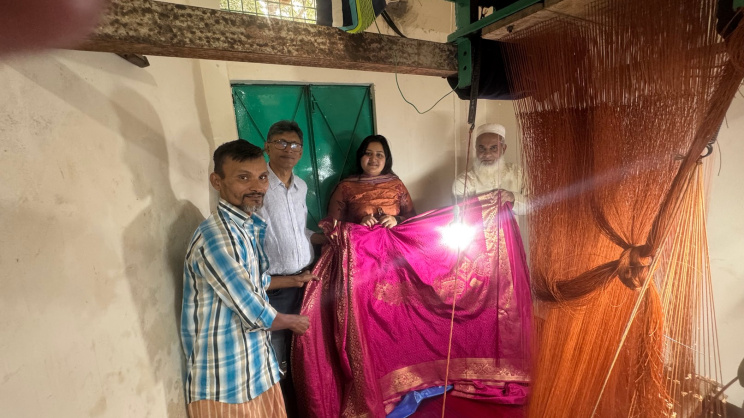
This innovation did not emerge from design theory alone. It was shaped through direct work with weavers including Abdullah Al Shad, Md Jahangir Hossain, and Abdul Kader, whose practical involvement helped move the experiment from concept to loom.
That collaboration matters because the device is only useful if it can survive contact with actual weaving conditions.
Kabir is open about the fact that the experiment depended on trust from the weaving side. “This experiment would not be possible without the courage of the weavers,” she emphasises. “They are the ones who actually make it.”
The team also faced scepticism. When Kabir first proposed a larger motif, the response was immediate: “It’s not possible. In Katan, everything is 3.5 inches.” The challenge was not only technological, but psychological. The loom had been understood in a certain way for so long that design imagination itself had become restricted.
 For all latest news, follow The Daily Star's Google News channel.
 The eventual breakthrough came through working together, testing what the loom could actually do rather than what people assumed it could do.
Designing beyond the saree
A major part of this experiment is not just about making weaving easier, but about rethinking how Katan can be used without distorting the fabric itself.
Kabir and Rahman are both critical of the common design shortcut of buying a finished saree and cutting it into jackets, tops, or gowns. Rahman puts it bluntly: “A saree is a complete dress on its own, as it already has a border, anchal, and a visual structure designed specifically for that form. When it is cut apart, motifs are often misplaced, cropped, or wasted.”
Kabir connects this directly to their larger goal of making Katan more relevant to contemporary wearers. “We are working to take this to a global platform,” she says. “If you only make sarees, you can’t truly reach a global audience.”
That is why they are experimenting with “different cuts — jackets, blazers, jumpsuits, and gowns.” In her words, they are “breaking the monotony of Katan and Benarasi by creating different patterns.”
What comes off the loom, then, is not generic yardage but a woven garment kit. If a dress requires three yards, three yards are woven to the exact width, with motifs placed where they are needed for the front, back, or sleeves. The tailor only has to cut and sew along the intended lines. This makes adaptation more intentional and avoids wasting a completed saree.
Kabir is clear that diversification is not being pursued for novelty alone. “We want to show how diversified these fabrics can be,” she says. “Whether it’s Indo-Western fusion, Western wear, or traditional ethnic wear, we want to do it all.”
Nonetheless, before any global ambition, she stresses a more immediate task: “Our first goal is to make our own people understand the value, and then the rest of the world will follow.”
Revival as a practical goal
What Kabir and Rahman are ultimately trying to do is not just diversify design. They are trying to make a revival economically and visually plausible.
Rahman says it plainly: “I want to see a revival.” He wants more weavers working, more people wearing Katan and Benarasi, and more looms active in Mirpur. “We want to see the number of looms in Mirpur grow from 100 to 10,000,” he says. He wants Mirpur to function as a serious textile village again and eventually see Bangladeshi heritage textiles on global fashion platforms.
But his emphasis remains local before global. “We want to make our own people understand the value, and then the rest of the world will follow.”
That ambition explains why the device matters. It is not just a technical fix. It is a way of making handloom weaving more flexible, less wasteful, and more responsive to contemporary design without reducing it to machine logic. It helps Katan remain handmade while giving it room to move.
And that may be the real innovation here: not replacing tradition, but removing one of the obstacles that kept it trapped in repetition.
Comments