


From progress to pushback: Why reproductive rights are slipping worldwide


As global leaders prepare to convene at the Women Deliver 2026 in Melbourne, a pressing concern looms large: the growing rollback of sexual and reproductive health and rights (SRHR).
For Professor Sarah Hawkes—a global health expert at Monash University and co-CEO of Global 50/50—this moment is not an isolated crisis but part of a broader, deeply political global shift.

In an interview with The Daily Star, she reflects on the forces driving this backlash, the limitations of data in policymaking, and why the future of global health may depend on rethinking power itself.
Beyond health: a wider political pushback
Hawkes situates the erosion of SRHR within a much larger regression.
“The pushback, on SRHR sits within a broader pushback on gender equality and rights-based approaches,” she explains.
Reproductive rights have increasingly become a strategic battleground—used to contest broader ideas of equity and justice.
Drawing on findings from a recent Lancet Commission, she points to structural drivers:
- authoritarian politics
- economic instability
- demographic anxieties
“These are not isolated health issues,” she notes. “They are tied up with politics, economics, and demography.”
She emphasises that the backlash is not confined to one country. It is sustained by transnational networks, ideological movements, and even digital cultures that normalise anti-rights narratives.
When global power shapes local lives
One of Hawkes’ most striking arguments challenges the current architecture of global health itself.
She raises a fundamental question: who actually decides?
“People in Chandpur of Bangladesh are not voting for who’s sitting in the White House, but the White House is dictating whether women have access to services.”
This asymmetry, she argues, undermines democratic accountability. External funding—while often essential—can distort national priorities.
Yet paradoxically, the recent withdrawal or reduction of funding by major global actors could present an opportunity.
“It may empower national governments to say: this is actually our responsibility.”
Rather than relying on external donors, countries may be compelled to strengthen domestic accountability—bringing decision-making closer to the people it affects.
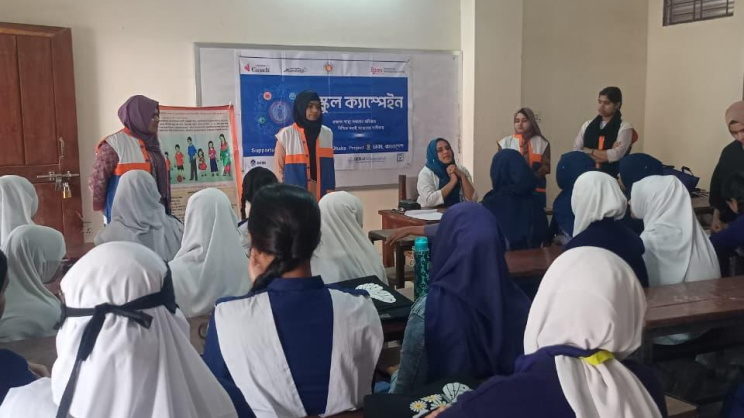
Bangladesh: a success story with unfinished business
Having worked in Bangladesh during the 1990s, Hawkes views the country as one of South Asia’s most compelling public health success stories.
“Bangladesh has managed incredible progress—on health indicators, on women’s education,” she says.
However, she cautions against complacency.
Much of this progress, she argues, has been achieved in siloed areas—without a fully integrated approach to SRHR.
 For all latest news, follow The Daily Star's Google News channel.
 “You can achieve strong outcomes in individual areas, but not necessarily as a comprehensive whole.”
The challenge now is to move beyond fragmented gains towards a more holistic, rights-based system.
Why data alone cannot change policy
In global health, data is often seen as the ultimate tool for advocacy. Hawkes is more sceptical.
“We can’t assume policymakers make decisions purely on empirical data—because we know they don’t.”
Instead, she emphasises the role of values, ideology, and context.
Even in high-income countries—where data gaps are minimal—policy decisions frequently diverge from evidence.
That said, she highlights one critical deficiency across settings:
“The biggest gap is the absence of disaggregated data.”
Without gender-disaggregated data, health systems cannot identify inequalities—let alone address them effectively.
Rethinking leadership: beyond representation
At Women Deliver 2026, Hawkes will contribute to a key debate: how to measure feminist leadership.
For her, the concept goes far beyond simply increasing the number of women in leadership roles.
“It’s not just about parity in numbers—it’s about how power is exercised,” she says.
Feminist leadership, in her framing, involves:
- shared power
- inclusive decision-making
- dismantling hierarchical structures
Yet measuring these qualities remains a challenge—one her team is actively working to address.
Research suggests that such leadership models are not merely ideological—they are linked to stronger organisational performance and better health outcomes.
Changing norms: law, culture, and resistance
Across South and Southeast Asia, social norms continue to shape access to care—often limiting women’s autonomy.
Hawkes argues that change must occur at multiple levels simultaneously.
Legal reforms, for instance, can have profound ripple effects.
“If you change the legal context, you start to see shifts in gender norms.”
Examples include:
- parental leave policies encouraging shared caregiving
- divorce laws enabling women to leave abusive relationships
But she is clear: there is no single solution.
“You need entry points at multiple levels.”
A collective challenge in a divided world
As geopolitical tensions rise and global cooperation weakens, Hawkes warns against an “us versus them” framing.
“These are collective challenges that need collective solutions.”
Her closing message is both pragmatic and hopeful.
Progress, she argues, will depend on solidarity across borders, identities, and ideologies.
We are the 99%. Collectively, we can make the world better for us.
The road to Melbourne—and beyond
With Women Deliver 2026 set to bring together policymakers, researchers, and advocates, the stakes could not be higher.
For Hawkes, the priority is clear:
to move beyond fragmented debates and reclaim a collective vision for equity, accountability, and rights.
In a world increasingly defined by division, the future of reproductive rights may depend not only on policies—but on who holds power, and how that power is exercised.
Comments