


War tribunal issues death warrants
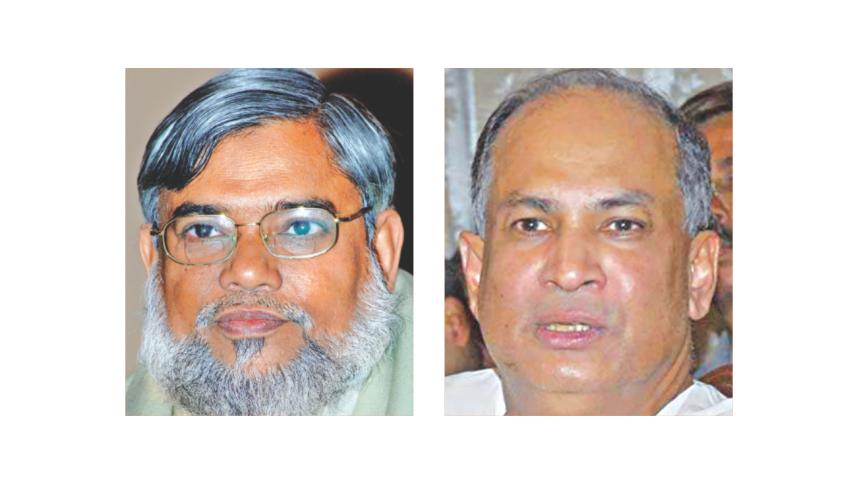
The International Crimes Tribunal yesterday issued death warrants for convicted war criminals Salauddin Quader Chowdhury and Ali Ahsan Mohammad Mojaheed, a day after the Supreme Court released its full verdicts upholding their death penalties.
Two tribunals had handed down capital punishments to them around two years ago for committing crimes against humanity during the Liberation War.

The ICT registrar's office issued two warrants for the convicts following its directives, Registrar Shahidul Alam Jhinuk told reporters yesterday.
The warrants were sent to the senior jail super of Dhaka Central Jail, he said, adding that copies of warrants were also sent to the Dhaka district magistrate for "necessary action" and to the home and law ministries for "information".
Jahangir Kabir, senior jail superintendent of Dhaka Central Jail, told The Daily Star that they received the death warrant at 3:10pm and he read it out to Mojaheed later.
Faridur Rahman Rubel, jailer of Kashimpur Central Jail-1, last night said they received the warrant at 8:55pm and read it out to Salauddin around 9:00pm. "He [Salauddin] behaved quite normally at that time."
Meanwhile, the defence counsels of the two convicts yesterday served notices on the tribunal's chief prosecutor, expressing their intention to file review petitions with the Supreme Court within 15 days.
Prosecutor Zead Al Malum, who deals with the prosecution's administrative affairs, said the chief prosecutor's office didn't receive any such notice till last night.
The SC in two judgments in June and July this year affirmed the death penalties of Jamaat-e-Islami Secretary General Mojaheed and BNP standing committee member Salauddin after hearing their appeals in two war crimes cases.
The apex court's full verdicts reached the tribunal on Wednesday night. Talking to newsmen earlier in the day, Attorney General Mahbubey Alam said the jail authorities could start the process of executing the verdict after receiving the copies of judgements.
If the convicts file review petitions, the process would remain halted until the review petitions are disposed of by the SC, he added.
Shishir Manir, a counsel for Mojaheed, yesterday said there is no legal scope for executing the convicts inside the 15-day period determined by the SC for filing a review petition.
If the convicts are hanged within this period, it will be considered a contempt of court, he added.
APPEALS, TRIALS
On June 16 this year, a four-member SC bench, headed by Chief Justice Surendra Kumar Sinha, unanimously upheld the death penalty of Mojaheed for planning and instigating the killings of intellectuals and professionals at the fag end of the Liberation War in 1971. Mojaheed was the chief of the notorious Al-Badr, an auxiliary force.
He is the first ex-minister facing capital punishment for war crimes and also the first accused convicted of killing intellectuals and professionals.
The SC upheld his life sentence, handed down by the International Crimes Tribunal-2 on July 17, 2013, for killing music composer Altaf Mahmud, Jahir Uddin Jalal, Badi, Rumi (son of Shaheed Janani Jahanara Imam), Jewel and Azad at the Old MP Hostel at Nakhalpara in Dhaka.
The highest court also affirmed his five years' jail term for confining and torturing Ranjit Nath, a civilian, at a Bihari camp in Faridpur.
On July 29 this year, the SC bench led by the chief justice upheld the death penalty of ex-BNP lawmaker Salauddin for the brutal killing of Natun Chandra Sinha, Awami League leader Mozaffar Ahmed and his son; and two acts of genocide in Sultanpur Banikpara and Unasattarpara villages in Raozan, Chittagong where 74 villagers were massacred.
It also upheld his 20-year jail sentence, handed down by the ICT-1 on October 1, 2013, on two charges: acts of genocide at Maddhya Gohira Hindupara and at Jagotmallopara in Raozan. At least 37 people were killed in the two villages.
 For all latest news, follow The Daily Star's Google News channel.
 The SC also affirmed the tribunal's verdict that sentenced him to five years' imprisonment on each of two charges of abducting, confining and torturing Saleh Uddin, who later became vice chancellor of Shahjalal University of Science and Technology, and Nizamuddin Ahmed, who later became a journalist.
Comments