


Tories win majority
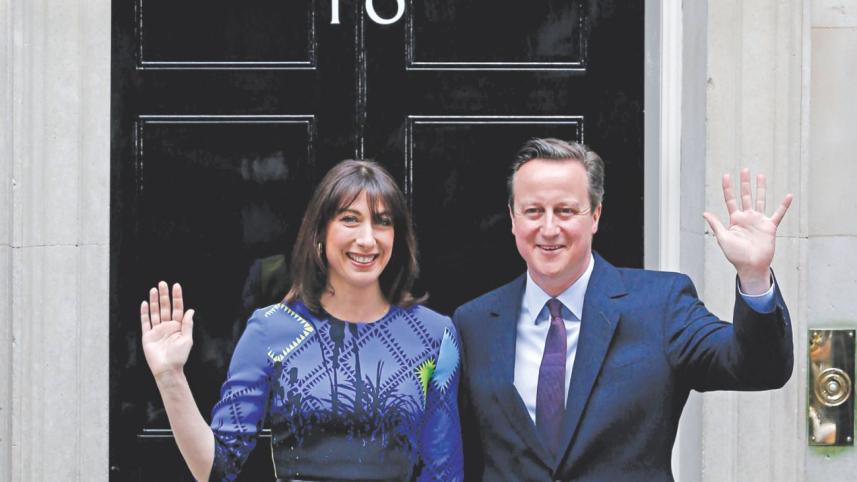
David Cameron's Conservatives won a stunning victory in Britain's election, which cut short the careers of his top three rivals and put the country's European Union future in doubt.
Widespread predictions of a close contest with the opposition Labour party turned out to be wide of the mark, as the Tories won 331 seats in the 650-seat House of Commons.

The shock victory seals a new term for Cameron as head of a majority Tory government.
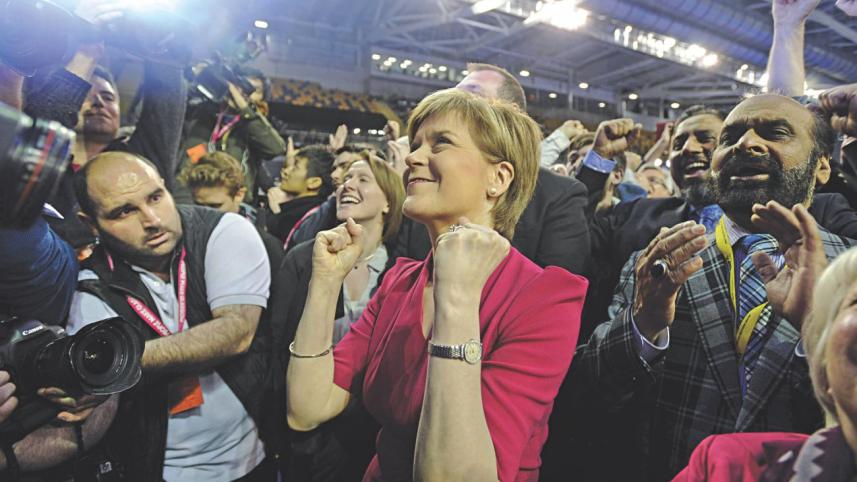
The Tory victory was focused on England, however. North of the border, nationalists won a historic landslide in Scotland, just seven months after losing a referendum on independence.
In another dramatic development, Labour leader Ed Miliband, Liberal Democrats leader Nick Clegg and UK Independence Party (UKIP) leader Nigel Farage stepped down over their parties' electoral drubbing.
With all 650 seats declared, the Conservatives have ended up with 331 seats in the lower house of parliament, 24 more than in 2010. Labour have 232, the Lib Dems 8, the Scottish National Party (SNP) 56, Plaid Cymru 3, UKIP 1, the Greens 1 and others 19.
The Tories get a 36.9 percent share of the UK national vote, Labour 30.4 percent, UKIP 12.6 percent, the Lib Dems 7.9 percent, the SNP 4.7 percent, the Green Party 3.8 percent and Plaid Cymru 0.6 percent.
Turnout is set to be 66 percent, marginally up on 2010 and the highest since 1997.
The Conservatives' victory means they will be able to govern without the need for a coalition or a formal agreement with other parties.
David Cameron has promised to lead a government for "one nation" and make "Great Britain greater" as he returned to Downing Street as prime minister.
Speaking outside No 10 after visiting Buckingham Palace yesterday, he said the UK was "on the brink of something special".
"We will govern as a party of one nation, one United Kingdom … That means ensuring this recovery reaches all parts of our country, from north to south, to east to west."
Having secured five more seats than needed for a Commons majority, the Conservative leader is now beginning the process of putting together the new government. George Osborne has been reappointed as chancellor, Theresa May as home secretary, Philip Hammond as foreign secretary and Michael Fallon as defence secretary.
Cameron said he would reach out to all parts of the UK and strive to "bring the country together" in the wake of the SNP's election landslide in Scotland, where it won 56 of the 59 seats.
He said he would press ahead with devolution of powers to all nations as well as referendum on the UK's EU membership.
"In this parliament I will stay true to my word and implement as fast as I can the devolution that all parties agreed for Wales, Scotland and Northern Ireland."
'DARK HOUR'
Speaking at Labour's London headquarters, Miliband said he had phoned David Cameron to congratulate him on his victory.
 For all latest news, follow The Daily Star's Google News channel.
 He said he would step down as leader with immediate effect after Labour won 26 fewer seats than in 2010, adding that deputy leader Harriet Harman would succeed him pending a leadership contest.
"I am truly sorry that I did not succeed," he told party supporters. "I have done my best for nearly five years."
"I take absolute and total responsibility for our defeat. I am so sorry for all of those colleagues who lost their seats … And now it's time for someone else to take forward the leadership of this party," he said.
Announcing his own exit as Lib Dems leader after more than seven years, Clegg said the results -- which saw his party reduced from 57 to eight seats -- were the most "crushing blow" to the party since it was formed in the late 1980s.
"This is a very dark hour for our party," he told party supporters in London. "But we cannot and we will not allow the values of liberalism to be extinguished overnight. Our party will come back. Our party will win again."
MORE WOMEN IN PARLIAMENT
In another dramatic change to the political landscape, the number of women in Parliament has risen by about a third, BBC reports.
With results in all 650 seats declared, about 29 percent of MPs are women -- up from 23 percent before the election. This represents the largest increase since 1997.
Comments