


The sins of midnight shoppers
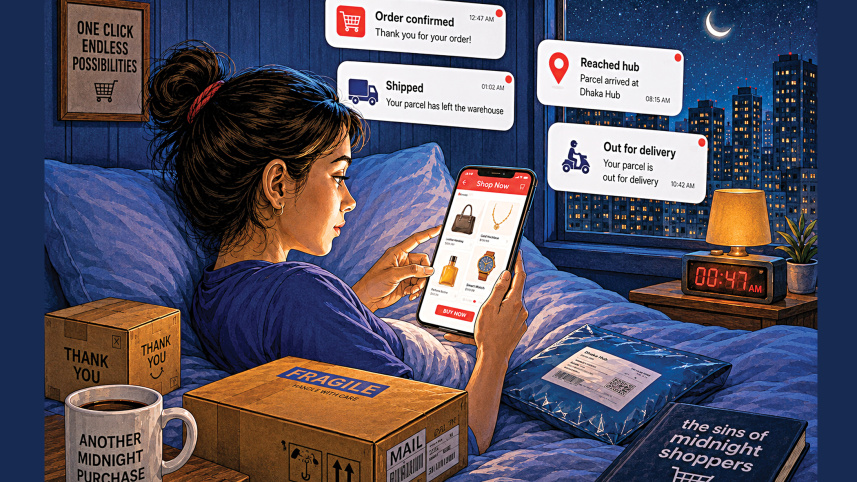
“Track your parcel” is the new‑age “You’ve got mail.” The beep of delivery updates has replaced the once‑iconic inbox ping of the early internet era. What was once a digital ritual of email notifications is now the compulsive refresh of apps to check if my detergent, jewellery, or midnight impulse buy has left the warehouse, reached the hub, or is “out for delivery.”
That phrase, “track your parcel”--has become shorthand for an entire ecosystem of logistics and labour. It carries the same emotional charge as “You’ve got mail,” only now it’s tied to e‑commerce, to parcels inching their way across Dhaka’s courier networks. It captures the thrill and anxiety of our changed social behaviour, sustaining the city’s digital marketplace.

At the heart of this is doomscrolling -- the endless, mindless browsing that peaks at midnight. What begins as casual scrolling or sharing reels with friends quickly spirals into impulsive buying. Customers like me end up ordering items we may never use.
Parcels arrive in a steady stream. Five in a day, sometimes more. Often, I don’t even remember placing the orders, let alone needing the items. Doomscrolling blurs the line between leisure and compulsion. And it isn’t confined to one class or demographic. Midnight shopping cuts across society. It’s a collective ritual, a new urban rhythm: the sins of midnight shoppers.
Online platforms exploit this vulnerability with targeted ads and interactive promotions, creating a cycle of consumption that feels both thrilling and exhausting. For vendors, it’s a lucrative model -- flash sales, live‑streamed promotions, and instant replies keep consumers hooked, ensuring demand never sleeps.
They bait customers like me with live commentary, flashing deals, and instant responses -- like a midnight adda that never ends. Internet usage has morphed from connectivity to consumption, revealing a psychological undertone: doomscrolling has become compulsive retail therapy, making shopping less a convenience and more a nuisance.
At that zero hour, when we should be winding down -- reading a few pages of a novel or exchanging the day’s events with family -- we lie in bed with phones glowing. Kitchen gadgets or pearls flash across the screen, ordered in a haze of half‑conscious impulse.
This surge in e‑commerce reshapes urban labour dynamics while highlighting the tension between healthy consumerism and unchecked indulgence. Midnight shopping shows how digital platforms can rewire spending behaviour in ways traditional retail never could.
And the couriers? They’re booming. From food to household essentials, they deliver with clockwork reliability—save for the occasional platform that swaps promise for knockoffs. The delivery companies aren’t to blame.
Courier services have become the backbone of this marketplace. Pathao, Paperfly, Sundarban Courier Service—all scaling rapidly, handling thousands of parcels daily. Their networks stretch from Dhaka’s dense neighbourhoods to remote villages, ensuring online shopping isn’t just an urban privilege.
Midnight orders mean couriers are busier than ever, with schedules stretching into odd hours. Reliability has become their selling point -- customers expect parcels to arrive quickly and intact, and firms race to meet those expectations.
I wait for the familiar ping, “Out for delivery,” and Lucifer, ever amused, counts my doomscrolling and midnight shopping among his favourite sins.
 For all latest news, follow The Daily Star's Google News channel.
Comments