


Lost professions in Dhaka
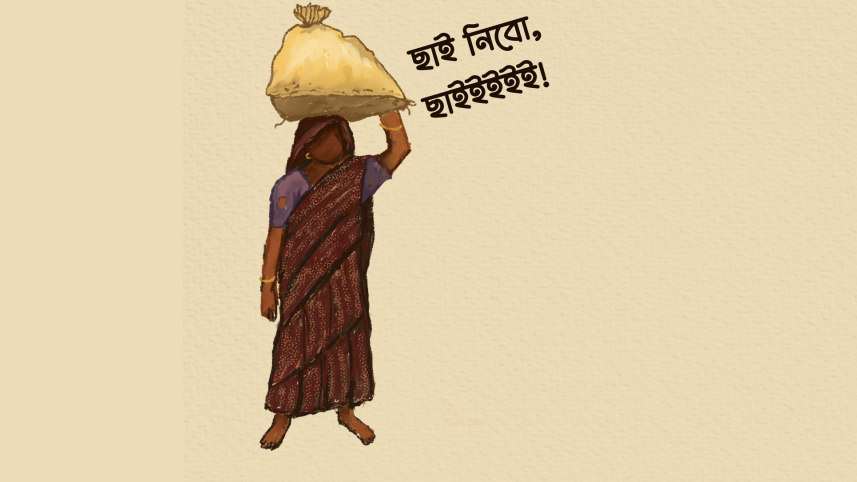
Have you ever realised that we are slowly forgetting the essence of Dhaka, especially those regular things we once used to start our day with?
Not long ago, we would wake up to the stretched-out voices echoing through narrow streets and sleepy neighbourhoods. Those voices were more than just sounds, they were part of our daily life.

“I had just moved to Dhaka when I met a lace-fitawali who became very close to me. She used to visit our neighbourhood every evening, and I often bought little things from her,” Sabira Yesmin, a home-maker who lives in Paikpara, Mirpur, recalled. “It was a very wholesome thing at some point.”
The 90’s had its own character, and every profession carried its own voice. Let’s be honest, how long has it been since you last heard the familiar call of “Chhai loibooo Chhai?” or “Lace-fita horekmal, dui teka…” echoing through the streets?
For many people back then, mornings in Dhaka felt incomplete without the familiar call of “Murgi e murgi!” echoing through the neighbourhood. A van loaded with live chickens would slowly move through the streets every morning, stopping from door to door as people gathered to buy fresh poultry for the day.
Moreover, the milkman would arrive carrying large metal milk cans, carefully pouring fresh milk into bowls or containers brought out by the households.
Now tell me, when was the last time you saw pink clouds of sugar candy stacked inside a glass box, or a kulfi-malai cart wandering through a neighbourhood like a Pied Piper of Hamelin, with a trail of excited children following right behind?
“We used to gather plastic bottles to buy sugar candy. And it was like a competition between me and my cousins to see how many bottles we can save to get those pink candies,” reminisced a 35-year-old Md Akash Hossain, with his eyes full of nostalgia.
Maria Alam, who now lives in China, was recalling her old days in Dhaka too. “I still remember those guys with colourful costumes, more like clowns – used to come over with a mic and stretch his voice saying ‘Channachhurrrrrr’.”
Back then, there were people who roamed here and there with handmade, bicycle-like grinding machines that were used to sharpen “shil-pata,” “boti,” and kitchen knives. The sound of those machines was once a familiar part of everyday life in Dhaka.
Recalling another memory from her childhood, Alam laughed, and shared, “I was probably six or seven years old. I was fascinated by the sharpening machine, so I went up and touched it. And guess what? I ended up with a huge cut on my hand.”
In the age of Netflix, YouTube, or Spotify, this generation barely knows about the CD shops from the 90’s. These tiny shops did not just sell CDs but most of them rented out movies, dramas and music albums for a small fee.
Sheela Akhter, a working professional, shared her feelings on how she and her friends used to rent CDs so often, and how excited they were when they finally got their hand on the famous film “Daruchini Dwip.”
While sharing those memories, she got emotional and expressed, “My family didn’t have a DVD player, so I used to go to my friend’s place to watch films. Good old days!”
The street hawkers, CD renters, ‘lace-fitawalis,’ and so many others were never just people doing jobs. These people were part of their childhood, part of the sound of the neighbourhood.
Maybe that’s why these memories feel so heavy. Because when they think of them, they are not just remembering lost professions, but remembering a time when Dhaka felt a little slower, a little closer, and a lot more alive.
 For all latest news, follow The Daily Star's Google News channel.
Comments