


The anomalies within our child marriage restraint law

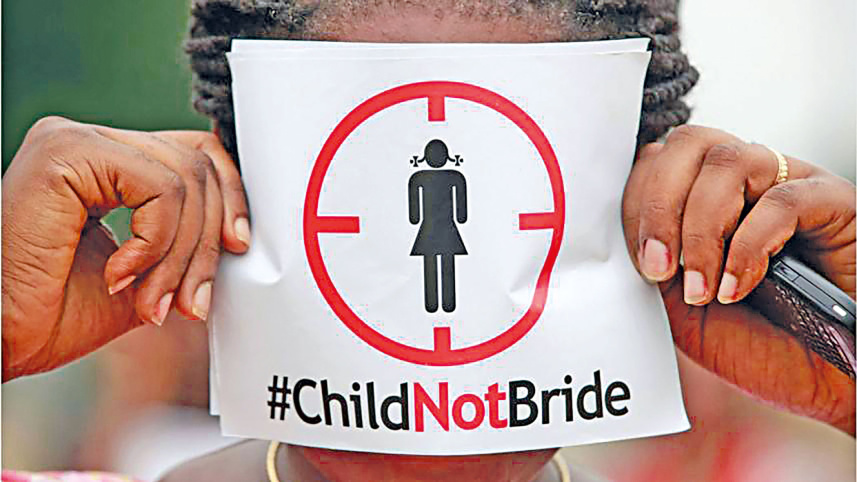
Child marriage is a harmful social vice that impinges on an array of rights of a child and disproportionately impacts girlchildren in particular. Bangladesh has a special law aimed at preventing and punishing early marriage; contrarily, an overwhelming number of social media posts defending child marriage points towards the ineffectiveness of the law in shaping public morality. Indeed, the lack of robust enforcement undermines the purposes of the law. More importantly, I argue that the flaws remain in the law itself, designed with contradictory and ambiguous provisions that allow the people to exploit the loopholes.
The Child Marriage Restraint Act 2017 aims at the prevention and, eventually, the gradual elimination of child marriage in Bangladesh. Under section 7, the law criminalises marriage of any minor boy or girl. Furthermore, the Court can issue, under section 5, an injunction against the solemnisation of child marriage if it is satisfied that such marriage has been arranged or is about to be solemnised. The law also prescribes penalty for the parent or guardian or any person in charge of the minor committing an act to promote the marriage or permitting it to be solemnised or negligently failing to prevent it from being solemnised. The punishment also extends to the persons solemnising the child marriage.

Unfortunately, significance of these provisions has been overshadowed by the special provision (section 19) that allows marriage of a minor girl or boy under certain conditions, namely a. if done in the ‘best interest of the minor’, b. at court’s direction, and c. with consent of the parents or guardians of the minor. However, if the law was enacted to put an end to child marriage, a plain reading of the provision will reveal that the provision itself contradicts the purpose for which it was passed.
Again, the foremost condition for the court to approve a child marriage is to see whether it is done ‘in the best interest of the child’, seemingly borrowing the phrase from the UN Convention on the Rights of the Child (CRC). The aim of the ‘best interest’ doctrine is to ensure full and effective enjoyment of all the rights recognised in the CRC and holistic development of the child, including the child’s physical, mental, spiritual, moral, psychological and social development. It is linked to other general principles of the Convention, such as the right to non-discrimination, the right to life, survival and development, and the right to be heard.
Since one or both parties are unable to express ‘full, free and informed’ consent in child marriage, the Convention considers the same as a form of forced marriage and as a harmful practice, which the states parties are obliged to address and eliminate without any reservation. Moreover, as the practice negatively affects the dignity, physical, psychosocial, moral integrity and development of the child, it appears that child marriage itself is an act that contravenes the ‘best interest’ doctrine. Paradoxically, our law first approves of it and then asks the court to inspect whether the ‘best interest’ has been protected through it.
On the other hand, Rule 17 of the Child Marriage Restraint Rules 2018, which supplements section 19, lays down the procedure for the application of the special provision. Under this rule, the parents, guardians or even the pair may apply to the court for permission to solemnise the marriage, coupled with the reasons for doing so and applicable documentary evidence. The court sends them to the enquiry committee, which then recommends whether the marriage is for the ‘best interest’ of the minor and as a ‘last resort’, whereafter the court makes a decision on the applicability of the section.
Contrarily, the CRC’s General comment No. 14 (2013) explicitly sets the parameters in giving full effects to the child’s best interest and the elements to consider in doing so, including the child’s right to health, education and protection against exploitation. However, such elements have not been incorporated in the Rules in the form of guidelines, which leaves the provision ambiguous, and the assessment of ‘best interest’ remains susceptible to arbitrariness.
Since one or both parties are unable to express ‘full, free and informed’ consent in child marriage, the UN Convention on the Rights of Child considers the same as a form of forced marriage and as a harmful practice, which the states parties are obliged to address and eliminate without any reservation. Moreover, as the practice negatively affects the dignity, physical, psychosocial, moral integrity and development of the child, it appears that child marriage itself is an act that contravenes the ‘best interest’ doctrine. Paradoxically, our law first approves of it and then asks the court to inspect whether the ‘best interest’ has been protected through it.
Another anomalous aspect of the Act is its conflict with parallel structures of personal status law in the country. Although the law penalises child marriage, it does not invalidate it. Rather, the personal law governs the validity of the marriage, which often permits marrying off minor girls or boys. This remains another key factor underlying the law’s ineffectiveness.
It is worth mentioning that Bangladesh ratified two important international instruments that stipulate the prohibition on child marriage, namely the Convention on the Elimination of All Forms of Discrimination Against Women (CEDAW), and the Convention on Consent to Marriage, Minimum Age for Marriage and Registration of Marriages (Minimum Age Convention). Article 16(2) of CEDAW clearly stipulates that the ‘betrothal and the marriage of a child shall have no legal effect’. Similarly, Article 1(1) of the Minimum Age Convention provides for ‘full and free’ consent of the parties for a marriage to be valid.
Although Bangladesh has not put a reservation on Article 16(2) of CEDAW, it has done so in case of Article 2 of CEDAW (which absolves Bangladesh from passing any law in conflict with the Sharia law) and Article 1 of the Minimum Age Convention (reserving the right to apply the provision in accordance with the personal laws of different religious communities of Bangladesh). Besides the sociopolitical reasons, it is because of the said reservations that the treaty obligation to invalidate child marriage could not be translated into actionable domestic law. However, the extent to which the reservations impede the realisation of the object of the treaty has given rise to a growing opinion that the said reservations ought not to have any legal effect whatsoever.
Finally, it can be said that the successive governments in Bangladesh have only paid lip service to the treaties concerning the prohibition of child marriage. Furthermore, the reservation on the treaties calls seriously into question the sincerity of the state in taking actions to prevent it. If the enactment of the 2017 Act was a step forward, then the special provision incorporated therein took us two steps back. All of these lead to the conclusion that the crisis extends beyond the implementation problem; it is entrenched in the law itself.
The writer is Law Desk Assistant of Law & Our Rights, The Daily Star.
 For all latest news, follow The Daily Star's Google News channel.
Comments