


Why the adda of Aziz Super Market is fading away

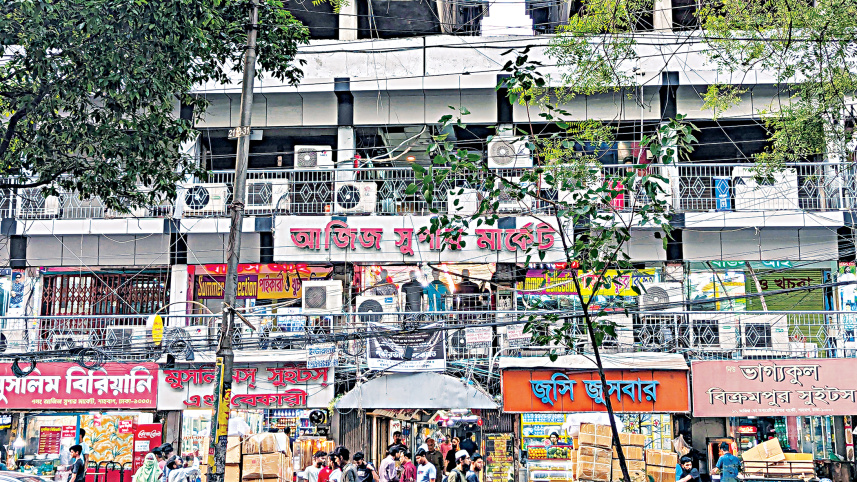
There are certain places in Dhaka that now exist less as actual locations and more as long, emotionally charged stories older generations refuse to stop telling. Aziz Super Market is one of them.
Well, just to be clear, it still exists physically, much as it always did. But culturally, it has been quietly recast from a space where people once went to think, into one they now visit largely to reassure themselves that thinking once took place there!

At its peak, Aziz Super Market was deeply entangled with figures like Ahmed Sofa, Humayun Azad, and an entire ecosystem of writers, artists, theatre activists, and intellectuals whose sustained presence and intellectual gravity almost turned it into an unofficial cultural hub.
I will not stretch that part too much because, if you grew up in Dhaka, chances are somebody’s father or uncle who owns at least one panjabi and a jhola bag has already delivered a long lecture on “what Aziz or Antel Para used to be.”
And honestly, my father was no different.
I grew up hearing about Aziz Super Market the way medieval people probably heard about Atlantis -- less a place, more a story older people insist is real. For a long time, I genuinely assumed Aziz must contain at least one secret literary society, three revolutionary poets, and a man angrily quoting Sartre somewhere near a staircase.
However, when I finally decided to visit the place myself, what I found was… complicated.
Not disappointing exactly. More like running into a once-famous radical who now sells clothes but still occasionally quotes Marx between customers.
Now, before the older generation accuses me of disrespecting heritage, let me clarify something: the traces are still there!! You can absolutely sense that Aziz Super Market once mattered enormously to Dhaka’s cultural crowd. The building still carries that very specific exhausted intellectual energy. There are still bookstores tucked into corners like stubborn survivors of a war.
But alongside all that, there are boutiques. Panjabis. Tote bags. Food shops. Clothing stores. Random fashion outlets selling the sort of kurtis that somehow appear in every corner of Dhaka eventually.
To understand this slow transformation -- or slow surrender -- of Aziz Super Market better, we spoke to a few bookstore owners who had watched Aziz change floor by floor.
According to the owner of Kishloy Bookstore, Rafiqul Islam, previously known as Pathshala, the transformation of Aziz Super Market was gradual, shaped by higher rent agreements, rising advance payments, and the harsh economic reality that books, unfortunately, do not sell as well as panjabis before Eid.
“Bookshop owners do not earn much from selling books,” he explained. “We stay because we are attached to readers more than profit. If I start selling clothes, I might earn more, but I wouldn’t get to interact with the kind of people who still come searching for out-of-print books on the Bengal Renaissance, or a piece of history everyone else has already stopped caring about. Those people still come here. Fewer than before, but they still come.”
We also talked to a visitor named Ezazul Karim, who is back in the country after 20 years.
“Back in my university days, Aziz Super Market was our post-uni adda spot. The old Aziz is gone, and so are my friends. If my circle had ten people, only two came back. And your generation could not fill that gap of eight readers,” Karim says.
And Karim is right. Perhaps that is the quiet tragedy of Aziz Super Market in its simplest form: the readers, thinkers, writers -- the serious ones, the obsessive ones, the people willing to lose entire afternoons to thought -- still exist, just no longer in numbers large enough to resist rent, or the slow, unapologetic pragmatism of Dhaka!
 For all latest news, follow The Daily Star's Google News channel.
Comments