


Durga Puja grows into a retail season


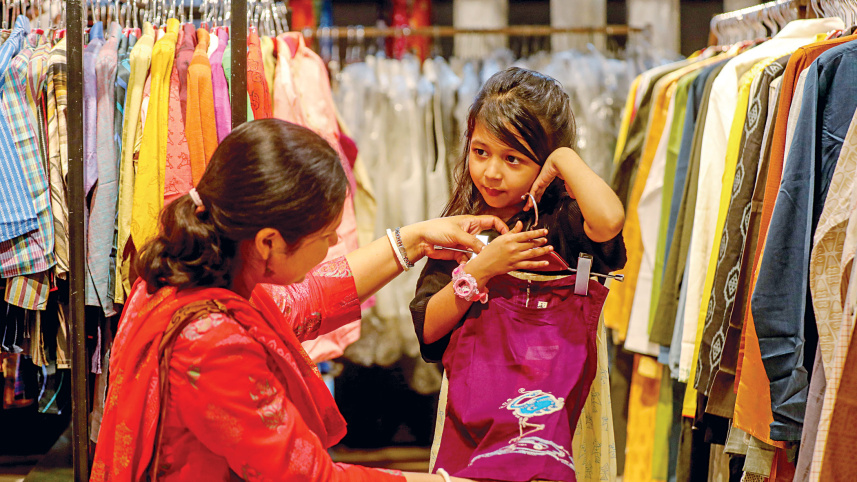
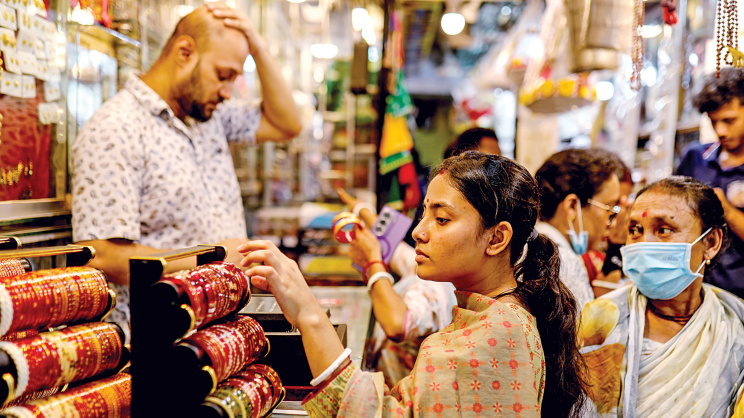
Amid the shopping rush in Dhaka’s Mirpur-10, Bina Roy is thinking mostly about the journey ahead. She has come with her daughter and son to buy clothes and gifts for her parents, sisters, brothers-in-law, nieces, nephews, cousins and in-laws. She has already been to New Market twice and ordered some items.
Her family usually celebrates Puja at her father-in-law’s home in Shahjadpur upazila, Sirajganj, or at their own home in Shewrapara, Dhaka. This year they will go to her parents’ home in Harina Bagbati, Sirajganj Sadar. Her two sisters live in different districts, and their children study elsewhere. After several rounds of phone calls, they fixed a date when everyone could be together. For Bina, Puja is much more than a festival of new clothes. “It is a chance to return home,” she says.

This year’s Durga Puja will be celebrated from October 16 to 21, with extended government holidays running from October 20 to 24.
Such journeys feed a seasonal spending pattern that has grown in recent years. Hindus make up about 8 percent of Bangladesh’s population, according to the 2022 census, and Durga Puja is the country’s fourth-largest festival. It now sits alongside Pahela Baishakh and the two Eids as a broader cultural occasion.
While there is no official data, industry insiders estimate that the two Eids account for about 70 percent of annual festival sales, Puja for about 10 percent, and Pahela Baishakh and other occasions make up much of the rest.
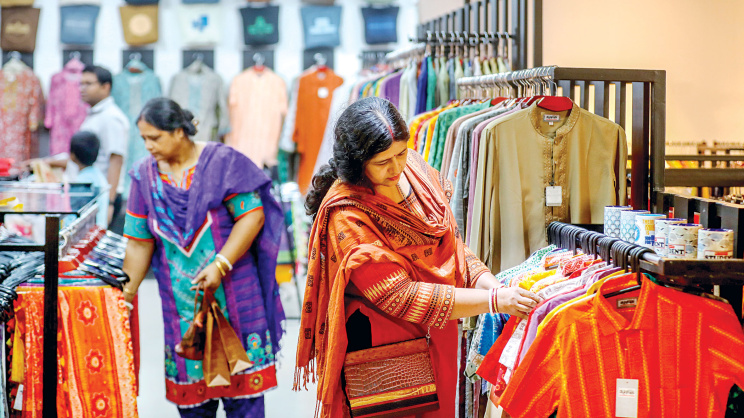
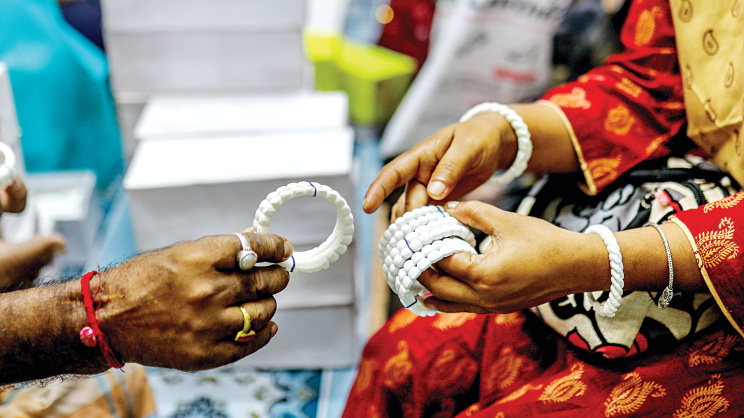
Shopping starts about a week before the festival and continues for at least a few days after it begins. Shopkeepers say sarees and salwar-kameez are the biggest draws, particularly katan, silk, embroidered and Jamdani sarees. Imitation jewellery shops at New Market report brisk sales of bangles, necklaces and rings. A significant share of products sold in the season is still imported.
Soumik Das, chief executive of Rang Bangladesh, says the Puja market once relied heavily on imports, but that dependence has declined sharply. A significant share of shoppers now wait specifically for locally made festival clothes, he says, and Puja has become a major retail season needing dedicated preparation, like Eid and Pahela Baishakh. The brand began producing limited Puja collections around 2005, and a strong market had emerged by 2009-10. Sales have since grown 15 to 20 percent a year, and the company now plans a 45-day selling window.
Sajjad Hossain, online sales executive at Cats Eye, says the brand has run Puja campaigns since its early years in its nearly 46 years in fashion. Customer response compares favourably with the two Eids and Pahela Baishakh, he says. Formal shirts remain the main sales driver, with smart casuals and panjabis also drawing interest.
Azharul Hoque Azad, president of the Fashion Entrepreneurs Association of Bangladesh, said it was difficult to estimate the overall increase in retail sales.
“Sales have not been significant so far this year. There are still a few days left, so sales should improve during that time,” he said.
Azad also said it was difficult to compare this year’s sales with those of the last two years.
“The situation is not the same now,” he said.
For that reason, he added, it is too early to say how this year will ultimately compare with the previous two.
At footwear giant Apex, the festival matters far less. A senior company official says Puja has been part of its annual marketing for many years, and the brand runs a campaign each year, displaying Puja-themed materials in stores that focus on festive messaging, product availability and presentation. But Puja contributes only 1 to 2 percent of sales, well below Eid.
Some customers complete their Puja shopping during Eid, particularly when discounts are on offer, he noted.
The jewellery trade tells a similar story. Enamul Haque Khan, president of the Bangladesh Jewellers’ Association, says gold was once gifted mainly at weddings and birthdays but is now also exchanged at Eid, Pahela Baishakh and Puja. Even so, Puja accounts for only a small share of annual sales. Sharp rises in gold prices have priced out many ordinary buyers, leaving purchases to upper-middle and upper-income groups.
Food businesses report mixed effects. Mahbubur Rahman Bokul, head of Bangladesh operations at Ontario-based Premium Sweets, says the two Eids generate more sales than Pahela Baishakh, while Puja has a relatively limited effect. Pahela Baishakh is celebrated across religious communities, he says, whereas Eid has a broader commercial impact because Bangladesh is Muslim-majority.
The company receives few customers during the festival, though some visit on Dashami. Corporate gifting has also declined, he says.
OLD DHAKA’S TRADE
Part of the festival’s economy sits outside the retail chains. In Shankhari Bazar in Old Dhaka, shoppers crowded the shops on both sides of the narrow street during a visit on October 4. Much of the buying is for the deities rather than for people: conch bangles, conch shells, vermilion, crowns, garlands, bells, pots and lamps. Sarees and ornaments for the goddesses Durga, Lakshmi and Saraswati sell for between Tk 700 and Tk 20,000, depending on quality.
 For all latest news, follow The Daily Star's Google News channel.
 Sudip Sarkar, owner of Sajghar, says there is always a rush for idol decoration supplies before Mahalaya, and this year is no exception. Sarees imported from India for the deities are in high demand and almost sold out, he says, and wholesalers from across the country are buying them. Light shopping continues all year, but sales rise significantly during Puja.
Decorative lamps are a highlight. Artisans have laid out Shangkha Pradip, Padma Pradip and Mayur Pradip designs. Suman of Sur Brothers and his assistants were applying final coats of paint. The lamps, which burn before the deities, especially on Vijaya Dashami, sell for Tk 40 to Tk 200 depending on colour and design.
Shivabrata De, who travelled from Keraniganj via Babubazar, was buying conch bangles, vermilion, alta and a saree. “Puja is our biggest festival,” he says. The idol will be decorated with these items on Mahalaya, and he plans another day or two of shopping for the family afterwards.
Dipankar Sur, owner of the clothing and cosmetics store Aashirbad, says the Puja mood is already evident but “anxiety still lingers among people” for various reasons, and sales have not yet picked up fully. He expects them to rise after Mahalaya on October 10.
For some businesses, Puja is the main event. Ananya, an e-commerce platform, formally expanded in 2020 to sell traditional naru, a coconut sweet. Chief Executive Joytirmoy Chaki says his in-laws have long experience of making it and the company wanted to bring that taste to a wider market. In its first Puja season, it relied on Facebook groups rather than formal marketing. Orders grew gradually, and volumes and operations expanded steadily in 2021.
He said they sold 200kg of naru in 2020. Last year, they sold 500kg. The company has set a significantly higher target this year.
He said usually 15 to 20 women work to make the naru, but during Puja that number rises to 40.
PAYMENTS, HOTELS AND TRAVEL
Banks and mobile financial services report a clear seasonal lift. Mahia Juned, additional managing director at City Bank, says transactions rise significantly in the weeks before Puja, as customers spend more on retail, dining, travel and lifestyle. In last year’s Puja campaign, the bank recorded about 30 percent growth in transaction volume and 27 percent growth in transaction numbers against a regular period.
In a similar tone, an official of Mutual Trust Bank, seeking anonymity, said the bank sees a seasonal increase in the weeks leading up to Durga Puja. “Card transaction volumes could rise by around 10 percent compared with a normal month during the upcoming Puja season.”
The bank expects spending to grow gradually as the festival approaches, particularly across clothing, jewellery, dining and travel.
“The pre-Puja period typically sees consumers increase purchases of new clothes and accessories, while spending on dining and leisure activities also rises during the festival,” said the official.
Travel-related expenditure is also expected to increase as many people use the Puja holiday to visit family or take short trips, the official noted. Among the major spending categories, clothing is expected to record the strongest growth, followed by jewellery, food and dining, and travel.
“Also, we have observed that customers perform wedding shopping during this time due to the upcoming wedding season in the winter,” said the banker.
Shamsuddin Haider Dalim, head of corporate communications at bKash, says festivals prompt people to buy new clothes, eat out, travel home and exchange gifts. Consumers spend on clothing, electronics, transport tickets, hotels and food, he says, and easier payment services have increased digital transactions. During the Puja season, bKash is offering more than Tk 8,000 in cashback and discounts at over 40,000 physical and online shops until October 31.
Hotels expect a seasonal surge. Zafren Reza, reservation executive at DuSai Resort & Spa, says room inquiries typically begin about a month before Puja, with occupancy well above normal. All 85 rooms have sold out in recent years, and a five-day holiday this year should keep occupancy strong.
Raxy Dominic Gomez, senior manager for marketing and sales at Mermaid Beach Resort, says the extended holiday should attract more guests. Schools and colleges are closed during the festival, boosting family travel, and better train services and a wider choice of flights mean two- or three-day breaks are now enough for many people to travel.
Niloy Kumar Biswas, executive director of tour operator Bengal Vista Tours, says demand rises significantly even among people with only a couple of days off. The longer holiday should generate stronger interest, with Nepal, Thailand and the Maldives being popular destinations. Nepal and the Maldives are particularly attractive because they require no prior visa. India remains an option, but getting a visa has become difficult. Travel demand is strong, he says, but remains below Eid levels.
Comments