


Boishakh in fragments: Food, storms, and memory
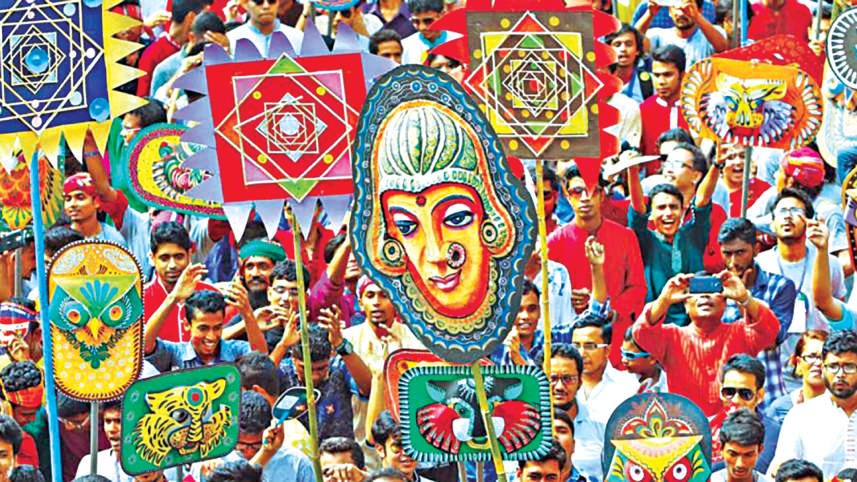
There is a tendency to become nostalgic about the smallest of things, and nostalgia can be a powerful emotion. It has a way of weaving itself into memory, quietly colouring moments. Memories themselves have a way of appearing unbidden, never seeking consent. I find myself treasuring my memories, guarding them in case they slip away. A song drifting from a shop doorway, the familiar smell of someone’s deshi cooking as I walk down the street, the soft haze of a misty morning—and suddenly I am somewhere else, transported to another time, to another place. I often wonder whether my childhood memories of Pohela Boishakh are snapshots in time, blurred at the edges, or borrowed memories from snippets of conversation or old photographs, my mind filling in the gaps.
In London, the celebrations are smaller and more intentional. They are arranged around busy schedules, often taking place in someone’s home rather than out in the open. There is food, music, and conversation—familiar elements but quieter and on a smaller scale. There is a different kind of intimacy here: a sense that the celebration exists because we must make space for it, all of us gathering to recreate something of what we remember.
 For all latest news, follow The Daily Star's Google News channel.
 Over the years, with friends having moved away, and my children having grown up, there is a lessening of the flurry of activity, the excitement less palpable. I miss going to the Boishakhi mela that takes place in May, around the Brick Lane area in East London, famously dubbed ‘Bangla Town.’ The first time I went was 20 years ago. I took my children because I wanted them to experience Pohela Boishakh for themselves instead of a second-hand retelling.
We arrived just as the procession began, instantly greeted by the rhythmic pulse of musicians and the graceful movements of dancers making their way through the crowd. Among the highlights was a large metal tiger float, followed closely by children wearing colourful tiger masks and waving Bangladeshi flags. The atmosphere grew even more vibrant with a couple dressed in traditional bridal attire, perched atop a rickshaw. As the procession gradually wound down, our focus shifted towards the stage in an adjacent field, where an eclectic line-up of performances awaited. The sounds of Bangla rock reverberated through the air, followed by Bollywood melodies, energetic bhangra, and innovative East-West fusion. The scent of festival food mingled with the music, while the swirl of costumes and lights added to the sensory richness. This diverse entertainment reflected the festival’s inclusive spirit, appealing not only to the Bangladeshi community but also welcoming a broader audience eager to immerse themselves in the rich tapestry of culture and celebration.
The last time I celebrated Pohela Boishakh in Bangladesh was in 2019. Dhaka is always bustling, but even the streets had a different energy. The intricate designs of the alpona painted on the long stretch of Manik Mia Avenue leading to the Jatiyo Sangsad Bhaban was a sight to behold. I had been invited to a lunch organised by friends, and I felt like a child once again, rummaging through my mother’s wardrobe and wearing her off-white jamdani saree with red motifs, and slipping matching bangles onto my wrists. What I remember most is the food— a spread of several types of bhorta, panta bhat, fried hilsa served with green chillies and onion, and more dishes than memory can do justice to. The food was presented in clay bowls and pots, others on banana leaves. My eyes were definitely bigger than my stomach by the time the mishti was served. For a moment, it felt as though memory and reality had quietly met.
This is an excerpt. Read the full article on The Daily Star and Star Books and Literature’s websites.
Nadia Kabir Barb is a British Bangladeshi writer and journalist whose work has appeared in international literary journals and anthologies. Her debut short story collection, Truth or Dare, was named one of the Indie Press Network’s “Best of 2023” and was a finalist for the 2024 Eyelands Book Award. She was also longlisted for The Bridport Prize Peggy Chapman-Andrews “First Novel Award” and The Novelry’s 2025 “The Next Big Story”.
Comments