


The queen who would not stay dead
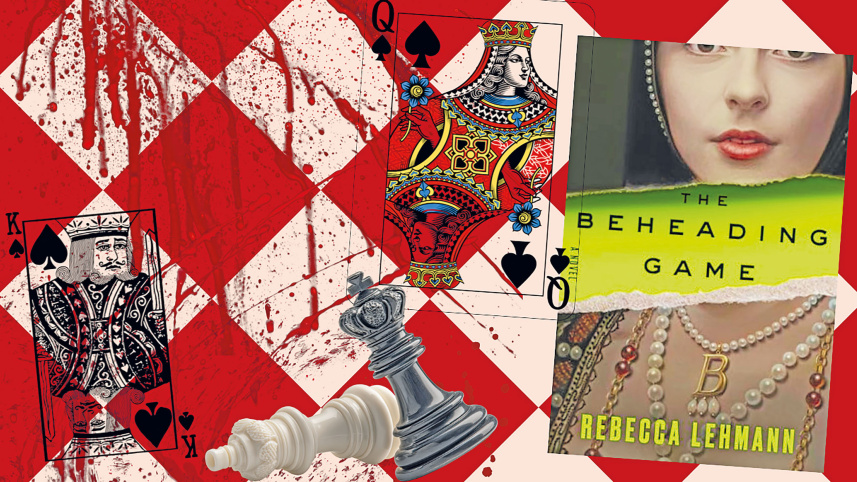
The history of the six wives of Henry VIII has become the stuff of legend in English history.
Generations of history buffs have simultaneously been horrified and fascinated by the monarch’s abusive relationships with his queens. Many a schoolchild in the Anglophone world learned the following grisly mnemonic device to remember the fates of the six queens: divorced, beheaded, died, divorced, beheaded, survived. Of the six, it is Anne Boleyn whom history remembers best. The mother of Queen Elizabeth I, it was Anne for whom Henry separated England from the Roman Catholic Church to annul his previous marriage to Katherine of Aragon. Anne was later tried and beheaded for adultery, incest, and treason. It was for these reasons that I was intrigued when I learned about the historical fantasy novel The Beheading Game by American literary scholar and poet Rebecca Lehmann.

Clearly inspired by the beheading game from Sir Gawain and the Green Knight, Lehmann imagines Anne awakening from her own beheading, seeking to return the favor by beheading Henry. However, I argue that The Beheading Game has more in common with a revenge tragedy. In contrast to the Green Knight, who spares Sir Gawain with a minor cut on the neck, Anne is fully determined to kill her former husband, driven both by a desire for revenge against the barbarity he inflicted against her and a need to protect her daughter, Princess Elizabeth.
A common woman from the Fens who comes to work in London as a seasonal sex worker, Alice serves as a foil to the former queen. Despite their differences in rank and education, the two women have both been imprisoned for sexual impropriety.
Lehmann begins to establish Anne’s identity as a tragic heroine by portraying her as the victim of a great injustice. In the prologue of the novel, Lehmann explains that while Anne was tried and executed for adultery, incest, and treason, most modern historians believe her to be innocent. In Chapter 1, Lehmann describes Anne awakening inside an arrow chest in the Tower of London, where she realises her head has been wrapped in lace and placed on the knees of her decapitated body. The readers see firsthand the graphic outcome of Henry’s actions against his wife, and through her eyes, they can experience her memories of the trial and execution. Anne escapes the Tower of London and crosses the River Thames to Southwark, where she breaks into a local tavern and reattaches her head with a needle and thread. Lehmann’s description of Anne sewing the dismembered ends of her head back onto her neck is painful to read, but it can be interpreted as a powerful moment of Anne regaining agency over her own body. It is fascinating that Lehmann chooses to preserve the scars. Anne tries to hide the scars with one of Princess Elizabeth’s swaddling clothes, but they nevertheless serve as a powerful and permanent reminder of the crime committed against her.
It is noteworthy that as soon as Anne has recovered physically, she decides to return across the river to confront Henry. Initially, Anne hadn’t decided what revenge would look like. She just knew that to regain control of her life and to achieve justice, she needed to face her ex-husband. It isn’t until she watches a bear-baiting match in an open-air arena in Southwark that Anne determines she needs to kill Henry before he marries his fiancée Jane Seymour and they produce an heir. Anne compares the king to a wounded bear, wild and uncontrollable. She not only sees her ex-husband as a direct threat to Princess Elizabeth, but also to the stability of the realm itself. Anne sees in her daughter Elizabeth a monarch who will continue her work of building an independent and reformed Church of England. For Anne, killing Henry is a blurring of patriotism, motherly devotion, and personal revenge.
Lehmann creates a fascinating companion and sapphic love interest for Anne in the character of Alice. A common woman from the Fens who comes to work in London as a seasonal sex worker, Alice serves as a foil to the former queen. Despite their differences in rank and education, the two women have both been imprisoned for sexual impropriety. Both women had been trapped in marriages with cruel husbands. They are also both devoted mothers who will happily risk themselves for their children’s well-being. Alice challenges Anne’s preconceived notions about the common people, and she helps the noblewoman develop a newfound sense of appreciation for the commoners and their way of life.
If I had to critique anything about the novel, I think Lehmann missed an incredible opportunity to have Anne interact with Princess Mary. As the other woman who encouraged Henry to annul his previous marriage with Katherine and to declare Princess Mary a bastard, it would have been powerful to have Anne have to confront the young princess from the dethroned position that she had supported Henry inflicting upon the princess and her mother. Katherine had already died before Anne was executed, but Anne could at least have answered to her daughter.
I strongly recommend The Beheading Game by Rebecca Lehmann. It represents a compelling rewriting of the Anne Boleyn story into a gothic revenge tragedy. While some might roll their eyes at the idea of the late queen coming back to life, I imagine history buffs and gothic horror fans will be entertained by this novel.
Jonah Kent Richards is a Shakespeare screen adaptation scholar, an English teacher, and contributor for Star Books and Literature.
 For all latest news, follow The Daily Star's Google News channel.
Comments