


Patriarchy inversed: Reimagining Rokeya’s Ladyland in 2026
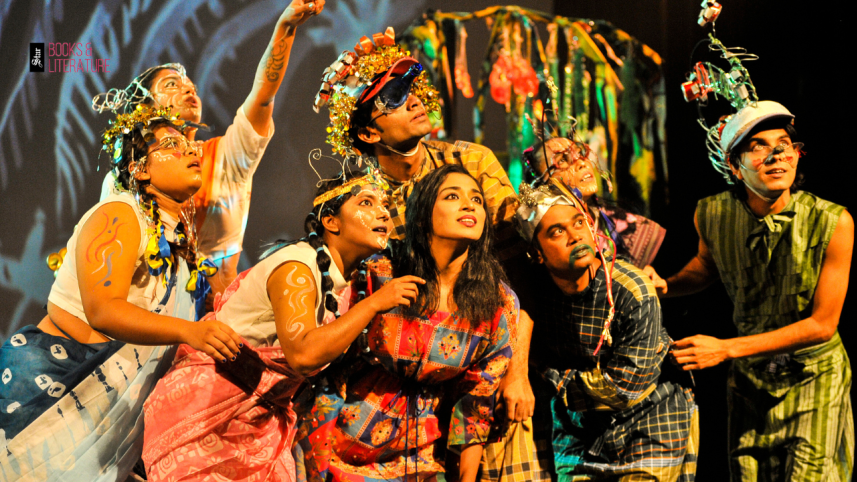
“Ladyland is not perfect,” remarks Sultana, one of the protagonists in the much awaited play, “Project Ladyland 2026”. Produced by HerStory Foundation in collaboration with the British Council and Women of the World Foundation, the play was greeted by a full house this weekend. Staged at the Bangladesh Mohila Samiti theatre, the performance made a splash on Friday, August 14. Adapted from Rokeya Sakhawat Hossain's groundbreaking short story, “Sultana's Dream,” the dramatisation delves into their reimagination of Rokeya's Ladyland 121 years after the story took place. While the play incorporates the overarching themes and aesthetic style present in the original story, its unique plotline focusing on the 21st century rendition of Ladyland elicits an inevitable question from the audience: does the play truly honor the revolutionary imagination of the work it evokes?
This modern retelling unfolds in a techno-feminist fictional land where we see the protagonist Sultana in 2026, navigating the hustle and bustle of ever-draining Dhaka city. In a dream, she travels to Ladyland, which has significantly changed since its conception. Greeted by Sara, Sultana is shown around the country and introduced to the technological advancements made over the decades. While admiring their society, Sultana feels conflicted when she is confronted with the Night Law, which restricts men indoors from sunset to sunrise regardless of their profession. A central question—whether the Night Law should be repealed—plagues Ladyland as the future of the country depends on their decision. While the premise is intriguing and grounded in contemporary Bangladeshi feminist conversations, the development of the social order in Ladyland over the past century is not sufficiently addressed.

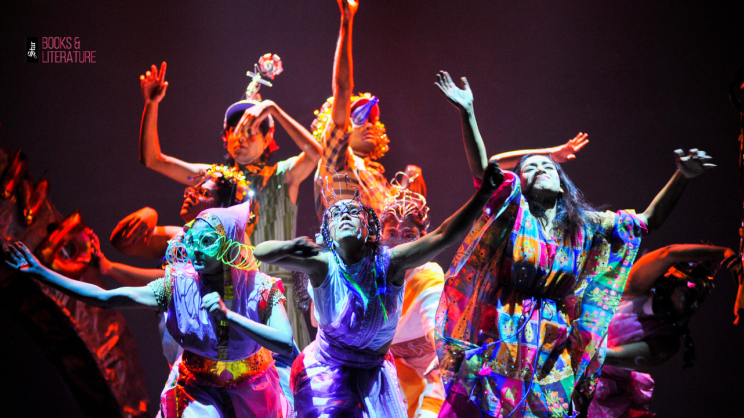
Granted, all adaptations are subject to interpretation, compression, and dramatic license, particularly when reenvisioning a century of imaginary progress for a futuristic theatre production. However, fidelity to Rokeya’s original worldbuilding remains a matter of concern. When the character of Dadima recounts the history of Ladyland’s formation, some key details present in the original story are excluded. Regardless of whether this was a deliberate decision or a matter of simple oversight, the omissions flatten the narrative. For instance, while Dadima briefly mentions that women were able to win the war through the use of solar power 131 years ago, the lack of emphasis on how the men of their country were asked to retreat to the ‘zenanas’ so that the women could fight the war while maintaining their modesty obscures the history of how women came to rule Ladyland. Moreover, in Rokeya’s narrative, the men were not forced to stay in the ‘Murdana’ but rather when they wanted to return to the traditional Purdah system, the queen had stated “that if their services should ever be needed they would be sent for, and that in the meanwhile they should remain where they were.”
Following the establishment of the ‘Murdana’ system, the men looked after the children and the house, focusing on domestic labour while the women were in charge of managing the society. In the play, Dadima mentions that now besides being allowed outside during the day, men are also able to choose their own profession. The Night Law exists to grant women the freedom to move about in safety after sundown. However, the narration does not address the evolution of the system of seclusion nor does it explain the mechanisms of its current enforcement. Since Rokeya’s Ladyland did not have any police nor a criminal justice system as there were no crimes being committed, the inclusion of robo-cops in the dramatisation and the portrayal of men being arrested for breaking the Night Law seem incompatible with Rokeya’s vision, especially when these developments remain unexplained. Consequently, the play fails to delineate the dissolution of the monarchy nor does it elaborate how Ladyland is governed in 2026. When we left Ladyland in 1905, the Queen was in charge, whereas, in “Project Ladyland 2026”, the narrator makes a reference to the leaders of the nation without any further elaboration, leaving the audience confounded and questioning.
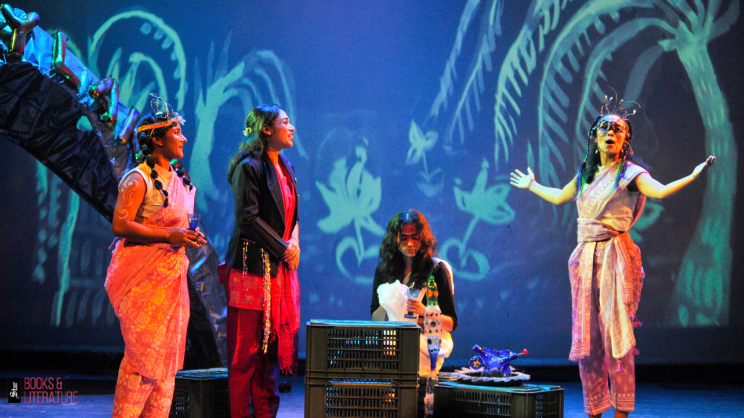
Despite the narrative discontinuities, the endeavour to reimagine Rokeya’s utopia for a modern theatre, infused with the traditions of Bangali pala gaan, is an ambitious and commendable undertaking, and the immense effort of the production team is evident throughout the show. The philosophy behind the props design where everything is made entirely from recycled materials reflects the waste-management system envisioned in the play, in which discarded materials are reused as part of the technologically advanced society. Emphasising the value of time, the current inhabitants enjoy leisure hours and find fulfillment in pursuing traditional handicrafts.
Nevertheless, inconsistencies in the worldbuilding lead to a fragmented narration that disrupts the momentum of the performance. While the opening scene does an excellent job of grounding the setting in contemporary Dhaka, some of the subsequent scenes can feel meandering as their relevance to the central plotline remains unclear. At times, the story arc feels thin and uneven underscoring the superficiality of the central conflict—the fight for the abolition of the Night Law. As the evolution of the ‘Purdah’ remains unaddressed, the play lacks adequate context to understand the urgency the male citizens of Ladyland experience. Even though the play attempts to embody the reversal of the patriarchal system that Rokeya had employed, its failure to satirize the gender dynamics dilutes the sharp humorous juxtaposition present in the original text. Rather than treating the seclusion of men as a witty critique of their collective incompetence, the play portrays the Night Law as a distressing civil rights issue. By transforming Rokeya’s ingenious subversion of the social order into a profound struggle against state-enforced seclusion, the central conflict loses its satirical edge, which irrevocably flattens the narrative’s revolutionary spirit.
The production likewise dilutes the significance of the solar-punk infrastructure that was once foundational in Ladyland. Although they introduce technological advancements such as the ‘hyperdoor,’ these do not have the same political relevance as Rokeya's sustainable and renewable innovations that subvert the colonial models of extractive modernization. This superficiality also extends to the play's contemporary commentary. The dramatization aspires to critique the capitalist consumerist system while highlighting the absurdity of real-world campus Night Laws that female public university students in Bangladesh have been actively protesting against. Unfortunately, the narrative fails to engage with these ideas in depth, thus diffusing the focus of the show.
In spite of these limitations, one of the most captivating parts of the production was their unique approach in engaging the audience. The brochure of the production could be folded in half, one side representing ‘yes,’ the other ‘no;’ at the beginning of the show the audience were asked to raise their brochures showing ‘yes’ if they had read Rokeya's original text and ‘no’ if they hadn't. When the conflict arises, and men are taken to the 'Mimangsha Shobha' for breaking the Night Law, the narrator poses the question of abolition to the audience, allowing us to decide the fate of Ladyland. Ironically, when the majority votes against repealing the night law, we are allowed to see the dire consequences of our actions—where the men who continue to protest collapse due to fatigue and despair. Here the show pivots, going back in time to reverse the decision, thus abolishing the Night Law. However, the conflict that follows after the law is altered is only briefly portrayed, leaving the ultimate resolution unsatisfying. Correspondingly, the conclusion in the last scene—where the living library teaches the inhabitants to live in harmony without gender discrimination—remains underdeveloped on stage.
Essentially, the production serves to underscore both the potential and the limitations of interpretative adaptations. While the team embarks on a formidable and ambitious project worthy of appreciation, the absence of a cohesive narration and a sharp satirical commentary makes the production feel rather incomplete. By dramatising the gravity of the Night Law, the play deviates from the keen irony that permeates the original story, weakening the radical vision of Ladyland. Nonetheless, the endeavor of staging this production emphasises the timeless relevance of Rokeya’s subversive works, reminding us of the radicalism she possessed over a century ago and how pertinent she still remains.
The production brings together a diverse team of writers, theatre practitioners and artists. The script was written by Zohra Binte Zaman, Anika Bushra Shoshee, Nafisa A. Iqbal and Upama Adhikary, with editorial support from the HerStory team. The crew and vision are led by Katerina Don, Curator of HerStory Foundation.
The production team includes Bappy Ameen as Production Manager, alongside co-producers Risana Nahreen Malik and Khandakar Imdadul Haque Sohan. Shovon Surjo serves as fitness instructor and choreographer, with Wajed Al-Rahman as staging director. The production’s visual aesthetic is shaped by painter Hridita Anisha, upcycling artists Taranum Nirbir and Manzoor Real of Urukku Bangladesh, artist Faiza Fairooz (Rhimjhim), and costume designer Bushra Islam Labonno. J0N4K1 has produced the original score, which contributes to the production’s sci-fi atmosphere, while the shadow puppetry is created by Shafrin Islam with assistance from Anika Tabassum Nuzhat.
Maisha Masfica Tanisa plays Sultana, with Tawsiad Shaolin as Sutrodor and Priti Das as Sara. The cast also features Salim Shadman (Sasha) as Shishir, Israt Jahan Ikra as the Robots, Juliet Rajeena Quiah as Dadima, Muntasrin Rahman (Mim) as Kolpona, Dipu Mahmud as Bidut, Afrida Amir as Momo and Ohiduzzaman (Tony) as Taj.
Sadman Ahmed Siam, as the name suggests, is indeed a sad man. Send him happy quotes at: siamahmed09944@gmail.com.
Kashfia Nahreen is a passionate reader and an aspiring writer who spends her days cuddling with her cats.
 For all latest news, follow The Daily Star's Google News channel.
Comments