


Cooking up heat
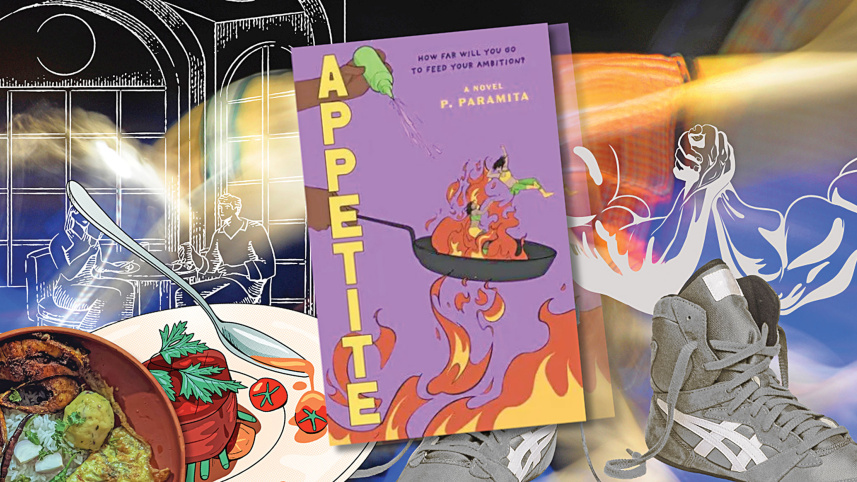
Reading through P. Paramita’s debut novel Appetite, I was reminded of my own days of wrestling fanaticism, around 2008, when I would eat through hours of TNA (I was particularly obsessed with Sting, even aping his facepaint at home with talcum and markers). I remember being subjected to Triple H’s signature Pedigree in my cousin’s living room, and how recklessly we tried out the manoeuvers we were warned not to.
Appetite, whose narrator Zarina is a young sous chef at a Connecticut restaurant, gives a much more pointed treatment of wrestling fandom. Zarina wishes to one day run her own “Bangladeshi Fusion” restaurant in the US. She is anxious about her future, of her icy relationship with her mother and her boss, who does not find her recipes impressive enough to be added to the menu. Yet, Zarina is increasingly unable to get ahead in her career, pushed further and further back through her debilitating preoccupation with a wrestler named Sierra Mist.

The novel’s strengths lie in Zarina’s disappointments. The character’s setbacks are rendered with real heart.
Zarina, who religiously follows Wrestle Thunder Ground (WTG) and Sierra Mist in particular, discovers at the start of the novel that a GIF she has shared on social media has gone viral, resulting in a follow back from her idol Sierra Mist herself, and not only does Sierra follow her, but she DMs Zarina and later gives out her number. Zarina ends up being an unofficial “GIF supplier” to this superstar wrestler, in exchange for the rare replies, attention, and occasional free tickets. Much of the story revolves around this, to the point where I wondered if the novel was just wishful thinking stretched into a book-length plot. When I was 10 years old, I too must have fantasised about becoming friends with a famous wrestler, who would single me out among their millions of followers. I would be singled out as his best admirer, and enjoy a private connection with him that others would not have. But I was 10, the protagonist here is 24. Zarina’s obsession with Sierra Mist jeopardises her focus and drive toward her more real passion for bringing Bangladeshi cuisine to the world. At one point in the story, as Zarina is passed over for a promotion at the restaurant because her attention always veers off to her group chat with other Sierra superfans; she muses, “...a part of me feels relieved. If I’d gotten the promotion, I’d have more responsibilities and less time to focus on wrestling Twitter.”
It is interesting that Paramita chooses to show this parasocial relationship but at the same time one cannot help finding Sierra’s actions to be absurd. As Zarina herself once asks Sierra, why her? The story references Elon’s takeover of Twitter, placing it after 2022—it seems puzzling that a celebrity would engage with a random, albeit a fan with good GIF-making skills, fan to such an extent over this. The issue is not the unrealistic nature of the story, for life is strange enough, but that the writing never once convinces the reader to accept this version. Zarina’s conversations with her mother and her employer are two glaring instances of flatness. The mother only exists to berate Zarina over her dreams; Andrew, her boss, only exists to be an obstacle. They are not humans, but props.
As Appetite staggers into its middle and Sierra Mist, who is white and affluent, faces some pushback over her lack of effort to promote persons of color in her field, the celebrity offers the usual platitudes, that she means well and is usually “apolitical”. But Zarina does not accept the half-hearted apology, “Part of me is surprised and appreciative that she’s called, but also, she’s a grown woman in her thirties. Does she really need me to explain what went wrong in this situation?” Zarina says, but isn’t Zarina also a woman in her mid-20s and acutely politically aware (Paramita writes her as one throughout the novel), as someone with her skin colour in the US is compelled to be? Why then is she written to be fawning over a personality like Sierra Mist’s, never seeing through her until confronted with her personally?
It is touching that Paramita, through her narrator, wants to bring the joy of Bangladeshi food into the wider world, and yet one cannot but wince at the mechanical nature of the glosses (“...ilish, known as the hilsa in English, the national fish of Bangladesh” or “...adding the water as the sauce reduced, an old South Asian trick called Koshano” or “Grilled meat isn’t a part of Bangladeshi daily cuisine…” to drop a few instances). By the end of the novel, it feels rushed. Sierra’s sway over Zarina fades. Our protagonist meets a girl named Raya at a Bangladeshi sweet shop and within minutes of knowing her, Zarina asks if she would like to work for her fusion restaurant, something that did not yet exist.
The novel’s strengths lie in Zarina’s disappointments. The character’s setbacks are rendered with real heart. When Zarina is stood up by Sierra Mist—a genuine encounter with one’s idol exposed as holding little weight for the latter—one truly feels for her. There is merit in that depiction of disillusionment. It is also an intense portrayal of the more corrosive aspects of fandom.
Appetite flourishes when it deals head on with the power imbalance found in fandoms such as this (from both the “idols” and others in the community) and how humiliating it is particularly for people who do not look and sound like the majority. For all of Appetite’s shortcomings, and its lack of realistic characters is a big factor, Paramita travels through her world of wrestling and cuisine with genuine enthusiasm, optimism, wonder, and hope.
Shahriar Shaams writes and translates fiction. He can be reached on instagram @shahriar.shaams.
 For all latest news, follow The Daily Star's Google News channel.
Comments