


Agency, identity, and the rewriting of Medusa
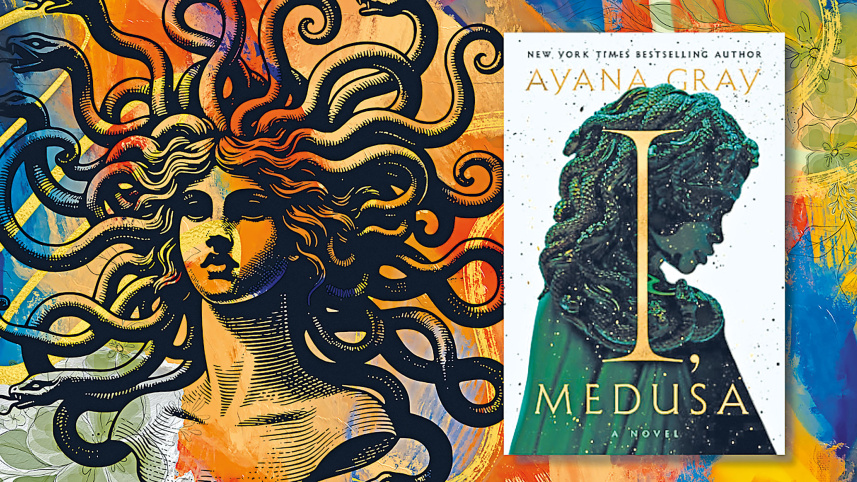
One of the most interesting adaptations that I have read recently is the 2025 novel I, Medusa by African American novelist Ayana Gray. According to Greek mythology, Medusa was a priestess of the goddess Athena who was raped by the sea god Poseidon and transformed into a gorgon by the goddess as a punishment for losing her chastity. Medusa was later beheaded in her sleep by the mortal hero Perseus. In her novel, Gray tells Medusa’s origin story. Gray not only reimagines Medusa as a Black woman, but she turns the character from antagonist to the heroine of her own story. In a story about a snake-haired woman whose gaze turns men into stone, Gray asks, is it really the gorgon who is the monster or rather the god and goddess who transformed her into one?
While Gray’s novel preserves the characters and plot of the original Medusa myths, she chooses to portray Medusa and her family as resembling people of African descent. It is a fascinating choice because Gray explicitly states that Medusa is still the mortal daughter of the sea gods Phorcys and Ceto, but they all share the same brown skin and Afro-textured hair. Gray places particular emphasis on Medusa’s locs (dreadlocks). Medusa describes her locs as her “pride” and her “dearest physical possessions”. For Medusa and her sisters, Stheno and Euryale, the act of braiding and washing each other’s locs were cherished family bonding moments. During Medusa’s initiation to become one of Athena’s priestesses, Medusa presents her hair braiding as her craft. Gray’s portrayal of Medusa’s love of her locs can be read as a celebration of the hairstyle as a centuries-old African symbol of beauty and cultural tradition.
 For all latest news, follow The Daily Star's Google News channel.
 Gray’s novel represents a powerful retelling of the Medusa that not only reimagines her as a woman of colour, but also as the tragic heroine of her own story. I imagine that some of those readers who avoid Greco-Roman mythology because they can’t see themselves in the stories or because they dislike the problematic portrayal of many of the women might very well be drawn to Gray’s adaptation.
It is not a coincidence that when Athena declares that Medusa has used her beauty for blasphemy and wickedness—and that she will have beauty no longer—the goddess chooses to target her hair. In a transformation scene reminiscent of a Hollywood horror movie, Medusa falls to the floor in pain as her locs fall out and are replaced by long black snakes. Medusa describes how “[t]hey writhe against one another, tangling like so many grotesque locs”. When Medusa’s best friend Theo tries to help her, she accidentally turns him into stone with her gaze. In one powerful move, Athena took the physical feature that Medusa believed to be her most beautiful and turned it into something monstrous. Indeed, Medusa says that Athena has turned her into a monster.
However, Gray makes it clear that despite Medusa’s new appearance, it is Poseidon and Athena who are the monsters. After being transformed into gorgons themselves for condemning Athena’s actions against their sister, Stheno and Euryale ask Medusa about what happened between her and Poseidon, and they reassure her that she did nothing wrong. They remind Medusa that Poseidon was thousands of years older than her and he was able to use his position as king of the sea court, as well as the fact that Medusa was drunk with Olympian wine, to manipulate her. The sisters remind her that even though Medusa initially welcomed Poseidon’s advances, she had the right to change her mind at any point.
It is this support from her sisters that allows Medusa to recover her sense of agency and self worth. Stheno reminds Medusa that her body belongs to herself and that she will learn to control her new powers. However, Stheno warns Medusa that her snake-locs, and the rest of the world, won’t respect her unless she makes them. Inspired by her sister, Medusa pulls out one of her snake-locs, killing it in the process. The action subdues the rest of the snake-locs into submitting themselves to her will. Once Medusa has regained control of her snake-locs, she comes to accept them and even sees the beauty in them. Gray makes it quite clear that Medusa isn’t a victim, but a survivor.
Medusa’s journey comes to a head with her reunion with Athena. Despite the goddess’s anger, Athena can’t help but express her admiration over how strong, powerful, and feared Medusa has become since her transformation. Athena even offers Medusa a chance to return to her service as her enforcer against injustice. While a small part of Medusa is tempted by the offer, she realises that the offer would come at the cost of her newly gained freedom. She understands that the goddess had cursed her not out of sense that Medusa had betrayed her, or that Poseidon had violated her, but because Athena had believed Medusa had belonged to her and that Poseidon had used her “tool” without her permission. Medusa refuses to ever let Athena or anyone else use her again. As a young girl, Medusa’s mother Ceto once told her that the worst monsters didn’t bother hiding themselves in the dark. By the end of the scene, Gray shows that the true monster of the story wasn’t the mortal girl turned into a gorgon, but the goddess who tried to possess that mortal girl and then cursed her out of jealous rage when another god tried to exploit her as well.
If I had to critique anything about the novel, it would be that I wanted to learn more about Medusa’s mother Ceto. The sea goddess is a complex and tragic character in her own right. Once a powerful sea goddess, she was forced to submit to the Olympians and is trapped in an abusive marriage with Phorcys. She self-medicates her depression with alcohol and she sometimes physically abuses her daughters Stheno and Euryale. But in her own way, she loves Medusa and tries to protect her daughter from Athena against whom she holds a long bloody grudge. Despite their complicated relationship, Medusa sees herself in her mother. I would have loved for the mother and daughter to develop more fully. If not for them to reconcile then at least for them to get a chance to better understand each other.
I strongly recommend I, Medusa. Gray’s novel represents a powerful retelling of the Medusa that not only reimagines her as a woman of colour, but also as the tragic heroine of her own story. I imagine that some of those readers who avoid Greco-Roman mythology because they can’t see themselves in the stories or because they dislike the problematic portrayal of many of the women might very well be drawn to Gray’s adaptation.
Jonah Kent Richards is a Shakespeare screen adaptation scholar, an English teacher, and contributor for Star Books and Literature.
Comments