


The writing’s boring, so he’s a third-class writer
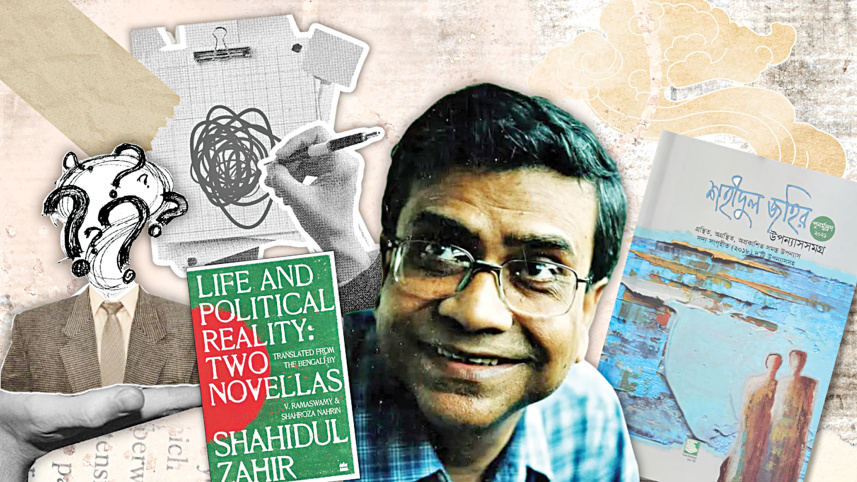
Some authors are gadflies, ever stinging and nettling the established order. Some write for more or less the same reason a carpenter works with wood, or a sous-chef does mise en place. Even gadflies, one might say, write because it is their job. Regardless of intent, some stories are not meant to comfort. They strip away the scab of conflicting national narratives, only to expose a collective wound still raw and festering.
That’s what Shahidul Zahir does. He is not an easy read in the traditional sense.

His deadpan, unflinching telling of wartime violence and shifting allegiances in post-liberation politics is often gut-punching, even nauseating. Eye-opening, too. Moving through these stories, I encountered a history left untaught in school. One might even chuckle, as I did despite myself, at the earthy wit and borderline profane humor punctuating his narratives. In Zahir’s fictional universe, the story of a monkey suckling baby Chan Miya of Ghost Lane, or of war criminal Moulana Bodu feeding crows human flesh in 1971, seems not entirely improbable, perhaps even plausible, in the quotidian sprawl of old Dhaka or Sirajganj. Reality, after all, is grimmer, gorier.
Beyond these pages, at the Thakurgaon East Pakistan Rifles camp in 1971, the Pakistani Army threw captured freedom fighters into a tiger cage. The captures were enabled, in large part, by local collaborators. That’s just one case in point. Zahir’s fiction takes its bearings from political realities, at times refracted through people’s narratives. It is this oral tradition that lends his stories their texture and opens them to the marvelous.
Haunting, poignant, witty, and tender all at once, his fiction is sure to elicit a strong emotional response from the reader. So, when I came across a renowned scholar’s assessment of Zahir as a writer, I was not surprised. The scholar’s comment, however, struck a nerve among literary circles, particularly online. In a 37-second viral clip excerpted from a 26-minute talk, the scholar remarks: “I do not consider Shahidul Zahir a third-rate writer, let alone a first-rate one. He is a third-class writer.” Rather than surprise, it made me wonder how to tell whether a writer is “third-class.” Can we rate them on a comparative scale of 0 to 100? If so, who should represent 100? If we pick Rabindranath Tagore or Kalidasa, should that choice be determined by the volume of work produced? But there is a catch here: Writers are products of their time, and economic structures shape both the form and content of literature. Another crucial question: Who would represent 0? As I dug deeper into my enquiry and placed the clip in context, I found that the comment reveals more about the critic than about the writer being referred to. Read symptomatically, it speaks volumes about the critic’s position within structures of power and his ideological standpoint.
Although the talk dates back to March 1, 2024, a snippet went viral only last month, nearly two years after the full video was posted on YouTube. In that talk at the BUET Literary Festival, our scholar in question asks: Why is some literature called world literature, while other national literatures continue to be labeled postcolonial literature despite originating in countries that have gained independence and ended colonial rule? Further highlighting the global hegemony of English, he notes that to write in English—or to be translated into it—is to stand a chance of gaining visibility in the global market and of entering the exalted category of world literature. But Bangladesh, the scholar argues, has yet to produce world-class literature.
One might be tempted to assume that perhaps he means to condemn the global market, in which being considered world literature depends on being legible to English-speaking readers, or that he is broaching the question of national and international market forces that allow only a handful of authors to gain wider popularity, leaving many others un(der)represented. How many of us have even heard of Bipam Chakma, if I may ask? In my view, Chakma is no less significant than Franz Kafka or Gabriel García Márquez.
But this is not the scholar’s line of enquiry. He insists that while Bangladeshi writing is beginning to be translated and circulated transnationally, it still has not made the cut as world-class literature. Later in the discussion, turning to Zahir, he declares that Zahir is a “third-class” writer. On what grounds? His “language is absolutely boring,” says the scholar. Akhteruzzaman Elias, too, is “monotonous, terribly monotonous.” And I wonder again: Can personal taste really be the ultimate test of literary merit? Can a class-bound aesthetic preference stand in for a universal standard? My questions warrant an answer. So I present my Jawab-e-Shikwa, a demonstration of how Zahir’s fiction bears the hallmarks of world literature.
That which responds in content and form to the pressures of globalisation is world literature, according to the Warwick Research Collective. More precisely, world literature is the literature of the modern capitalist world-system—a system in which capitalist modernity develops globally within the same historical moment, but unevenly. Different regions experience modernity at different speeds and under unequal conditions. This combined unevenness may manifest in fiction through the coexistence of capitalist modernity with earlier social and class formations. For example, capitalist economies may develop alongside feudal forms of social hierarchy. Zahir’s Shei Raate Purnima Chhilo (Mowla Brothers, 1995) brings this contradiction to life. In the background, military dictator Ayub Khan introduces the Basic Democracy system—a US-backed, foreign-aid-driven project of capitalist modernisation. In the foreground, protagonist Mafijuddin, a rich peasant and Union Council Chairman, comes to regard his position as a lifelong entitlement. Emboldened by a political system that empowers rural elites while concentrating real authority in the hands of the military and bureaucracy, Mafijuddin refuses to allow anyone in the village to challenge his authority; he expects to remain chairman through uncontested elections. Looming over all this is a mysterious, uncanny presence of the moon that seems to watch over and even dictate the course of Mafijuddin’s life. Overall, this novel is a patchwork of the magical and the real, of postmodern non-linearity and collective focalisation. Of state-led capitalist development and residual-feudal social relations. Stitched together, these elements articulate the contradictions of combined and uneven development.
Alternatively, even the most basic syllogistic reasoning (e.g., All A are B; C is A; therefore, C is B) leads back, in this case, to the same conclusion. Take the 1971 Liberation War as an example. Across Zahir’s oeuvre, memories of war, to borrow Zahir’s metaphor, continually break through the soil and spring up “like shoots of grass.” If we understand the Bangladesh Liberation War not as an isolated national event but as one shaped by both local struggles and global forces, then the literature that engages with it can also be read within the framework of world literature. Any attempt to understand this war without considering local nationalist movements and class struggles alongside global political currents offers only a partial understanding. Conversely, explaining this war solely through global political movements—Cold War rivalries, anti-colonial struggles, translational ideological exchanges—without accounting for peasant protests, labour movements, and linguistic nationalism denies local actors their agency, argues historian Subho Basu. Basu’s Intimation of Revolution (Cambridge University Press, 2023) masterfully examines the 1971 war through this entanglement of local and global affairs.
Our concerned scholar also turns to 1971. The two points he presents in support of his claim that Zahir is a third-class writer are that Zahir’s portrayal of the 1971 war is “completely false” and that his language is “absolutely boring.” The said scholar himself chooses to write in the Sanskritised sadhu bhasha (commonly translated as the “chaste language”) and deems the colloquial cholito bhasha unfit for philosophical writing. Given his commitment to linguistic “chastity,” it is unsurprising that he would find the informal, intimate, slang-ridden everyday speech that Zahir employs in his narratives unsettling, even though such language is familiar to many Dhaka households.
Besides, the only evidence our concerned scholar provides for his allegation of false historical representation rests on a false premise. A false alarm, too. Although he condemns Jibon O Rajnoitik Bastobota (Mowla Brothers, 1988) for its “stereotypical” depiction of razakars wearing skull caps, nowhere in the novella is there any mention of a skull cap, let alone a razakar wearing one. Could it be that the scholar is projecting his own preconceived image of a razakar onto the text? After all, Jamaat-e-Islami chief Ghulam Azam is rarely seen without a headdress in photographs—be it the photograph taken when he met General Tikka Khan to discuss the formation of the Peace Committee or the one captured shortly before his death.
Calling into question the historical authenticity of this novella is to deny the Ershad-era political shifts: local collaborators of the Pakistani Army were rehabilitated shortly after the war; some war criminals regained political power; Ershad seized power through a military coup; the Awami League-led 15-Party Alliance, the Bangladesh Nationalist Party-led 7-Party Alliance, and Jamaat-e-Islami jointly opposed Ershad’s military rule. Then, a change of scenario. The enmity between the pro-liberation national bourgeoisie and the anti-liberation collaborators withered away. The two parties participated in the 1986 election, thereby lending legitimacy to military dictator HM Ershad’s regime. Conflict conveniently gave way to cooperation to secure a share of power. Where are the general people in this scheme of things? Zahir offers a way of seeing, if one is willing. To know. To recall.
Shahroza Nahrin, co-translator of Shahidul Zahir’s Life and Political Reality and It Was Full Moon That Night, is a PhD student of comparative literature and South Asian literary history at the University of Pennsylvania. When she is not writing, researching, or translating, she is actively ferreting out a sparring partner to debate.
 For all latest news, follow The Daily Star's Google News channel.
Comments