


Poet Shamsur Rahman’s drama translation: Eugene O’Neill’s ‘Marco Millions’
John Dryden, an English poet, literary critic, and social reformist of the 17th century, believed that “it is only for poets to translate a poet”. Ironically enough, Rabindranath Tagore was once critiqued by Hallam Tennyson, the grandson of Lord Alfred Tennyson, for his “weak, incompetent and faulty translations into English of many of his poems.” Many of us might not agree with Hallam Tennyson’s estimate of Tagore’s translation but then again, we also know Nirod C Chowdhury—an equally reputed and criticised Indian writer and critic—also expressed similar skepticism about Tagore’s English translation skill. Though poetry translation is safer in the hands of the poets, I have read excellent verse translations done by non-poets also. But one thing I strongly believe in is that one who has a poetic state of mind—be one a poet or not—should translate poetry.
We all know Shamsur Rahman is widely regarded as a poet of excellence and an integral figure in modern Bangla literature. He, like many creative writers, translated poetry from other languages, two ready examples are his translation of American poet Robert Frost’s Selected Poems (1936) and the poems of Indian Sufi poet Khwaja Ghulam Farid. I am not certain if he translated Khwaja Farid’s poems from original Multani or Saiki—most likely he did it from English, meaning, translation of a translation. Unfortunately, these two translations—Frost’s and Farid’s—are not traceable now; at least, I have no copies of them, and Rahman’s family too failed to provide any clue.

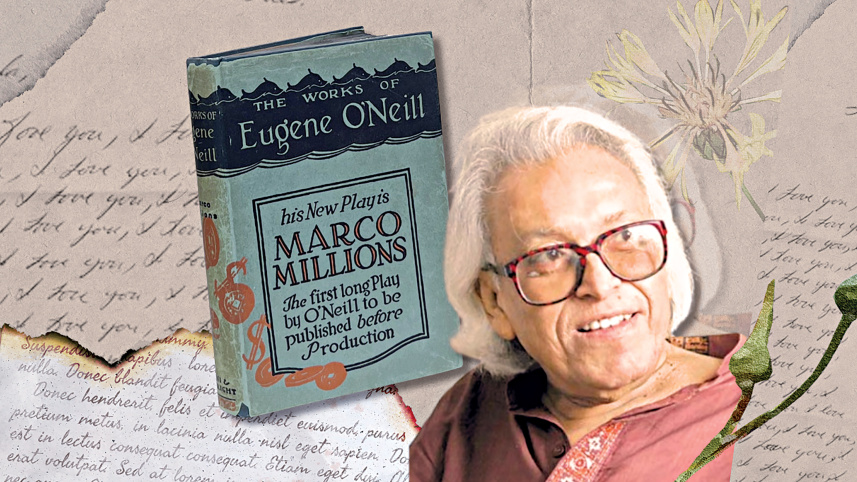
Poet Shamsur Rahman, translated three plays: Eugene O’Neill’s “Marco Millions” (1967); one of Tennessee Williams’s plays titled “Hridoyer Ritu” (1971) in Bangla, but the source language title is unknown as there is no print available; and William Shakespeare’s “Hamlet” (1995). Since “Hamlet” is an over-discussed play, both original and translated, I would prefer to concentrate on his translation of “Marco Millions”.
Written in 1927, O’Neill’s play “Marco Millions” critiques the materialism that was rapidly taking hold of American society, particularly in the years leading up to the full blossoming of the American Dream in the 1930s. Through a sophisticated blend of realism and expressionism, O’Neill exposes the moral and spiritual decay of the west, offering a sharp critique of its values. Rahman’s translation, undertaken during the politically charged atmosphere of 1960s East Pakistan, took on a deeper significance. In the wake of colonial struggles and the rise of national consciousness, Rahman’s work bridged the gap between global critiques of materialism and the local struggles for identity and justice, making his translation not just a literary act, but a sociopolitical commentary on the challenges of the time.
The rise of American theatre occurred from the mid-20th century through playwrights like Eugene O’Neill, Arthur Miller, Tennessee Williams, and later Edward Albee. As mentioned earlier, Shamsur Rahman translated two plays of the age. The year 1967 is particularly significant in terms of the sociopolitical context of this region. I recall, around that time, specifically in the mid-1960s, Fateh Lohani translated Arthur Miller’s “Death of a Salesman” (written in 1948) into a play titled “Ekṭi Shamanno Mrittu”, which portrayed the futility, illusion, falsehood, trickery, and eventual despair of the American Dream, as well as the tragic experience of real life.
I believe the writers and intellectuals of East Pakistan in the 1960s paid attention to American literature for five reasons: first, during that period, American artists and intellectuals were among the most rebellious against the US government, and this resonated with the writers and intellectuals of East Pakistan. For example, Robert Frost’s poetry was often considered poetry of the people, expressing the emotions of ordinary people, such as in “The Road Not Taken” or “Stopping by Woods on a Snowy Evening”, which, as I recall, was translated by poet Shamsur Rahman in his collection Selected Poems of Robert Frost (1968). Second, the portrayal of materialistic mindset, crude rusticity, and the futility, falsehoods, trickery, and despair in the plays aligned with the socio-economic and political life of East Pakistan. Third, the idealisation of American society and its government’s sense of inclusiveness, which is still absent from Bangladesh’s political practice. The fourth reason is using the statements of American intellectuals, writers, and thinkers to guide us in finding a logical stance against our country’s politics. Finally, the longing for estrangement from the longstanding colonial English literary establishment. In this regard translation of Shamsur Rahman’s Selected Poems of Robert Frost and Eugene O’Neill’s “Marco Millions”, as well as Fateh Lohani’s translation of Arthur Miller’s “Death of a Salesman” (A Simple Death), Eugene O’Neill’s “Lazarus Laughed” (Eternal Laughter), “Morning Becomes Electra” (Drowned in Mourning), and Ernest Hemingway’s “The Old Man and the Sea” (The Sea’s Embrace) can be cited. While I have not been able to find an exact timeline for these translations—I assume they were all translated in the 1960s—I have also not discovered whether these plays were ever staged in East Pakistan. However, Fateh Lohani’s translated manuscript of “Death of a Salesman” is currently being staged in Bangladesh.
Another underlying reason for the fascination towards American literature, especially drama, is that in East Pakistan, intellectuals harbored a leftist mindset deep within their thoughts, and they sought fulfillment in the candidness of American writers, as well as in the writings of Russian and Latin American poets and writers—such as Russian authors Mayakovsky, Sholokhov, Yevtushenko, or Latin American writers-poets like Pablo Neruda, Gabriel García Márquez, and Carlos Fuentes. I would like to identify the intellectual group of that time as the “Beauty Boarding” group, with the reasoning that these individuals spent a considerable amount of time in Beauty Boarding, much like the Bloomsbury Group in Britain, founded in the early 20th century by Virginia Woolf, John Maynard Keynes, E.M. Forster, Vanessa Bell, and Stephen Strachey.
I have already mentioned that the primary issue in the translation of “Marco Millions” lies in its title, which I consider a ‘printing error,’ for the very name of the play has been printed “Marcomillions” both in English and Bangla, instead of “Marco Millions” in the translated version of Rahman. This could likely be a mistake by the publisher, as the book was published in the port city of Chattogram by Shahina Banu in the Bengali year 1374 (no Gregorian year mentioned), and the misprint could have resulted from the translator’s lax of supervision because, I assume, Shamsur Rahman had little or no time to frequent between Dhaka and Chittagong to edit or proofread the book, and we all know he lived in Dhaka city throughout his entire life.
It is unclear why Shamsur Rahman decided to translate “Marco Millions” as his Bangla translated version does not have any introduction that is essential for such a translation work. However, it can be assumed that beyond the complexity of the storyline, what attracted him more was the message within the play—though I am not sure whether he was urged by the US Embassy to translate this play and Frost’s poetry. I vaguely remember that the translated anthology of Frost’s poems that I had once in my possession and later got lost for political and social unrest in the country, contained some sort of acknowledgement of such a request, but since I have no documentary proof at this moment, I cannot be certain.
The main message of the play was a critique of America’s weary disillusionment, and at the same time, it symbolically satirised the so-called American Dream—the elusive American Dream—by mocking the quest for the discovery of America by the Venetian merchant and eager traveler Marco Polo, which is analogous to the current immigration aspirations of the impoverished people of the third world. The play is divided into two acts and is quite long—168 printed pages in the original English and 208 pages in the Bangla translation, with a prologue and conclusion, making it a total of three acts and eleven scenes. The number of characters is also relatively large—35 in total, along with several secondary characters. Thus, in practical terms, staging this play under amateur conditions would be nearly impossible.
Naturally, the focus of my discussion will be on the quality of the translation. The primary and major issue in translation, particularly in drama translation, is the placement of equivalent words, phrases, or idioms in the target language that match the source language, which has been tagged as “Problems of equivalence”. One of the major problems in translating drama is when the use of correct equivalents and sentence structure leads to awkwardness, which disrupts both the effortlessness of speaking the dialogue and establishing connection with the audience.
It is undeniable that in its own need, the dialogue of a drama does tend to reach a refined and ornamental level. This issue particularly complicates the translator’s task. Maintaining the elevated and ornamental nature of the source language while making the dialogue speakable and communicable in the target language, is not an easy task. Above examples, though not adequate, prove Shamsur Rahman has done it mostly well in “Marco Millions”.
Retaining the signs or semiotics of social behavior in dialogue, which linguists identify as phatic expressions, is particularly difficult for translators. Expressions such as “hello”, “hi”, “goodbye”, “take care”, “nice weather we're having”, “it's a busy day”, “uh-huh”, “you see”, “I mean”, “right”, “bless you”, “my bad”, “miss you”, and innumerable such others, which involve a combination of language and culture, are extremely challenging to translate.
“Marco Millions” starts with such a phatic expression, “Pooh!” which Rahman had no difficulty translating, as it has immediate synonyms like “phũ” into Bangla. Noticeably enough, Rahman had no problem decoding these social human expressions, which have no specific linguistic meaning yet are used universally, to render into target language. The main reason for this is perhaps the play itself has a people-oriented message. “Marco Millions” translation is at its best when Poet Shamsur Rahman rendered several poems the play has. As I said before, one who has a poetic state of mind—be one a poet or not—should translate poetry.
But it is obvious that these translations of verses do not exhibit Poet Shamsur Rahman’s real poetic flair compared with what he wrote at his later age, for he was only 38 years-old when he translated “Marco Millions”.
The other weaknesses the translation contains are his use of too many too-formal Bangla vocabularies. He could do away with them by using common vernacular synonyms. Besides with so many typos and uncaring formatting the publication appears to be one of Rahman’s most slighted literary works.
On the whole, from a historical perspective, Shamsur Rahman’s translation of Eugene O’Neill’s “Marco Millions” is a significant contribution to the literary and intellectual landscape of East Pakistan in the 1960s. The play’s critique of the American Dream, along with the challenges Rahman faced in translating it, provides valuable insights into the complexities of drama translation.
Abdus Selim is an eminent academic and translator. He can be reached at selim70plus@gmail.com.
 For all latest news, follow The Daily Star's Google News channel.
Comments