


Navigability crisis
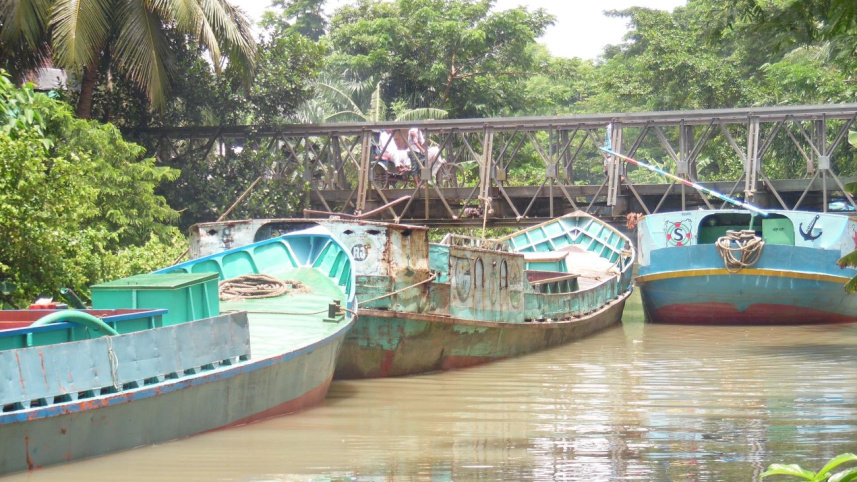
A riparian district once famed for its on-water and riverside markets, where rivers provided the principle means of cargo transport, Jhalakathi's waterborne traditions look set to fade away, due to the construction of unplanned bridges, culverts and box culverts over rivers and canals that have significantly reduced navigability.
"Until five years ago I transported agricultural produce to several markets by boat," says Babul, a farmer from Sangor in Rajapur upazila. "It's no longer possible since the canal routes were destroyed by the construction of culverts and bridges that don't have enough height above water level to allow boats to pass underneath."

"I always sent sand by trawler," says Nurul Alam, a trader from Nalchity upazila, "but now I have to use trucks because the trawler can't pass under most of the bridges and culverts."
Hundreds of farmers and dozens of business people face the same issue. Universally they blame the construction of unplanned bridges and low clearance height culverts for undermining the safest and cheapest transport option for goods in Jhalakathi. Business people report transport costs have tripled due to the need to rely on roads.
The local government engineering department, roads and highways department and district administration all require that sufficient height clearance is maintained when constructing any bridge or culvert over a canal or river, says A.Z.M. Shahnawaz, the Bangladesh Inland Water Transport Authority executive engineer in Barisal zone. "None can destroy the navigability of canals and rivers by constructing any structure above it," he says.
Executive engineer of the local government engineering department, Selim Sarkar, agrees. "No bridge or culvert should destroy navigability; but the construction of many of these bridges and culverts was started decades ago, without considering the consequences for water transport."
"We protect navigability in any bridge or culvert project," he continues, "taking a certificate from the inland water transport authority before any new construction."
A.K.M. Hamidur Rahman, the executive engineer of roads and highways in Jhalakathi agrees says sufficient clearance for continued navigability is a first priority with their department. "We maintain a height of six metres above water level as a rule," he says.
Yet despite the assurances weekly and regular markets situated on canals and riverbanks in many places are suffering. Where once easy navigability in delivering goods was assumed, a part of Jhalakathi's character, nowadays it looks set to become a local feature found only in history books.
 For all latest news, follow The Daily Star's Google News channel.
Comments