


Investment in nutrition to yield 16-fold return
Leading nutritionists and food experts yesterday suggested investing more in nutrition, saying it could accelerate productivity and break the cycle of poverty in Bangladesh.
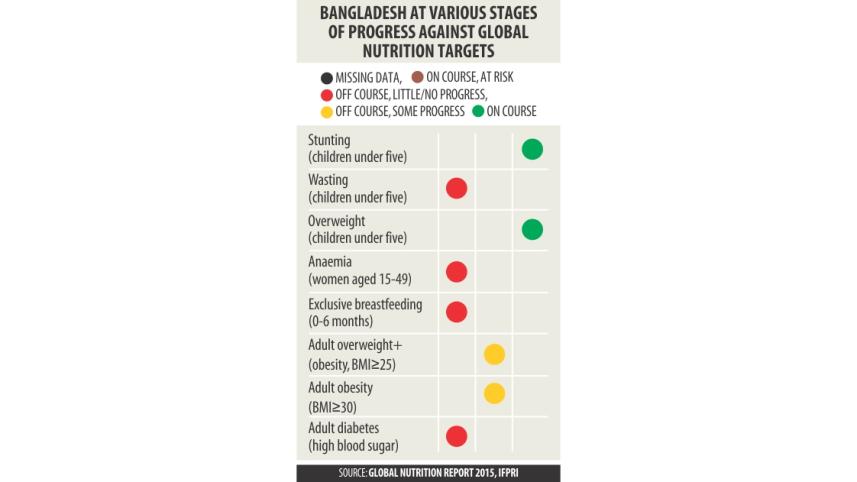
They said that while Bangladesh was on the course of meeting the global targets of reducing stunting and overweight in children under five, it lagged behind in terms of wasting, anaemia in women, exclusive breast feeding, adult overweight, obesity, and diabetes.

"One dollar investment in nutrition today can bring 16 dollars of return in future," said Dr Lawrence Haddad, senior research fellow at the International Food Policy Research Institute (IFPRI), which launched the Global Nutrition Report 2015 at Hotel Lake Shore in the capital yesterday.
When children suffer from malnutrition, they do not grow properly, he said in his keynote presentation.
"On the other hand, children with proper nutrition get better grades in school and have better economic gains in later life."
Speaker of National Parliament Dr Shirin Sharmin Chaudhury said Bangladesh has achieved tremendous success in food security, but nutrition still remained a big challenge.
"Malnutrition is not only a problem of Bangladesh, but of the whole world. So, all need to work together. We need to invest more to improve the nutrition status," she said.
Dr Akhter Ahmed, IFPRI representative in Bangladesh, said malnutrition starts from the womb when the mother is undernourished.
"If the childhood malnutrition continues, it will increase risks of child mortality, low cognitive development, and thus create a cycle of malnutrition," he said.
According to experts, while poverty, lack of nutritious food, and lack of awareness are major factors behind malnutrition, environment and food safety became issues of concern in Bangladesh.
They said an integrated approach was required to fight malnutrition so that at all stages of food production, distribution, marketing, and consumption, authorities have coordination among various ministries -- agriculture, food, health, and education.
Dr Tahmeed Ahmed, director at the Centre for Nutrition and Food Security at the International Centre for Diarrhoeal Disease Research, Bangladesh (icddr,b), said anaemia among the women of their reproductive age was alarming, and it was linked to low birth weight of children.
"Thirty to thirty-five percent of children's birth weight is low in Bangladesh," he said. "Unless we take care of women's nutrition, child nutrition would not be good."
Dr Hossain Zillur Rahman, executive director at the Power and Participation Research Centre, said though the stunting rate of under-five children declined, number-wise it was still very high.
Extreme poverty, much of what occurs in urban slums, remains the greatest challenge to fight malnutrition, he said, adding that since Bangladesh was aspiring to become a middle income country, this level of malnutrition was not acceptable.
"The country will not make progress if workers' productivity does not increase [due to malnutrition]," he said.
Prof Nazma Shaheen, director at the Institute of Nutrition and Food Science of Dhaka University, cautioned against indiscriminate pesticide use in food production, saying pesticide residues could affect human health gravely.
Abdul Mannan, state minister for finance and planning; Roxana Quader, additional secretary at the health ministry; Dr Lalita Bhattacharjee, senior nutritionist at the Food and Agriculture Organization; Dr A Atiq Rahman, executive director of the Bangladesh Centre for Advanced Studies, also spoke.
 For all latest news, follow The Daily Star's Google News channel.
Comments