


Banned 2-stroke auto-rickshaws still scourging Ctg city
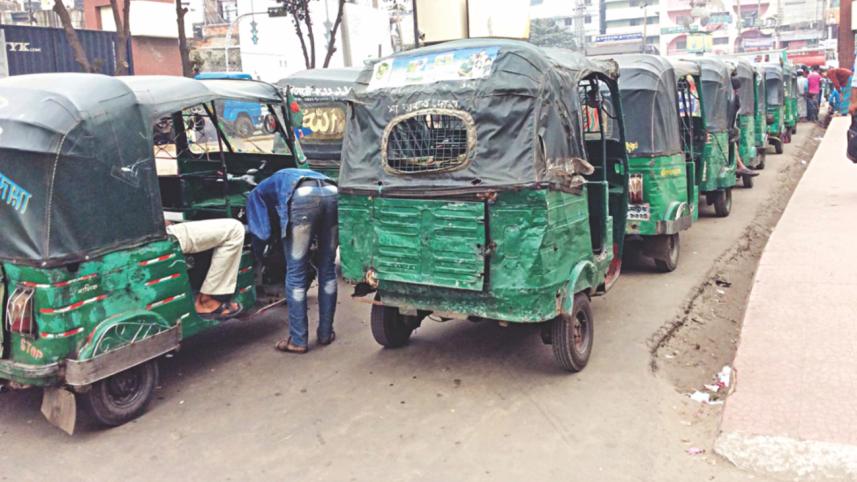
The two-stroke three-wheelers, known as baby-taxis, which were banned in Chittagong city in 2004 for higher emissions, are still plying in the city allegedly in exchange for bribe.
Besides being a significant contributor to pollution, the petrol-run vehicles persistently lead to traffic congestion, particularly in Chittagong and Karnaphuli EPZ areas, because they use two stands occupying almost half of the gate areas outside the EPZs, complained locals.

"Fearing traffic jams near the EPZ areas, especially after 7:00am and 4:00pm, we have to start off at least one hour earlier daily," said Nusrat Jahan Lisa, a BBA student, who travels between West Patenga and Wasa intersection to attend classes.
Bangladesh Road Transport Authority (BRTA) sources said these unfit three-wheelers caused pollution much higher than the four-stroke ones did. They, however, could not give a comparison between the levels of pollution caused by the two vehicles.
The baby-taxis have no necessary papers as well.
When this correspondent approached Md Rubel, a "lineman" at the illegal stand outside CEPZ, as a baby-taxi owner, he said, "It does not matter whether you have documents or not. Nor does it matter whether the engines of your vehicles are four- or two-stroke, we will keep those running if you sign up for the stands and pay fees."
Rubel coordinates the operation of the three-wheelers and collects money on behalf of a committee, which controls the stand. He also suggested a meeting with Milon, a leader of the committee.
Reached over the phone, Milon admitted that none of the vehicles has necessary documents.
At present, around 130 baby-taxis carry passengers, mostly garment workers, in CEPZ, and 30 in KEPZ, despite a constant presence of traffic police personnel. At first glance, the vehicles would look like four-stroke CNG-run auto-rickshaws because they are painted in green.
Asked about why law enforcers overlook the illegal operation, Milon and Md Selim, a member of the KEPZ stand committee, said bribes made it easy for them.
The committees take around Tk 10,000 from each baby-taxi owner for attaching it to the respective stand, while Tk 30 from each driver as a daily fee, and they distribute the money among themselves and also pay the "linemen", said the drivers.
In addition, a monthly fee of Tk 400 is collected from each owner, which is later distributed among police officials and influential people, the drivers added, but did not give any name.
The committee leaders said someone on behalf of the constables and sergeants collected the money from them every month. They also declined to name anyone.
However, Traffic Inspector of the EPZ areas Shahidul Islam denied that police were taking bribes. He also said, "We don't control the vehicles inside the EPZs. The EPZ authorities should take action."
CEPZ General Manager Ahsan Habib dismissed the suggestion, saying it was not the duty of the EPZ authorities to check or monitor vehicles; traffic police must do it.
When asked, Deputy Commissioner Sujayet Islam of Chittagong Metropolitan Police (Port Division) said he was neither aware of these illegal vehicles nor of police taking bribes. But he admitted that police could crack down on the illegal vehicles inside and outside EPZ areas.
"I have instructed the traffic inspector of the area to take action against any illegal vehicles in Bandar area and will also look into the whole matter," he added.
Meanwhile, Sirajul Islam, deputy director of BRTA, Chittagong division, said nearly two months ago, a BRTA mobile court fined some of the two-stroke vehicles.
He said both BRTA and police could confiscate the vehicles but his organisation could not lead mobile courts often due to the shortage of manpower.
Two-stroke three-wheelers have been banned in Dhaka since 2003.
 For all latest news, follow The Daily Star's Google News channel.
Comments