


APUB holds exchange of views on the role of private universities in implementing the National Budget 2026–2027
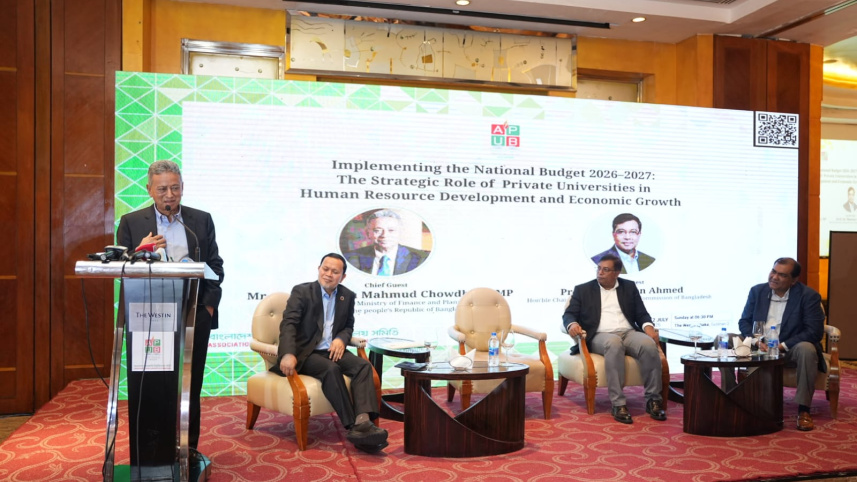
The Association of Private Universities of Bangladesh (APUB), the representative body of the founders of private universities, has urged the government to withdraw the remaining income tax imposed on private universities, provide greater public support for research, facilitate bank financing for the construction of permanent campuses, and approve PhD programmes to further strengthen the sector's contribution to human resource development, research, innovation, and employment generation. Minister for Finance and Planning, Amir Khosru Mahmud Chowdhury, MP, assured the participants that these proposals would receive due consideration through constructive discussions with the government.
The views were expressed at an exchange meeting organised by APUB on July 12 at a hotel in Gulshan, Dhaka, as part of a post-budget review of the National Budget 2026–2027. The programme was graced by Amir Khosru Mahmud Chowdhury as the chief guest. Prof. Dr Mamun Ahmed, Chairman of the University Grants Commission (UGC) of Bangladesh, attended as the special guest.

In his keynote address, the minister said, "Given the prevailing economic realities, reducing the income tax on private universities from 10 percent to 5 percent was not an easy decision. Nevertheless, we have made this policy decision in the national budget. Now it is up to you to utilise this opportunity effectively."
He also encouraged private universities to play a greater role in research and innovation.
Earlier, APUB Chairman Dr Md Sabur Khan presented a keynote paper. He expressed his sincere gratitude to the government and the finance minister for reducing the income tax on private universities from 10 percent to 5 percent. He expressed optimism that the remaining five percent tax would also be withdrawn in the future. He further noted that private universities invest substantial resources in purchasing land and constructing permanent campuses but are not eligible for bank financing, and therefore requested policy support in this regard.
Prof. Dr Mamun Ahmed said, "This year's national budget has increased the allocation for education. We do not differentiate between public and private universities. Improving the quality of our universities will significantly reduce the number of students seeking higher education abroad."
The speakers observed that Bangladesh's future economic growth will increasingly depend on a skilled workforce, research, innovation, and an artificial intelligence-driven knowledge economy. They emphasised that private universities are fully prepared to work as strategic partners of the government in achieving these national development goals.
During the programme, APUB also presented a policy position paper outlining several strategic recommendations, including promoting skills-based education, recognising graduate employability as a key indicator of university performance, strengthening industry-academia collaboration, expanding education in artificial intelligence and data science, enhancing internship and career development centers, and approving PhD programmes in qualified private universities. The paper also highlighted the importance of attracting international students to position Bangladesh as a regional hub for higher education and further strengthening partnerships among the government, industry, and higher education institutions.
The speakers further noted that for more than three decades, private universities have been investing their own resources in infrastructure development and human capital, making them an indispensable partner in Bangladesh's higher education sector. They also emphasised the sector's significant contribution to producing skilled graduates, generating employment, and supporting national economic development through both direct and indirect means.
The programme began with a welcome address by Ishtiaque Abedin, Secretary General of APUB. The vote of thanks was delivered by Benjir Ahmed, Vice-Chairman of APUB. The event was attended by APUB leaders, Chairmen of the Boards of Trustees, Vice-Chancellors, and distinguished academicians from private universities across the country.
 For all latest news, follow The Daily Star's Google News channel.


Comments