


IDP's Razib Mahbubul on making smarter study-abroad decisions
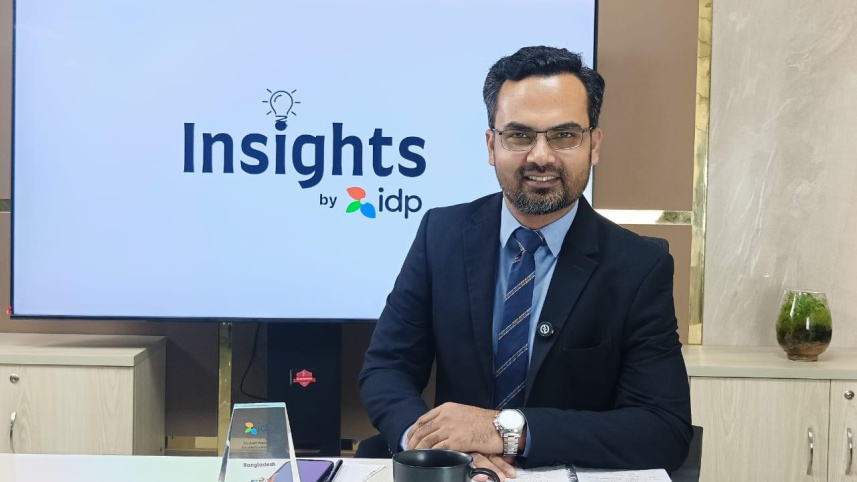
As more students explore opportunities to pursue higher education overseas, choosing the right destination and navigating the application process can feel both exciting and overwhelming. In this interview, Campus speaks with Razib Mahbubul, Country Director of IDP Education Bangladesh, about the evolving study abroad landscape, the support IDP provides to aspiring international students, and practical advice for those preparing to take the next step in their academic journey.
Campus (C): What are some of the key factors students should look into when choosing a study abroad destination?

Razib Mahbubul (R): One of the most common questions we face whenever a student comes to our office or sits down for a one-to-one discussion is, "Which country should I choose?"
My advice is this: don't start with the country. Our major focus should be on the student because every student is different. Their academic and financial backgrounds, career ambitions, and personalities are completely different. The focus should be on the student's long-term plan.
For example, if a student is interested in technology or business, they should focus on which university is strong in that area and what post-study opportunities, global exposure, or internships are available.
Secondly, affordability and cultural adaptability come into the picture as well.
From the IDP side, there are five key points that should be considered carefully: the quality of the course, the reputation and support system of the universities, the total cost of study and living, visa and post-study opportunities, safety, and lifestyle.
Safety and lifestyle are bigger concerns, and parents and students should consider these five things rather than just saying, "I want to go to Australia" or "I want to go to the UK."
(C): Many students overlook excellent study abroad destinations like Ireland, Malaysia, and New Zealand. Besides the US and Australia, what unique benefits and opportunities do these countries offer international students?
(R): In the last three to four years, the international educational landscape has changed significantly. The way we saw it five or 10 years ago has completely changed due to policy changes, recruitment changes, and inflation, which affects the cost of study and affordability.
Before comparing destinations, let me mention the “Big Four”. Australia is a very strong destination for its high quality, safety, and student support, but it has recently changed its policies significantly, seeking genuine students with stronger financial proof and higher English requirements. They want to ensure students are there only to study.
Similarly, the UK has seen government and policy changes, but it still houses some of the most prestigious institutions in the world for those who are academically focused.
Aside from those, Ireland is an English-speaking European country with some of the finest technological and research-based universities, particularly in healthcare, finance, and pharmaceuticals. Dublin acts as an innovation hub for the world.
Malaysia is a practical choice for Bangladeshi students because it is a closer destination, multicultural, and affordable. It has quite a few top 100 universities and branch campuses of UK and Australian institutions.
New Zealand is an excellent destination for safety, student well-being, and breathtaking natural beauty. New Zealand currently has no age restrictions, allowing people to move with their families for a cosy life and career prospects.
(C): As someone who frequently guides students studying abroad, has the process become significantly harder over the past decade or a few years?
(R): I would say not harder, but more complex. Ten years ago, it was still competitive, but now, with policy changes, institutions are looking closely at genuine student status, financial capacity, academic progression, and English proficiency.
Destination countries are also looking at the future impact on their economy and society. This is the time for students to be better prepared. They should not rely on incomplete information or social media rumours, nor should they take advice from someone who went abroad 15 years ago, because the rules have completely changed. It is time to be more serious and organised.
(C): How does IDP simplify the challenges of applying to universities abroad?
(R): At IDP, we help in a structured manner, looking at academic profiles, course selection, financial planning, and pre-visa preparations. Our global survey shows that 75 percent of students are now considering more than one destination, which is a positive sign of awareness.
 For all latest news, follow The Daily Star's Google News channel.
 When a student asks, “Where should I apply?”, we break that down into several questions: Which university and course are suitable for my background and career aspirations? What is the total cost, and can the family afford it? What are the documentation requirements and the visa approval rates? What happens after the completion of the study?
Our counsellors navigate students through all these steps.
IDP is present in more than 35 countries, has partnerships with over 1,000 universities, and is a co-owner of the IELTS exam. This global network allows us to understand and communicate changes quickly. Our brand promise is “transforming life through international education”, and we help students make their own decisions rather than making them for them.
Most importantly, all these services are free of cost.
(C): Students often feel nervous when applying to foreign institutions. What would your advice be to them to deal with the nervousness?
(R): When students take their first-ever flight to attend a university, it is completely normal to feel nervous. Even frequent travellers can feel nervous at immigration, and here a student is making a life-changing decision that will impact generations to come. However, there is nothing to be ashamed of; the goal is to convert that nervousness into a strength.
(C): Why do students need expert guidance when they first start planning to study abroad?
(R): At IDP, we strive to move students from a state of nervousness to one of preparedness. For example, if a student is nervous about their application, the first step is to organise their documents. For those worried about interviews or visa requirements for destinations like the UK or Canada, our counsellors conduct mock interviews to build confidence.
Additionally, IDP arranges pre-departure sessions to give students a glimpse of life in their destination country. With a network spanning 35 countries and seven major destinations, IDP maintains offices where students can seek support even after they arrive, including assistance with mental health or feelings of loneliness.
We believe that once someone is an IDP student, they are an IDP student forever.
(C): Do you have anything to say to students who are aspiring to go abroad for their higher studies?
(R): Everyone has a dream, and it is important to dream big. But the real question is whether you are prepared to work to achieve that dream.
Studying abroad is a life-changing decision for the student, their family, and future generations. Standing here in 2026, global exposure is no longer optional; students must be ready to compete on a global stage with peers from the USA, Spain, and beyond.
International education provides global exposure, cultural experience, and maturity, while helping to build financial stability and emotional intelligence (EQ).
My specific advice for students is simple. Avoid popularity traps: do not choose a country or course just because it is trending or because a friend is doing it. Focus on your own strengths and ambitions. Verify information; do not rely solely on social media rumours. Start early, research thoroughly, improve your English proficiency, and plan your finances carefully. Involve your family; your family should be the backbone of your journey, providing essential emotional and financial support.
Bangladeshi students are incredibly talented. For example, I recently met a student at the University of Sydney who is now the president of the student union there, representing Bangladesh on a global stage.
The world needs this talent, and IDP is proud to support students in these journeys.
Comments