


Classroom crunch disrupts academic activities at KU
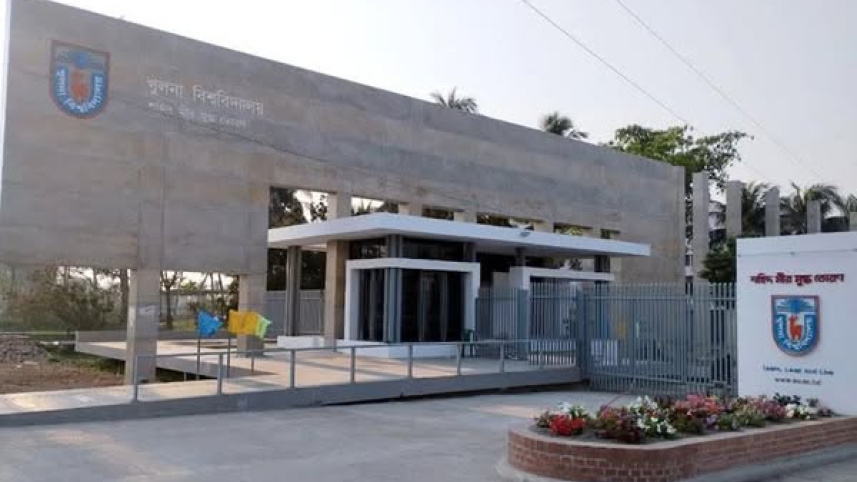
Academic activities at Khulna University’s Human Resource Management (HRM) Discipline began in 2016. Yet, a decade later, around 250 students across six batches still have only one classroom of their own, frequently disrupting regular classes.
And HRM is not alone. Most of the university’s 29 disciplines are facing a classroom shortage, with only 98 classrooms for 8,231 students, according to the university’s Student Handbook for the 2025-26 academic session.

Teachers and students said the long-standing shortage was disappointing, particularly at one of the country’s leading public universities, and raised questions about the adequacy of its academic infrastructure.
Agrotechnology, Environmental Science; Soil, Water and Environment, History and Civilization, Printmaking, Education and Sculpture have only two classrooms each. Agrotechnology and Environmental Science were established in 1996.
Tanvir Bin Mohit, a fourth-year student of the Agrotechnology Discipline, said having only two classrooms for students of five bachelor’s batches and six master’s programmes is disappointing. “Students often have to wait for another batch’s class to finish. Sometimes, our research lab is also used for theory classes, which affects our research,” he said.
The shortage is also affecting students of HRM, who have to borrow classrooms from another discipline.
Rahat Kabir, an HRM student, said they attend classes by borrowing two classrooms from the Business Administration Discipline because they do not have enough classrooms of their own. The discipline also has no laboratory, he said.
“Even though HRIS is included in the course syllabus, we cannot learn it properly because we do not have a lab. If we cannot learn these things even after studying at one of the country’s renowned universities, then who is actually responsible for this?” he said.
Regarding the classroom shortage in HRM, its head, Dr Mehedi Hasan said the situation would improve after the 10-storey Academic Building-4 is completed.
The Statistics Discipline is expected to move to the new building, after which the administration plans to provide HRM with the classrooms currently used by Statistics, he said.
“Every student comes to the university with dreams and expectations of learning. Their learning should not be disrupted due to a lack of administration or resources. Whatever is necessary to ensure learning, the administration should ensure that,” he said.
The university administration, however, said disciplines had not been allocated a fixed number of classrooms. Instead, they had been allocated space based on square footage, which could be reorganised according to requirements.
University Registrar Prof Dr S M Mahbubur Rahman said some disciplines have relatively large classrooms that could be divided to create more rooms.
“The classrooms of Agrotechnology or Environmental Science are quite large. If they want, they can partition each classroom to increase the number of classrooms,” he said.
He said the Environmental Science Discipline would be shifted to Academic Building-4 after its completion. There are also plans to provide classrooms to HRM, he added.
Prof Dr Md Yasin Ali of the Agrotechnology Discipline said facilities should be provided based on the nature and academic requirements of each discipline.
“Agriculture holds particular importance in the southwestern region. The Agrotechnology Discipline was opened to deal with agriculture-based problems. The university authorities should provide each discipline with facilities according to its nature, so that they have the minimum facilities needed to produce quality students,” he said.
Now, questions remain over whether the available space is adequate for the number of students, batches and academic programmes.
 For all latest news, follow The Daily Star's Google News channel.
Comments