


In conversation with three O and A level top performers

For most students, the significance of their grades – particularly of their board examinations – is not lost on them. In fact, they’re reminded, time and again, about its gravity, sometimes with a frequency that can border on annoyingly obsessive. Though a lot may be said about our collective fixation on the need to excel academically, there is little doubt that there is something awe-inspiring about a student who doesn’t just adhere to that aspiration but embodies it. Their achievement serves as a reminder of what dedication, diligence, and sincerity can get you. Then, there are some who go the extra mile and set a benchmark.
Samara Sharleez Emdad, Md Faiyaz Siddiquee, and Sazin Mustafa Muntakim fall squarely within that category. All three of them are students of Glenrich International School. Faiyaz and Siddique are both students of the twelfth grade and have attained the “World Top Scorer” title, with each having scored a perfect grade in AS Mathematics. They have also received A grades across all their AS subjects.

Similarly, Samara achieved a perfect score in IGCSE Mathematics along with A* grades in all the other subjects she sat for.
When asked what was going through their heads when they received their results, Samara could barely believe it. “It felt as though things had finally settled into place and that all the effort I put in over the last two years paid off,” she explains.
Faiyaz recalls feeling a profound sense of gratitude. “What makes moments like this special is not only the results on paper but also the people around me – the teachers who encouraged my questions, my family who supported my interest, and friends who shared my mutual enthusiasm for problem solving,” he says. “It felt more like a milestone in a journey that is still unfolding.”
Sazin, on the other hand, was quite nervous. “The AS level examination is known for heartbreaks, so I was quite afraid of how my results would turn out. However, when I first saw my results, the nervousness morphed into happiness as I performed better than I thought I would,” he recalls.
Though the students were initially gripped by a great deal of anxiety, it ultimately faded away, giving way to jubilation and gratitude. For Sazin, the results are a reflection of his hard work. And the reward, he says, is making the people around him proud.
Likewise, Samara feels more determined than ever. The results instilled in her the belief to approach challenges with greater self-assurance, as she regards it as a great milestone. She also expresses gratitude to her family, friends, and teachers for providing support to her.
Faiaz views his results as a by-product of the intellectual autonomy that he was granted. Having relied on explorative learning rather than traditional study methods, he seeks to understand the underlying mechanisms of the laws of our universe. Such a sentiment inspired him, along with Samara and Sazin, to pursue their own individual interests and extracurricular activities.
The distinction between academic and extracurricular activities is blurry for Faiaz. Ranging from research and mentoring to composing original music pieces and participating in olympiads, he believes that his many endeavours have shaped how he thinks. “Something that has helped me in my academic journey is authoring a book; it's called A Quest for Clarity. It taught me that explaining genuinely difficult ideas can also help me understand concepts on my own,” he says.
Sazin is of the belief that extracurricular pursuits are an important way for him to avoid academic burnout, as they provide an outlet to unwind and ease his mind. He partakes in playing football, video games, and cooking, as it provides a renewed sense of focus and motivation. Having also participated in olympiads and research, he echoes Faiaz’s sentiments, stating that it proved to be effective in helping him academically.
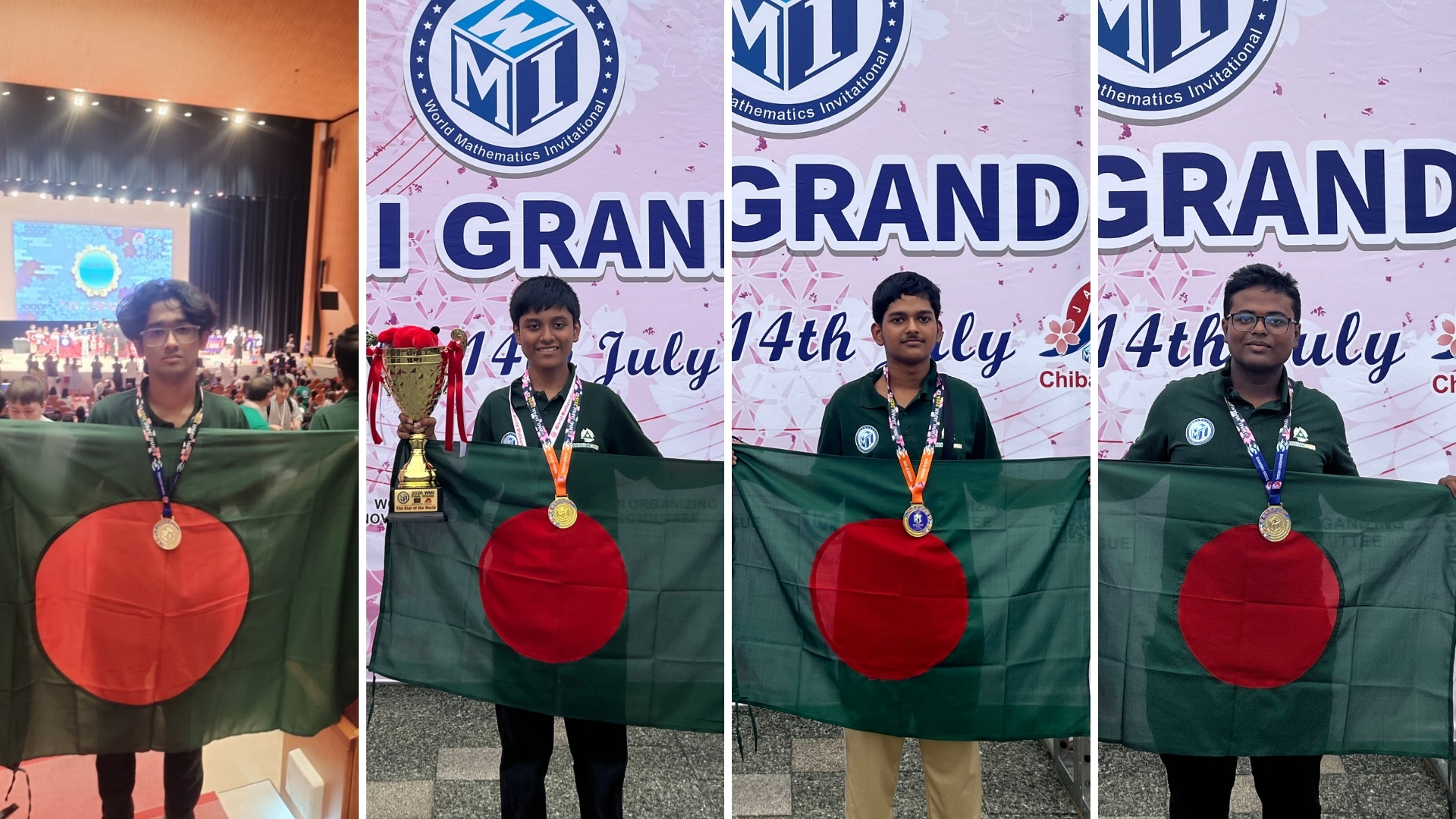
As for Samara, she says that karate is the most important asset to her. “It's what helps me keep a clear mind and prepare for the future,” she explains. Much like her seniors, she also attributed participating in olympiads as well as group competitions to helping her practice curiosity.
Exploring one’s curiosity allows students to develop a better sense of what works for them. This rings true for all three students who undertook study methods tailored to their needs.
Samara says, “My main study method was to bookmark tough or uncommon past paper questions instead of doing complete past papers. I accepted and learned from the mistakes I made in tests. The most important thing was that I discussed difficult problems, especially in physics and mathematics, with my friends, which I believed helped me a lot.”
To deal with tumultuous periods, she made an imaginary list of people she felt grateful for and why she wanted to work hard for them.
Faiaz states, “My core approach has always been reasoning with the principles first; really understanding the rigorous why behind the theorems and formulas rather than settling for the procedural ‘hows’.”
When studying A level Further Mathematics, he came across an exponential formula for hyperbolic trigonometric functions. Unsatisfied with just the formula, Faiaz then attempted to derive the formula himself.
On the other hand, Sazin tried to maintain a balanced and organised study routine. “I can't study well if I put excessive pressure on myself. So, I try my best not to do so.” His daily routine involved solving mock exams, identifying weaknesses, reviewing mistakes, revising topics, and then preparing himself for the next day. All of this wasn’t done in one continuous stretch but rather in focused increments throughout the day.
As recipients of the top world scores in their mathematics exams, they were asked about the fear commonly associated with the subject. All three of them assert that maths, even when it's complex, can become enjoyable if students are allowed to understand it more intuitively.
 For all latest news, follow The Daily Star's Google News channel.
 “Once students believe that the same logic they use in video games, cooking, or even in formulating a social media post can be applied to a math problem, it can prove to be an important skill,” asserts Samara.
Sazin stresses, “Students should mainly focus, especially at AS level, on building a strong conceptual foundation. When they experience the satisfaction of solving difficult problems, they’re more likely to appreciate the subject.”
“If you let students see the connections between pure mathematics and its application in physics and computation, rather than presenting it as a set of procedures, that really helps. In the mathematics and physics club that I founded, I tried to build a culture of open discussion where ‘whys’ were welcomed,” explains Faiaz.
Having done exceptionally well in their academics, the results are sure to spur them on to pursue their goals with a great degree of fervour. After all, the results don’t just signify excellence; they are also representative of their abilities.
Faiaz says, “I want to study mathematics and physics deeply, and explore the connections between them. My long-term interest can maybe extend into astrophysics and scientific computing.” He also wants to continue writing, researching, and expanding his organisation.
“These results have opened up a wider range of opportunities for my future. They have made it possible for me to apply to strong universities and consider a variety of academic pathways,” asserts Sazin. He also states that it has carved out a pathway for him at City University of Hong Kong and also imparted more confidence in him to aim higher.
Samara emphasises that the results have taught her greater discipline as well as reminded her that it is okay to fail sometimes. “My results fueled my ambition to make a positive impact in the world. And since I've just finished my O levels, a lot of people – including myself – have had some trouble with consolidating their A level subject choices, but now I believe that my subject choices of math, chemistry, physics, and further mathematics are pulling me towards the right direction in the future.”
Their wisdom, of course, isn’t just limited to their own individual feats. Each one of them extended advice to their younger counterparts as well.
Samara advises her juniors not to compare themselves to others. Instead, she tells them to compare their present progress with the past.
Faiaz underpins the importance of enjoying life. He also urges them to view maths not merely as a subject but rather as a universe to explore.
Lastly, Sazin says that while exams may appear overwhelming, they can be managed with consistent effort and the right approach. He reminds them to remain positive and that their results are a reflection of their preparation, not their potential.
Comments