


How global experiences shaped my perspective as a development professional
Last summer, when I boarded my flight from Dhaka, I didn’t know how deeply the next four months would shape me. I had a rough plan, some scattered opportunities stitched loosely together, and a stubborn belief that if I stayed open to the unknown, the unknown would teach me more than any classroom ever could.
I was a master’s student at the Bangladesh Institute of Development Studies (BIDS) Graduate School of Economics and a development professional at Shikha Shastha Unnayan Karzakram (SHISUK), accustomed to being grounded in research, fieldwork, and youth engagement. But this time, I was stepping out with the intention of learning from the world around me, even if the route wasn’t straightforward.

My first destination was Herrsching, a lakeside town outside Munich, where I had been selected to attend the International Leadership Workshop for Rural Youth. I arrived expecting a typical leadership programme—structured, formal, and dominated by lectures. Instead, I discovered a global community I hadn’t realised I was missing. Participants came from Kenya, Nepal, the Philippines, Germany, Latin America, and many other regions, all united by a shared desire to grow as leaders. Our days were filled with teamwork, simulations, hands-on agricultural challenges, and problem-solving activities that tested our ability to collaborate. Evenings, by contrast, came alive with music, storytelling, cultural exchange, and laughter.
In one of the team tasks, as we tried to build a makeshift irrigation system using limited materials, I saw leadership emerge in its truest form – not by speaking the loudest, but by listening deeply, encouraging others, and connecting people despite their differences. That was the first lesson Europe gave me: development is never theoretical; it is lived through human interaction, patience, and empathy.
When the workshop ended, I wasn’t ready to return home. I had a long gap before my next scheduled training, so I decided to stay in Sweden with my uncle’s family in Gothenburg.
One afternoon, while browsing online in search of something productive to do, I discovered that the WINWIN Gothenburg Sustainability Award Week was taking place nearby and that a Climate Fresk workshop was open to participants. I joined out of curiosity, but the experience reshaped how I understand climate education. Through cards and collaborative design, the facilitators made climate science simple, emotional, and accessible. In Bangladesh, climate conversations often feel heavy and technical. In contrast, they felt like a shared story we were all responsible for telling there.
During a coffee break, someone mentioned that the Nordic Youth & Children Climate Conference would be held in Stockholm the following week, and I applied for the conference, booked a seat, packed my bag, and left for Stockholm the following week. There, I witnessed something remarkable: children and teenagers engaging with policymakers as equals, questioning decisions, proposing ideas, and advocating for their futures. Seeing nearly 40 young participants from Sweden, Norway, Finland, Denmark, and Iceland confidently shape policy discussions made me imagine what youth platforms in Bangladesh could become if empowered in similar ways.
Just when I thought the unexpected opportunities were slowing down, I received a message from SHISUK asking me if I could attend APIMONDIA in Copenhagen. APIMONDIA – the world’s largest beekeeping and honey congress – was directly relevant to the community honey enterprise programmes we run in Bangladesh.
I didn’t hesitate. I boarded a train and soon found myself in a vast convention hall showcasing hundreds of honey varieties, hive technologies, medicinal research, and innovations from producers around the world. I tasted more honey in one day than I ever had before. What stood out to me was how small technical improvements, like better hive boxes, improved harvesting methods, and bee-friendly plants, could meaningfully increase the incomes of rural families back home. It was a powerful example of how global learning can directly support local development.
By October, it was time for the programme that had originally triggered my entire journey: the UNEP-affiliated CIPSEM Climate Training at the Technical University of Dresden. It was prestigious and intensive, filled mostly with mid-career government officials, environmental scholars, and climate professionals. I was the youngest participant there, and for a moment, that fact intimidated me. But as discussions unfolded on climate governance, adaptation strategies, environmental diplomacy, and ecological economics, I realised I had already built the confidence I needed. My experiences from Sweden, Germany, Denmark, and the workshop in Herrsching had prepared me far better than I had imagined.
Field visits made the programme even more transformative. We travelled to climate-resilient farms, forest management zones, circular economy hubs, and renewable-energy sites. For the first time, I understood how policies translate into infrastructure and behaviour, how a decision taken in a ministry can shape an entire landscape, and how governance becomes visible when you step out of the classroom and onto the field.
After Dresden, I headed to Bonn for the Young Scholars Initiative UNCCD Negotiation Simulation. Representing Bangladesh in a simulated global negotiation was intense, emotional, and eye-opening. We debated land restoration, finance mechanisms, and political compromises. I experienced the pressure countries feel in global negotiations, the need to protect national priorities while contributing to global commitments. For the first time, I could imagine myself someday sitting in a real COP negotiation room, carrying the voice of Bangladesh with confidence.
But beyond the conferences, workshops, and formal learning, the cities themselves became my teachers. I wandered through Amsterdam’s calm canals and bicycle-filled streets, learning how urban planning can influence social behaviour. Oslo opened my eyes to how nature can be woven into the heart of everyday city life. Milan’s architecture, Venice’s waterways, and Paris's effortless beauty felt like chapters from different worlds. Prague felt like a medieval dream, Bratislava like a secret whispered quietly, and Budapest, with its view from the mountain and gorgeous lights to decorate the city with yellow lights, felt like magic.
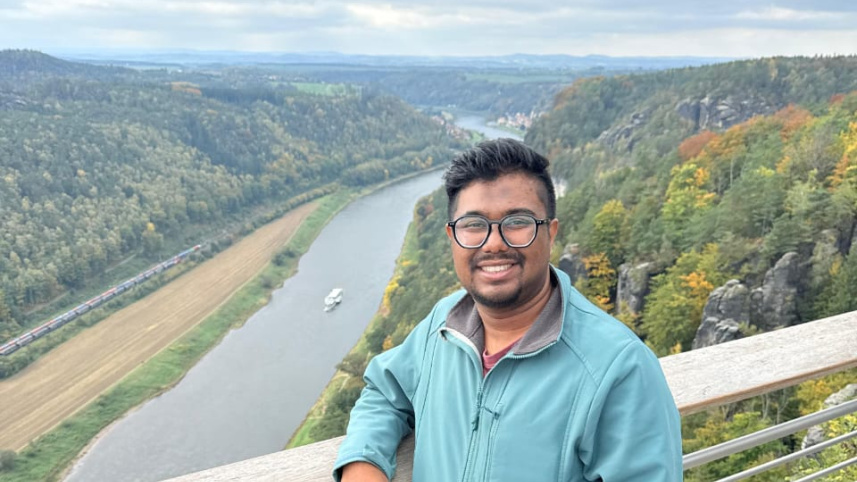
Germany offered the most emotional contrasts. Munich charmed me with its warmth and storybook streets. But visiting Dachau Concentration Camp shifted the mood sharply. Walking through the site, feeling the weight of history, human cruelty, and suffering, it was a difficult but essential moment. Later, hiking through the German Alps restored balance. River Elbe’s mirrored water, the snow-kissed peaks, and Saxon Switzerland’s sandstone cliffs reminded me how small we are in the presence of nature’s grandeur.
Through all these experiences, my understanding of development deepened. It is not only about economics, policies, or infrastructure; it is shaped by culture, discipline, social trust, design, and shared values. Europe taught me that progress is never accidental; it is built daily through collective responsibility.
When I finally returned to Dhaka to do my research at SHISUK and my master’s classes, I came home carrying far more than memories. I brought new technical knowledge for honey producers, fresh insights into climate governance, networks from around the world, a stronger grasp of negotiation strategies, and a renewed sense of purpose. Most importantly, I returned with the confidence that young people from Bangladesh can not only participate in global conversations, but they can also contribute meaningfully to them.
Development work is, ultimately, about understanding the world our communities live in. And sometimes, to understand that world, we must step outside it, if only for a while, to see more clearly how to serve it better.
The author is a senior research officer at Shikha Shastha Unnayan Karzakram (SHISUK).
 For all latest news, follow The Daily Star's Google News channel.
Comments