


Clean energy key to garment sector’s competitiveness: EU envoy
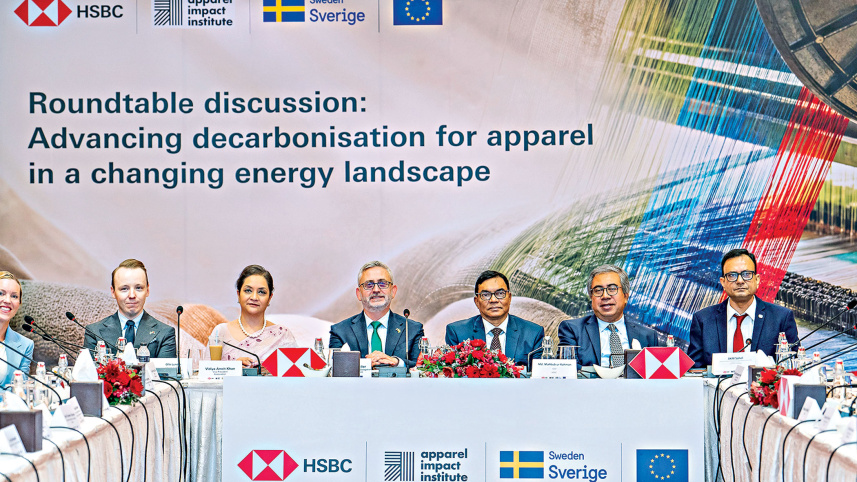
Bangladesh’s garment industry will need greater access to clean energy to remain competitive as European markets and global supply chains move towards a low-carbon future, Michael Miller, the EU ambassador and head of delegation to Bangladesh, said yesterday.
“Bangladesh has an opportunity to combine its manufacturing strength with cleaner production and position itself at the forefront of sustainable sourcing,” he said at a roundtable discussion titled “Advancing Decarbonisation for Apparel in a Changing Energy Landscape” in Dhaka, according to a press release.

The event was jointly organised by HSBC Bangladesh, Apparel Impact Institute (Aii), the Embassy of Sweden in Bangladesh and the Delegation of the European Union to Bangladesh.
Representatives from the government, global apparel brands, garment manufacturers, financial institutions, development partners and industry associations attended the event.
They discussed how Bangladesh can improve access to reliable and competitively priced clean energy for its apparel industry.
The sector will require $6.6 billion in investment to achieve 50 percent decarbonisation by 2030
Michael said the shift towards a low-carbon future in European markets and global supply chains would make clean energy increasingly important for Bangladesh’s garment sector.
“There is an opportunity to combine manufacturing strength with cleaner production that we encourage you to grasp with both hands, to place this country at the forefront of sustainable sourcing,” he added.
Kristina Elinder Liljas, senior director of sustainable finance and engagement at Aii, presented findings from the organisation’s research on financing the decarbonisation of Bangladesh’s apparel manufacturing sector.
The research identifies Bangladesh as one of the countries with significant potential to reduce emissions across global apparel supply chains. It also highlights the investment needed to achieve this goal.
The sector will require $6.6 billion in investment to achieve 50 percent decarbonisation by 2030, according to the research.
Md Mahbub ur Rahman, chief executive officer of HSBC Bangladesh, said, “As Bangladesh solidifies its global leadership in apparel, commercialising the energy transition is paramount. Unlocking private capital through supportive policy, scalable technology, and innovative financing will be the defining driver of future investment and competitiveness.”
The roundtable also highlighted the importance of international partnerships in supporting Bangladesh’s transition towards cleaner industrial production.
AKM Sohel, additional secretary and UN Wing chief of the Economic Relations Division at the Ministry of Finance; Olle Lundin, chargé d’affaires of the Embassy of Sweden; and Md Sarwar Hossain, deputy governor of Bangladesh Bank, also spoke at the event.
Participants said expanding access to clean energy is becoming important not only for environmental reasons but also for the competitiveness of the garment industry.
They said reliable and competitively priced renewable energy could help manufacturers reduce emissions and energy costs. It could also help them meet the expectations of international brands and markets.
Greater access to renewable energy could further help Bangladesh attract investment and strengthen its position as one of the world’s leading apparel sourcing destinations.
Randolph Brazier, global head of clean power systems and global sustainability at HSBC Holdings PLC, and Justin Wu, head of sustainability and climate change for Asia and the Middle East at HSBC, also joined the event over Zoom and presented their views on Bangladesh’s clean energy potential.
Vidya Khan, vice-president of the Bangladesh Garment Manufacturers and Exporters Association; Kim Hellström, senior sustainability manager for the Hong Kong special administrative region at H&M Group; and Olivia Windham Stewart, an independent sustainability adviser at ATTI Lead, among others, were also present.
 For all latest news, follow The Daily Star's Google News channel.
Comments