


What Bangladesh’s payment surge does and does not tell us

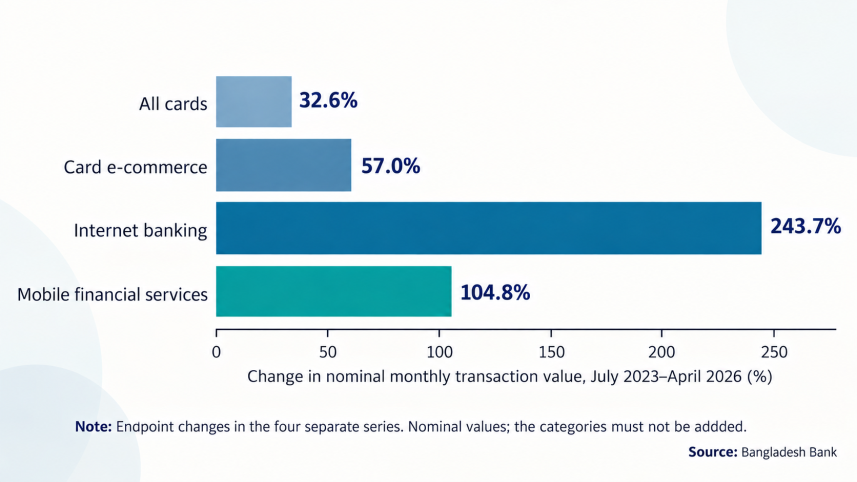
Bangladesh's payment numbers tell a striking story. Between July 2023 and April 2026, the monthly value recorded under internet banking more than tripled, while that of mobile financial services (MFS) roughly doubled. Yet a payment recorded by a digital system is not necessarily a purchase made without cash. That distinction should guide the next stage of policy.
In my analysis of 34 monthly observations compiled from Bangladesh Bank statistics, internet-banking value rose from Tk 46,243 crore to Tk 158,917 crore, a nominal increase of 244 percent. MFS rose from Tk 98,307 crore to Tk 201,337 crore, or 105 percent.

Total card value increased by 33 percent, while the card e-commerce component grew by 57 percent. These are changes between two monthly endpoints over 33 intervals, not annual growth rates. The categories also overlap in economic activity, so adding them would create a misleading national total.
The transaction counts reveal something the headline values conceal. Internet-banking transactions increased by 333 percent, faster than their value, while the calculated average amount per transaction fell from about Tk 59,232 to Tk 47,042.
MFS transaction counts rose by 105 percent, almost exactly in step with value, leaving the average amount near Tk 2,000. More transactions put pressure on processing systems even when the average amount carried by each transaction is stable or declining.
A central bank dashboard should therefore publish counts and values side by side, with clear definitions for each channel.
There is another reason to resist declaring victory over cash. MFS totals include cash-in and cash-out transactions. Card activity can include withdrawals.
A person may hold several registered accounts, and a registered account may be dormant. The 255 million MFS subscriber records in the panel's final month cannot be interpreted as representing 255 million distinct users.
Nor can rising digital transaction value tell us what share of everyday retail purchases has moved away from notes and coins. Bangladesh Bank's Payment Systems Report 2025 itself describes persistent cash use alongside digital expansion.
A small Bangla QR series offers a sharper warning against treating every upward figure as a settled trend.
In 2025, value reached Tk 842 crore in May but fell to Tk 58 crore in June. In November, the transaction count rose above October's level while value fell from about Tk 403 crore to Tk 309 crore.
Recalculating that month's value change gives minus 23.42 percent, while the source report's growth column shows a positive sign. The underlying amounts, the calculated rate and any subsequent correction should be published together so that users can see what changed.
Forecasting also rewards restraint. I tested eight methods on the same 12 one-month-ahead dates, retraining each model using only earlier months. A damped-trend method recorded the lowest mean percentage error for total cards (5.54 percent) and MFS (8.03 percent).
A simple drift forecast led internet banking at 7.31 percent. Ridge regression narrowly led card e-commerce at 7.80 percent, but other methods were almost tied.
With only 34 months of history and 12 forecast errors per method, those rankings provide a basis for continued monitoring, not a promise of future accuracy. More elaborate machine learning did not consistently outperform transparent baseline methods.
The data audit is as consequential as the model contest. The supplied panel marks 10 of the 12 forecast evaluation months as provisional. One February 2025 MFS extract exceeds the panel figure by Tk 5,645.6 crore, while the supplied card components at times differ from the reported card total by as much as Tk 460.7 crore.
These gaps may reflect revisions or differences in definitions, but the available material does not establish the cause. A public, dated record of source tables, definitions and revisions would make both journalism and policy analysis more reliable.
Bangladesh does not need a grander prediction from a shorter spreadsheet. It needs payment statistics that show what people are doing: merchant purchases separately from cash conversion, active users separately from registrations, and transactions separately from the value of money moved.
Bangladesh Bank and payment service providers can then test whether cheaper, safer and more dependable payment options are actually changing daily behaviour. The credible measure of progress is not the biggest digital total. It is whether a customer and a shopkeeper can use a trusted alternative to cash repeatedly and without friction.
The writer is a data science researcher at Shahjalal University of Science and Technology. This article draws on his research project, “Forecasting Bangladesh’s digital payment channels”.
 For all latest news, follow The Daily Star's Google News channel.
Comments