


Vegetable growers fear losses as rain floods fields

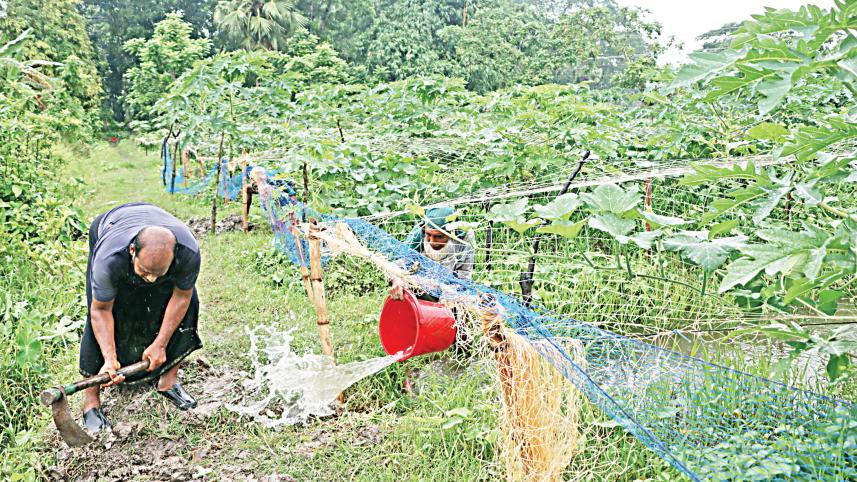
Non-stop rainfall since Tuesday has left large swathes of farmland under water, causing concern among vegetable growers across the country.
Thousands of hectares have already been submerged, with farmers fearing that if the rain does not stop soon, the damage to vegetables could be severe.
 For all latest news, follow The Daily Star's Google News channel.
 Crops such as chilli and other summer vegetables are particularly affected, as traders are staying away amid the dull weather.
"There are hardly any buyers," said Abu Hanif Morol, a farmer at Baratia village of Dumuria upazila in Khulna. "If this continues, we will lose even more."
According to the Department of Agricultural Extension (DAE), about 1.36 lakh hectares of cropland have gone underwater due to the prolonged downpour.
A scientist of the Bangladesh Agricultural Research Institute (BARI) said that if temperatures rise suddenly once the water begins to recede, it could kill many vegetable plants. This may lead to a supply shortage and a spike in market prices.
Summer vegetables like bitter gourd, ash gourd, ridge gourd, sponge gourd, snake gourd and bottle gourd are usually grown during this season.
The Bangladesh Meteorological Department said a low-pressure system over the Bay of Bengal and the advancing monsoon winds have triggered the persistent rainfall.
While the rain may taper off from Thursday, forecasters expect another spell from Sunday.
In kitchen markets of the capital, the impact is already being felt. Fewer shoppers are turning up, and supplies of vegetables, fish and daily essentials have shrunk. Prices of key items such as green chilli, fish and chicken have increased in recent days.
Delowar Jahan, a farmer of Kautia village in Ghior upazila in Manikganj, said 75 percent of the chilli plants on his half-bigha plot have died.
He estimated the loss to be around Tk 10,000.
Khulna farmer Abu Hanif Morol said the rain has damaged his gourds on two bighas of land. Some of his bean plants have also been affected.
"No traders have come to buy vegetables in the last two days," he said. "I harvested a few kilogrammes of hyacinth bean and took them to the local market, but with so few customers, I didn't get a fair price."
"If the rain goes on like this, prices will fall even further," he added.
In Jashore Sadar upazila, farmer Tarikul Islam said he used to sell bitter gourd at Tk 40 per kilogramme wholesale. Now, prices have plunged to Tk 14 to Tk 15 due to weak demand.
"The rain has caused the flowers to drop, pests are attacking the plants, and the roots are weakening," he said. "Production is taking a hit."
Islam has cultivated bitter gourd on 25 kathas of land.
Md Jamal Uddin, additional director of monitoring and implementation at the DAE's field service wing, said heavy rainfall has affected Aus, Aman seedbeds, jute, vegetables, orchards, betel leaf and watermelon fields.
According to DAE, 92,067 hectares of Aus, 16,017 hectares of Aman seedbeds, 16,621 hectares of jute, 5,705 hectares of vegetables, 560 hectares of banana, 542 hectares of papaya and 3,242 hectares of betel leaf farms have been submerged across the country.
In Feni district alone, 1,655 hectares of Aus, Aman, vegetables and chilli fields have gone underwater.
Other districts with widespread crop flooding include Cox's Bazar, Noakhali, Khagrachhari, Pabna, Bagerhat, Barishal, Pirojpur, Jhalakathi, Patuakhali, Barguna and Bhola.
Md Mahbubar Rahman Salim, principal scientific officer at the Vegetable Division of the Horticultural Research Centre in Gazipur, said that although vegetable cultivation has so far avoided large-scale losses, the situation could deteriorate quickly if temperatures rise while water levels fall.
"If that happens, many vegetable plants may die," he said.
[Zahangir Shah and Dipankar Roy contributed to this report.]


Comments