


The Iran war is exposing Bangladesh’s economic vulnerabilities

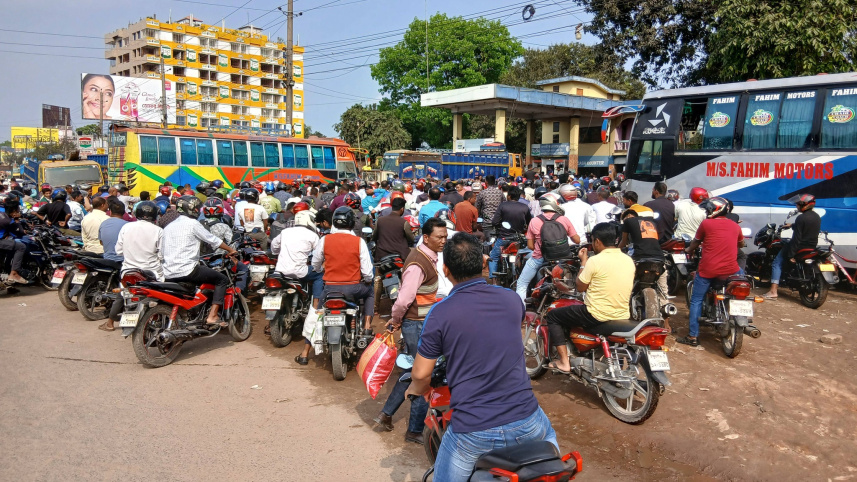
The queues appeared before the statistics did. Lines at fuel stations have lengthened, transport schedules are thinning, and industries are adjusting output as energy uncertainty spreads. The Iran war is reaching Bangladesh not through geopolitics but through something more immediate: the availability and price of fuel, fertiliser, freight, and foreign exchange.
This is how distant conflicts reach globally integrated economies like Bangladesh. Geography offers little protection when trade, migration, and financial flows are tightly connected to the global system.

The most important transmission channel is the Strait of Hormuz, through which roughly one-fifth of the world’s oil and LNG supplies normally move. The corridor also carries significant volumes of petrochemicals and fertiliser critical to agriculture.
Disruptions therefore affect not only energy markets but food production costs—an especially dangerous combination for developing economies already facing inflation pressures. For Bangladesh, this exposure is immediate and largely unavoidable.
A global shock hitting energy, food and trade at once
Global markets already reflect the shock. Oil prices have moved above $100 per barrel amid fears of prolonged disruption. Asian LNG markets have tightened as cargoes are delayed or diverted, while rising war-risk insurance premia are pushing up freight costs across multiple commodities.
Fertiliser markets have also reacted quickly. The Gulf is a major supplier of urea and other critical inputs, and even temporary disruptions can translate into higher food production costs months later—an important risk for fertiliser-importing countries like Bangladesh.
These developments do not arrive separately—they arrive together. Higher LNG prices raise power generation costs. Higher fertiliser prices increase agricultural costs. Higher freight rates push up import prices. But the deeper risk is not price alone—it is access. When disruptions affect fuel, fertiliser, and shipping simultaneously, the constraint becomes one of physical availability as much as affordability.
Availability risks matter more than price movements: prices strain budgets, but shortages strain the economy’s ability to function. The adjustments will have to occur not only through higher inflation but through rationing of energy, transport, and industrial activity—a far more difficult shock to manage.
How the shock spreads through the economy
The first major pressure point will be the balance of payments. Import costs will rise as energy, fertiliser, and freight prices increase, while the main sources of foreign exchange face uncertainty. Exports are likely to be hit hard, migration flows may slow, and even strong remittances—such as the recent $3.75 billion monthly record—cannot be assumed to persist if GCC labour markets weaken. Usable reserves of roughly $30 billion provide a cushion, but not a large one relative to Bangladesh’s import needs and external debt obligations. They can smooth adjustment, but not shield the economy from prolonged pressure.
The shock is also propagating through the fiscal channel. By limiting the domestic pass-through of global fuel price increases, the government is effectively absorbing part of the external price shock through higher subsidy costs, even as revenue mobilisation remains weak.
Price pressures are likely to intensify. Higher energy costs are pushing up transport and industrial prices, while fertiliser shocks will eventually feed into food inflation. This is classic cost-push inflation—precisely the type monetary policy alone cannot easily control. This creates a familiar emerging-market dilemma: tightening policy risks slowing growth, while insufficient adjustment risks allowing inflation to become entrenched.
The financial sector may become another channel through which the shock spreads. Officially reported non-performing loans stand at around 31 percent and even this likely understates underlying stress. With balance sheets already weakened, any slowdown in economic activity could quickly translate into further borrower distress. In stronger financial systems, banks cushion such shocks through continued lending, but in weaker ones, fragility can amplify stress—a vulnerability Bangladesh faces if conditions deteriorate.
Limited buffers against the shock
Bangladesh retains some buffers, but they are modest relative to the scale of the shock. Foreign exchange reserves provide time, not immunity. Multilateral financing may help smooth adjustment, but such support is gradual and conditional rather than immediate crisis relief.
Beyond these buffers, policy space is narrow. Fiscal options are limited, and with one of the lowest tax-to-GDP ratios in the world, the government has little room for tax relief or additional spending. Weak financial intermediation limits the scope for credit adjustment.
Administrative controls may restrain demand temporarily, but they cannot alter the global price shock.
These constraints explain the government’s initial focus on conservation: shorter commercial hours, tighter load-shedding schedules, restrictions on energy use, and administrative demand controls.
Such measures may slow fuel consumption, but they do not reduce the underlying cost of energy imports. Nor do they fully address enforcement risks, as shortages often create incentives for diversion, preferential allocation, and other irregularities in distribution systems. When supply tightens, governance weaknesses can quickly become economic vulnerabilities.
 For all latest news, follow The Daily Star's Google News channel.
 What this crisis requires
In shocks like this, the priority is not ambitious reform or rapid expansion. It is keeping the system functioning—ensuring energy and food security, protecting reserves, maintaining financial stability, and avoiding disorderly adjustment until external conditions improve.
This requires difficult but unavoidable policy choices. The exchange rate must be allowed enough flexibility to prevent excessive reserve losses. Reserves should be used to prevent disorderly movements, not to defend symbolic levels.
Energy subsidies cannot expand indefinitely. Where support is necessary, it should be more tightly targeted to protect vulnerable households rather than suppress prices across the board. At the same time, public investment may need temporary reprioritisation toward areas that sustain economic functioning—energy supply, logistics, and food security—while lower-return projects are deferred.
Banking sector weaknesses cannot remain indefinitely masked through regulatory flexibility. Temporary forbearance may be warranted to prevent liquidity pressures from becoming systemic stress, but prolonged accommodation risks deepening solvency problems. Targeted restructuring of the weakest institutions may therefore become unavoidable to safeguard financial stability.
These are not abstract reform agendas but standard crisis-management tools. Their effectiveness depends less on technical design than on how shortages are managed in practice. When fuel, credit, and foreign exchange become scarce, competition for access inevitably sharpens. Without credible discipline, adjustment can quickly become uneven and inefficient.
The real constraint is political, not technical
The challenge is not identifying what needs to be done but implementing it. Exchange-rate flexibility affects those accustomed to privileged access to foreign exchange. Subsidy reform affects groups that benefit from generalised price support. Project rationalisation affects networks linked to public spending. Banking reform affects borrowers long accustomed to weak repayment discipline.
Adjustment is rarely delayed by a lack of economic understanding. It is delayed by the political costs of acting early. Yet crises rarely wait for political convenience. The Iran war is not creating Bangladesh’s vulnerabilities—it is exposing them. Adjustment is a compulsion, not a choice. The only question is whether it happens early and gradually, or later under greater stress.
In shocks of this scale, economic strategy becomes clearer, even if implementation does not. When external shocks exceed domestic buffers, the first priority of economic policy is not growth. It is endurance.
Comments