


LPG market slows as price hikes hit demand
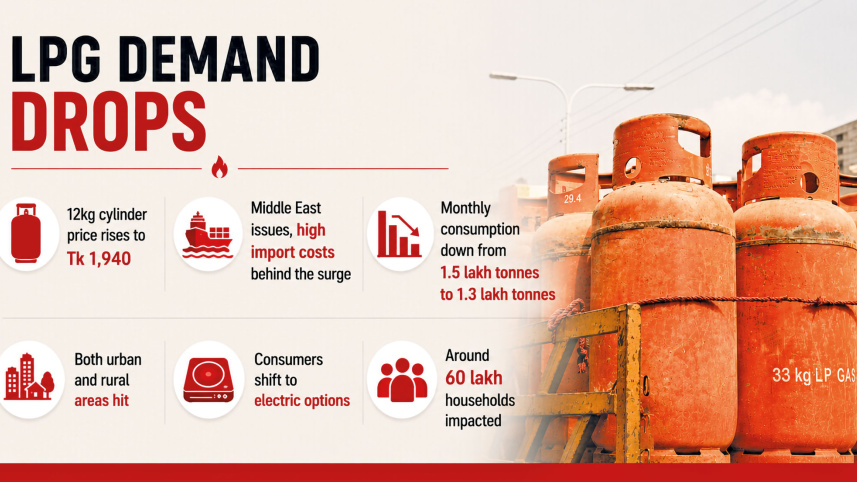
The country’s liquefied petroleum gas (LPG) market is seeing a sharp fall in demand as steep price increases, driven by higher import costs and supply disruptions in the Middle East, continue to strain household budgets and force consumers to cut back on usage.
Industry operators and distributors say LPG cylinder sales have fallen significantly in both urban and rural areas this month, as many consumers are shifting to alternative cooking methods to manage rising living costs.

The retail price of a 12kg LPG cylinder now stands at Tk 1,940 after the Bangladesh Energy Regulatory Commission (BERC) raised it by Tk 212 on April 19. The regulator cited higher import costs and supply shortages linked to tensions in the Middle East.
Subrata Saha, proprietor of Brahmanbaria Fuel Corner and a distributor of Bashundhara LP Gas, said demand dropped sharply following the latest price hike. Before the increase, he sold around 60 units of 12kg cylinders per day, but sales have now fallen to about 35 units per day.
He said many consumers are now switching to induction and infrared stoves as cooking costs have become almost equal to those of LPG. “Electric stoves are also more convenient and help households avoid extra costs such as transporting and carrying gas cylinders,” he added.
A top official of Petromax LPG said the market has shrunk sharply over the past one and a half months due to repeated price increases. “Within just one month of the latest price increase, the country’s monthly LPG demand fell from nearly 1.5 lakh tonnes to around 1.3 lakh tonnes,” he said.
According to him, the retail price of a 12kg cylinder rose from about Tk 1,400 in January to Tk 1,940 by mid-April, an increase of nearly 40 percent in four months.
“How can consumers suddenly bear such a sharp rise in cooking costs?” he said, adding that inflation and rising living expenses have further reduced purchasing power.
He also said many urban consumers are switching to electric cooking appliances to reduce monthly expenses.
Although the government-fixed price is Tk 1,940, he added that many companies are offering discounts of up to Tk 150 below the official rate to retain customers amid weak demand.
Abu Sayed Raza, chief marketing officer of Fresh LPG, a concern of Meghna Group of Industries, said geopolitical instability in the Middle East has disrupted global LPG supply chains and raised costs across the sector.
He said the resulting affordability crisis has temporarily affected around 6 lakh households, with some consumers returning to traditional cooking fuels.
“We are starting to see a market correction. Lower demand has prompted retailers to comply with government-mandated pricing, improving transparency and restoring buyer confidence,” he said.
“As a result, sales volumes are gradually recovering,” he added.
He also said Meghna Group of Industries is maintaining stable supply levels to keep clean energy accessible as global conditions gradually stabilise.
Mohammed Amirul Hoque, president of the LPG Operators Association of Bangladesh, said demand has fallen in both rural and urban areas due to rising prices and ongoing inflation.
He said higher cooking energy costs are increasing household expenses. “People are already struggling with inflation, so many are trying to cut costs wherever they can,” he said.
Hoque added that lower-income and lower-middle-income families have been hit hardest, especially in rural areas where purchasing power has weakened in recent months.
Harun Ortaç, chief executive officer of United Aygaz LPG Ltd, said international LPG prices have risen due to the Gulf conflict, making it more difficult for many countries to ensure a steady supply.
 For all latest news, follow The Daily Star's Google News channel.
 He said timely intervention by the BERC has helped operators continue imports despite challenging global conditions.
He added that BERC’s pricing adjustments and policy support have helped maintain adequate supply in the domestic market and prevent major disruptions in distribution.
Ortaç also said that competition among operators has helped reduce the impact of rising global prices on consumers, though the market remains under short-term pressure.
Comments