


Taka among region’s most stable currencies: BB report
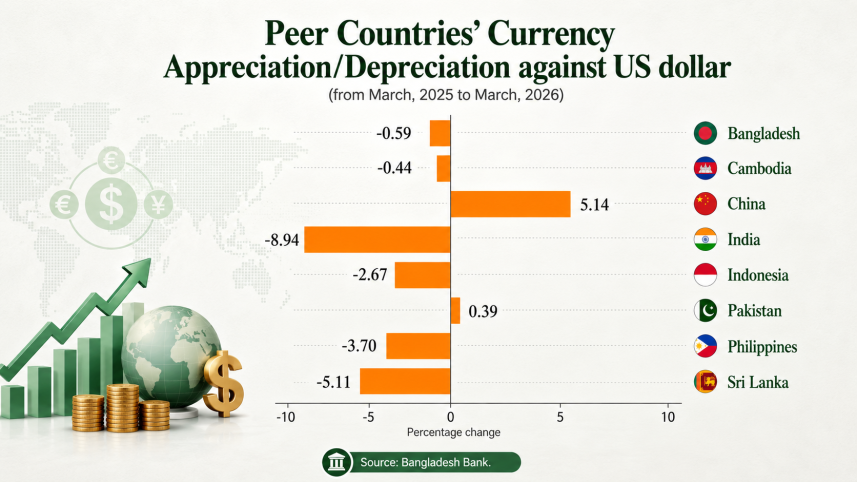
The Bangladeshi taka remained one of the most stable currencies in South Asia and neighbouring economies over the past year, depreciating by just 0.59 percent against the US dollar between March 2025 and March 2026, according to the Bangladesh Bank quarterly report.
The central bank's latest data showed that only Cambodia performed slightly better, with its currency weakening by 0.44 percent during the period.

Among the peer countries, India experienced the sharpest depreciation, with the rupee losing 8.94 percent of its value against the US dollar.
The Sri Lankan rupee depreciated by 5.11 percent, followed by the Philippine peso at 3.70 percent and the Indonesian rupiah at 2.67 percent.
In contrast, the Chinese yuan appreciated by 5.14 percent, making it the strongest-performing currency among the countries compared. The Pakistani rupee also posted a modest appreciation of 0.39 percent against the US dollar.
Officials at the central bank said that the relatively limited depreciation of the taka came after Bangladesh Bank adopted a more market-based exchange rate regime and tightened monetary and foreign exchange management to reduce volatility in the currency market.
In May last year, Bangladesh adopted a market-based exchange rate regime to meet an IMF condition.
The central bank has also been able to rebuild foreign exchange reserves through stronger remittance inflows and improved export earnings, helping ease pressure on the local currency.
After the fall of the Awami League-led government in August 2024, remittance inflows continued to rise, and the BB was able to build its forex reserves, according to BB officials.
As of July 30, the foreign exchange reserves (BPM6) stood at $31.60 billion, up from $24.86 billion during the same period last year, according to Bangladesh Bank data.
Over the past year, the exchange rate of the US dollar against the local currency has hovered between Tk 122 and Tk 123, indicating a stable currency.
Industry insiders said that a relatively stable exchange rate can help contain imported inflation by reducing the cost of essential imports such as fuel, food, and industrial raw materials.
However, in recent months, the US dollar has continued to strengthen against the taka amid increased demand for foreign currency to settle import bills.
On August 4 this year, the interbank exchange rate of the US dollar stood at Tk 123.81 per US dollar, up from Tk 123.69 per US dollar a few days earlier, according to Bangladesh Bank data.
 For all latest news, follow The Daily Star's Google News channel.
Comments