


Saudi-run Patenga terminal to operate at full capacity from July

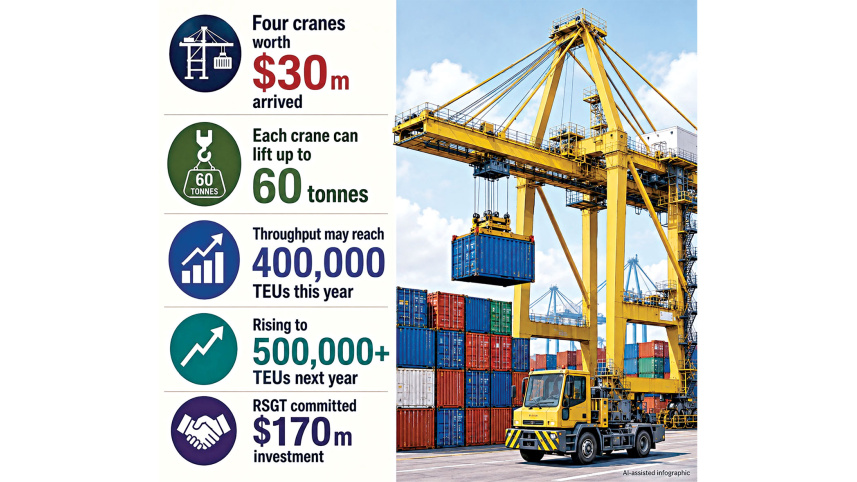
The Patenga Container Terminal, operated by Saudi Arabia’s Red Sea Gateway Terminal (RSGT), is set to begin full-capacity operations from next month after four ship-to-shore cranes arrived at the facility on June 19.
The cranes, worth $30 million, are now being installed and commissioned. They will allow the terminal to handle larger vessels, improve berth productivity and reduce vessel turnaround time, according to port and company officials.

They arrived aboard a specialised vessel and are expected to be operational within weeks.
The investment is part of RSGT’s development of the terminal under a 22-year concession agreement with the Chittagong Port Authority (CPA). The Saudi company became Bangladesh’s first foreign container terminal operator after taking over the facility in 2024.
According to company officials, RSGT has so far committed around $170 million to modernise the facility through investments in infrastructure, equipment, technology and workforce development.
The terminal currently handles around 155,000 twenty-foot equivalent units (TEUs) annually. RSGT expects the volume to reach around 400,000 TEUs this year after the new equipment is commissioned, rising to more than 500,000 TEUs next year, nearly 17 percent of the port’s total container traffic.
Alifa E Junnurine, manager for marketing and communication at RSGT, told The Daily Star that the cranes would significantly expand the terminal’s handling capability.
“Unlike the 12- to 13-container-wide vessels currently served at the port, the cranes can accommodate ships up to 16 containers wide. Each unit can lift up to 40 tonnes in single-container operations, 45 tonnes in twin-lift mode and 60 tonnes for specialised cargo handling,” she said.
“Being fully electric,” she added, “the cranes would also reduce reliance on fuel-powered equipment and support more sustainable port operations.”
The STS cranes complete the deployment of the terminal’s main cargo-handling equipment. RSGT had earlier invested $26 million in 14 rubber-tyred gantry cranes and around $3 million in a container scanner, which enabled the terminal to begin handling import containers earlier this year.
The terminal’s expansion carries wider significance. Chattogram port handles more than 90 percent of Bangladesh’s seaborne trade and processed approximately 3.41 million TEUs last year, making it the busiest container port on the Bay of Bengal.
Industry insiders expect that improved performance at Patenga will ease pressure on other existing facilities as cargo volumes grow.
The region is also set to generate rising trade demand from a cluster of major industrial and infrastructure projects — the Mirsarai Economic Zone, the Chinese Economic and Industrial Zone, a proposed free trade zone in Anwara, and the Matarbari deep-sea port.
Mohammed Amirul Haque, president of the Chittagong Chamber of Commerce and Industry, said the RSGT investment should be seen in that broader context.
“The investment made by RSGT should be viewed in the context of the wider economic transformation taking place in the Chattogram region,” he said.
On the other major projects, the CCI president commented, “Once these investments reach full production, cargo movement through Chattogram port will increase significantly.”
However, he added that even with the Bay Terminal, Patenga Container Terminal and Matarbari deep-sea port in operation, there will be a need for further capacity expansion and efficiency improvements.
He said all existing jetties and terminals at Chattogram port would need to be utilised more efficiently through modern equipment, automation and improved operational management to handle future trade volumes.
 For all latest news, follow The Daily Star's Google News channel.
Comments