


Govt moves to institutionalise internal audit across public sector
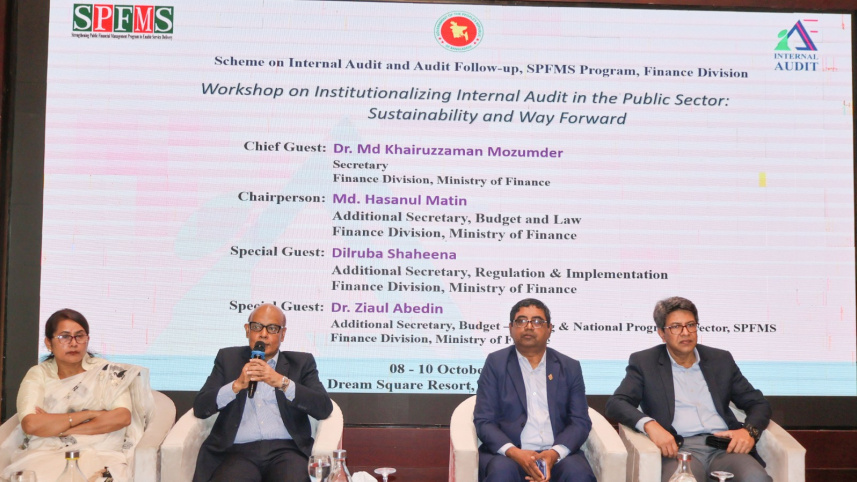
The government has initiated reforms to establish a permanent internal audit system across ministries and divisions to detect financial risks early, prevent losses and improve the delivery of public services.
The initiatives were highlighted at a three-day workshop titled “Workshop on Institutionalising Internal Audit in the Public Sector: Sustainability and Way Forward”, held at a hotel in Gazipur from October 8 to 10.

The workshop was organised by the Internal Audit and Audit Follow-up Scheme under the Finance Division’s Strengthening Public Financial Management Program to Enable Service Delivery (SPFMS).
Finance Division Secretary Dr Md Khairuzzaman Mozumder inaugurated the workshop as chief guest and unveiled the revised 2026 Model Risk-Based Internal Audit Charter and Manual.
Aligned with the Global Internal Audit Standards 2024, the revised manual establishes an institutional framework for objective evaluation, advice on protecting resources and enforcing controls, replacing the previous reliance on temporarily assigned staff.
Dr Mozumder described the introduction of internal audit across ministries as a landmark step towards ensuring transparency and accountability in public fund management. He also stressed the government's commitment to establishing an effective and sustainable system despite implementation challenges.
To safeguard auditors' independence, the framework introduces a dual-reporting mechanism under which auditors will report functionally to the relevant internal audit committee and administratively to the ministry secretary or principal accounting officer (PAO).
Presentations by five major government departments outlined progress and persistent structural challenges.
The Directorate General of Health Services (DGHS) identified 93 risks and completed six audit reports. It highlighted the need to reduce waste, recruit skilled personnel, ensure adequate funding and improve digital access to strengthen healthcare delivery.
The Public Works Department (PWD) identified 70 risks and made progress on annual audit plans. However, unresolved audit findings, limited independence and staff vacancies remain challenges, prompting calls for digital tracking and clearer oversight.
The Local Government Engineering Department (LGED) introduced risk-based auditing across 78 cost centres, generating 300 observations. Temporary staffing and the absence of a permanent organogram remain key constraints.
The Directorate of Primary Education (DPE) deployed a 13-member unit, mapped 41 risks and launched pilot initiatives in Raipura and Laxmipur Sadar. A consolidated report is targeted for July 2027.
The Roads and Highways Department (RHD) identified 82 risks and completed six audit reports, which exposed weaknesses in procurement, land acquisition and contract management. The department also cited limitations arising from reliance on staff assigned additional duties.
To address these challenges, a proposed sustainability roadmap envisages establishing permanent internal audit units or directorates across all ministries and divisions in phases over three years, subject to administrative approval.
The broader 2026-2031 action plan focuses on securing dedicated budgets, formulating recruitment rules, integrating digital monitoring with iBAS++ and strengthening coordination between internal and external auditors to safeguard public assets in the health, education and infrastructure sectors.
The inaugural session was chaired by Md Hasanul Matin, additional secretary of the Finance Division. Additional Secretaries Dilruba Shaheena and Dr Ziaul Abedin attended as special guests, while Additional Secretary Mohammad Azad Sallal delivered the key presentation on the sustainability plan.
 For all latest news, follow The Daily Star's Google News channel.
Comments