


Private-sector activity falls to lowest since Aug 2024: PMI
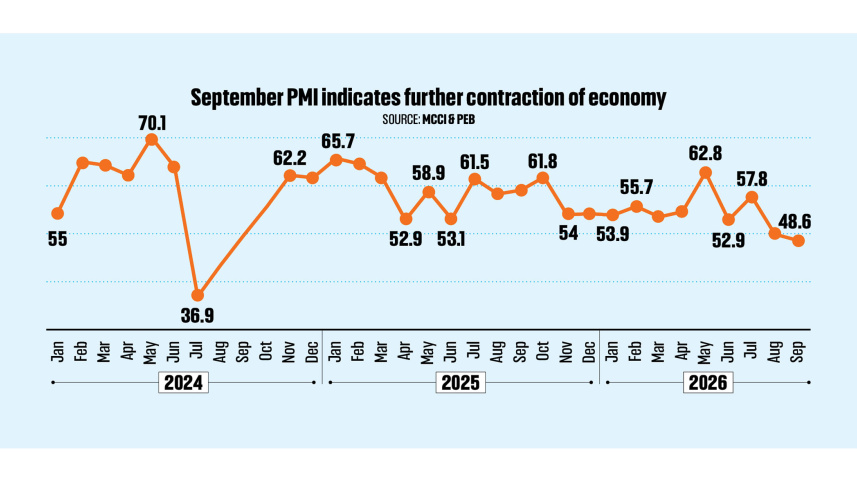
Bangladesh’s private-sector activity showed further signs of weakness in September, with the Purchasing Managers’ Index (PMI) falling to its lowest level since August 2024.
The headline PMI fell 1.3 points to 48.6 in September from 49.9 in August, signalling a second consecutive month of contraction, according to the latest report by the Metropolitan Chamber of Commerce and Industry, Dhaka (MCCI) and Policy Exchange Bangladesh (PEB).

In August 2024, the PMI stood at 43.5 amid political upheaval and social unrest following a mass uprising that led to the ouster of the Awami League-led government. The PMI had plunged to 36.9 in July 2024 from 63.9 in June, marking the lowest reading since the index was launched.
The PMI is a monthly score showing whether businesses across the economy are growing or shrinking, based on a survey of purchasing managers at over 500 private firms. A score above 50 signals growth and below 50 signals contraction, while the further a reading moves from 50, the faster the pace of change.
Manufacturing recorded the sharpest deterioration in September, with its index falling 2.6 points to 44.8.
“New orders, new export orders, output, stocks of input purchases and finished goods, and imports continued to contract at a faster rate,” the report said. “Order backlogs recorded a strong contraction, while supplier delivery times recorded a slower expansion.”
Employment, however, returned to marginal expansion, while input prices continued to rise.
Construction slipped 3.8 points to 48.5, returning to contraction after expanding in August.
“New business and construction activity contracted, while employment remained unchanged. Input costs continued to expand strongly but at a slightly slower rate. Order backlogs reverted to expansion,” the MCCI-PEB report said.
Services recorded a second consecutive month of marginal contraction, with its index declining 0.2 points to 49.0.
“New business and business activity reverted to contraction, while employment experienced slower contraction. Input costs expanded strongly while order backlogs remained in contraction,” the report said.
Agriculture remained the only sector in expansion, extending its growth streak to 13 months. Its index, however, declined 1.3 points to 55.2 as new business, business activity and employment expanded more slowly, while input costs continued to expand strongly despite a slight reduction.
The latest PMI reading comes after the Bangladesh Bureau of Statistics reported that the economy grew 4.6 percent in the April-June quarter, more than twice the 2.05 percent growth recorded a year earlier.
The rebound was supported by stronger growth in manufacturing and services, although economists cautioned that weak private-sector credit, energy supply constraints and financial-sector vulnerabilities continued to weigh on the economy.
“Bangladesh’s economic dynamism remains under pressure, as weakness in manufacturing, construction and services weighed on overall performance,” PEB Chairman and CEO M Masrur Reaz said on the latest PMI readings.
He said agriculture’s expansion provided resilience and positive expectations offered a basis for recovery.
The Future Business Index pointed to expansion across all four sectors, reflecting cautious optimism about business conditions in the coming months, according to the report.
“Strengthening domestic and export demand, ensuring reliable energy supply, easing financing constraints and containing cost pressures will be important to restore momentum,” Masrur said.
The PMI, initiated with support from the UK government, has been published by MCCI and PEB since 2024.
 For all latest news, follow The Daily Star's Google News channel.
Comments