


Fuel price hike may prolong inflationary pressure: economists

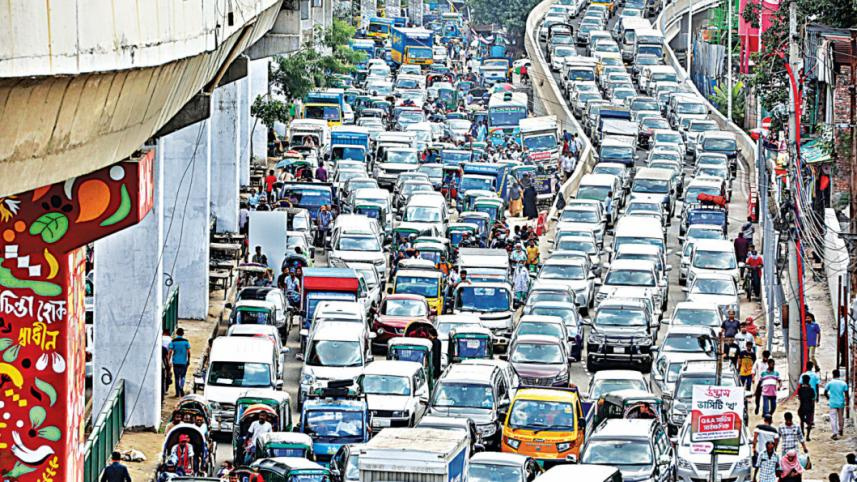
The latest fuel price hike could add fresh inflationary pressure to Bangladesh's economy by raising transport, production, and marketing costs at a time when inflation had only recently started easing, economists said today.
The Tk 20-a-litre hike could broadly affect consumers, particularly as diesel is widely used in public transport, agriculture, and industry.

The timing has also raised concerns as the government simultaneously announced a pay-scale increase for public servants, while millions of private-sector and informal workers are unlikely to see a similar rise in income, they said.
Targeted approach preferable: Nazneen Ahmed
Centre for Policy Dialogue (CPD) Executive Director Nazneen Ahmed said the fuel price hike would create multiple pressures across the economy.
"Increasing fuel prices has multiple impacts. It affects agriculture, transport, and then industries and factories," she said.

"Tk 20 is a big increase -- think about how much the cost of a bus will increase from one end of the city to the other, and the impact that will have on fares," she said.
Nazneen argued that the government should have taken a more calibrated approach rather than raising all fuel prices uniformly.
"If the objective is to reduce the subsidy burden, it could have been done gradually. Inflation rate of increase has slowed over the last two months, but this creates a new kind of pressure," she said.
"I think diesel and kerosene prices should have been kept unchanged, while the subsidy could have been offset by increasing the price of petrol and octane," she said, noting that diesel and kerosene are more heavily used by poorer households, public transport, and industry.
On the new pay scale, Nazneen said the salary increase alone might not have a major direct impact on inflation, but its simultaneous announcement with the fuel price hike could raise expectations.
"Individually, the pay-scale increase might not have had much impact, but because two things are happening simultaneously, inflationary expectations will increase and push prices higher," she said.
Production costs set to rise across sectors: Deen Islam
Md Deen Islam, professor of economics at the University of Dhaka, said the increase would raise production, marketing, and borrowing costs across the economy.
"The cost of getting loans and marketing will raise the prices of goods and services in one go," he added.

Deen said the inflationary impact could persist depending on how the government manages public confidence.
"We may see inflation in the near term. Whether this will be sustained in the long term depends on how much confidence the government can maintain among the people," he said.
"If there is no salary adjustment in the private sector, their real income will decline," he said.
"Perhaps the economy of Bangladesh was not prepared to face the changed international situation, so the timing of this policy needs to be considered," he added.
Deen said the government faced a trade-off between keeping fuel prices low through subsidies and containing the fiscal burden.
 For all latest news, follow The Daily Star's Google News channel.
 "If you increase the fuel price, the impact may be visible immediately or in the short run. If you keep it low through subsidies, the impact may come later, but you may see a more sustained effect," he said.
"There is no optimal policy here -- it is a trade-off between providing short-term relief or keeping it under control over the long term," he said.
No consultation, no justification: Anu Muhammad
Anu Muhammad, former professor of economics at Jahangirnagar University, questioned the decision to raise fuel prices without prior consultation.
"Logically, we did not even know about it -- they suddenly did it without consultation," he said.

"The government has not given any justification for why it did this, so the question of what else could have been done does not even arise," he said.
"Why does the price of oil have to be increased? Did it suddenly rise in the world market yesterday?" he asked.
He said the government could have reduced taxes and charges on fuel instead of passing the burden on to consumers.
"They receive various types of fees and taxes from oil. If there is a problem with the price, they could reduce those charges instead of putting the burden on the entire economy," he said.
He added that revenue constraints could be one reason for choosing measures such as raising fuel prices.
"The government's revenue position has become very tight, which is why it is choosing the easy means," he said.
"Prices of goods will now increase further for the people," he added.
"Judging by the government's approach, it seems to be trying to become unpopular very quickly," he added.
Warning of possible stagflation: Lutfor Rahman
Mohammad Lutfor Rahman, associate professor at the Department of Urban and Regional Planning at Jahangirnagar University, warned that the hike would ripple through production costs economy-wide and worsen conditions for low-income and daily-wage workers.
"The price of fuel is related to every commodity in the economy," he said, noting that private-sector and daily-wage workers, whose pay will not rise in tandem, would bear the brunt.

"Those who work daily or in the private sector will not see their salaries increase, worsening their situation," he said.
He also pointed to pressure on agricultural prices given farming's dependence on fuel, and voiced concern about an already stagnant job market.
"We may move towards stagflation -- high inflation, declining purchasing power, rising inequality, and an increase in joblessness," he said.
"The job market has been stagnant for quite some time, and industrialisation is unlikely to increase, making the employment situation even more constrained," he added.
"Overall, the situation ahead may be challenging for Bangladesh," he said.
Comments