


Five takeaways from Bangladesh's economy last week
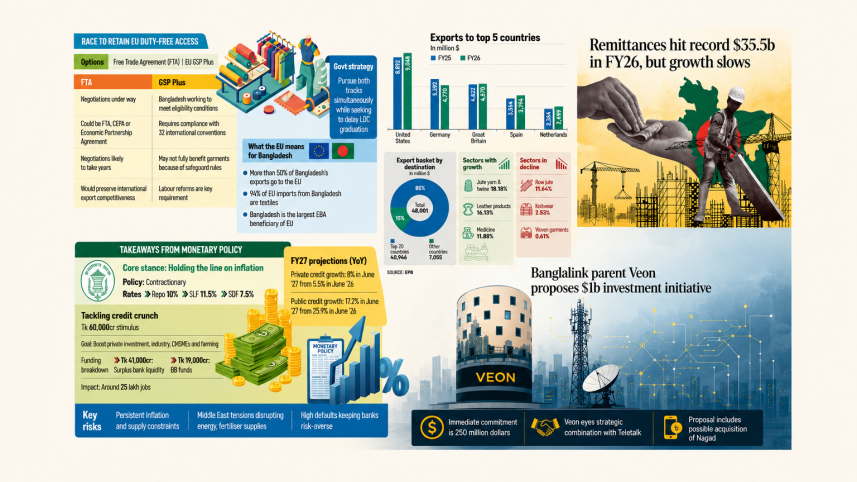
Bangladesh's economy last week revolved around a twin-track push to retain EU duty-free access, a $1 billion investment proposal from Banglalink's parent company, the central bank's tight monetary stance, record remittance inflows, and a marginal dip in exports.
The following is a recap of those major stories as covered by Star Business.

Govt takes twin-track approach to retain EU duty-free access (June 29)
Bangladesh is pursuing a dual strategy—negotiating a free trade agreement and seeking GSP Plus status—to maintain duty-free market access to the European Union after graduating from LDC status, thereby avoiding a potential loss of competitiveness in its largest export market.
Banglalink parent Veon proposes $1b investment initiative (June 30)
Veon, the parent company of Banglalink, has proposed a $1 billion investment initiative in Bangladesh focused on digital infrastructure, AI, and financial services. The company plans to act as an anchor investor to attract further foreign direct investment.
BB sticks to tight monetary policy as inflation stays high (July 1)
Bangladesh Bank has maintained its contractionary monetary policy, keeping the policy rate at 10 percent to combat persistent inflation. However, economists have questioned the effectiveness of this tightening, as the central bank simultaneously injects funds into struggling commercial banks.
Remittances hit record $35.5b in FY26, but growth slows (July 2)
Remittance inflows reached a record $35.5 billion in fiscal year 2025-26, growing 17.3 percent year-on-year on the back of increased migration and greater use of formal channels. However, the growth rate slowed significantly from the 27 percent surge recorded in FY25.
FY26 exports slip despite $4.2b June rebound (July 3)
Bangladesh's export earnings in FY26 declined marginally by 0.58 percent to $48 billion, despite a 26 percent rebound in June that yielded $4.2 billion. The full-year contraction was driven by a decline in apparel shipments amid weak global demand.
 For all latest news, follow The Daily Star's Google News channel.
Comments