


Export cap fails to cool jute market as premium prices climb


- Export curbs fail, premium jute prices rise
- Lower production tightens supply, fuels costs
- Medium-grade fibre eases slightly, remains elevated
- Hoarding allegations add pressure on market
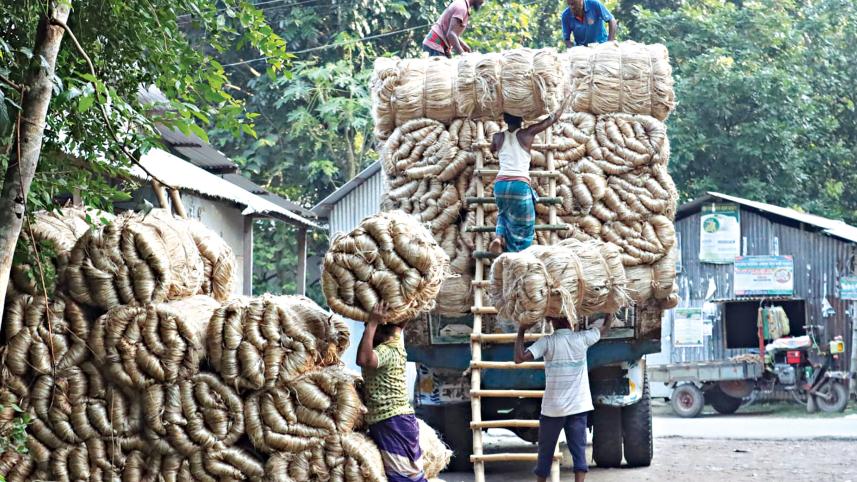
The government's move to impose export restrictions on raw jute, aiming to stabilise domestic prices, has failed to produce the desired effect even after two months. In fact, as traders had warned, it has had the opposite effect, with premium-grade raw jute prices climbing further.
Medium-grade fibre has softened slightly but remains elevated, highlighting the limited impact of the export cap.
The export restriction, issued by the commerce ministry in September following recommendations from the textiles and jute ministry, requires prior approval for raw jute shipments. The measure was intended to ensure domestic mills could secure enough fibre at reasonable prices and curb rising costs for jute products.
High-quality jute, which sold for around Tk 4,000 per maund (37.32 kg) in September and October, is now trading at about Tk 4,300, according to Farhad Ahmed Akand, former chairman of the Bangladesh Jute Association.
In Faridpur, the largest producing district, the Department of Agricultural Marketing (DAM) reports premium jute selling for Tk 4,000-Tk 4,300 per maund, Tk 100-Tk 300 higher than before the export restrictions. Faridpur alone produces around 2.14 lakh tonnes of premium-grade jute annually, making it the country's main hub for high-quality fibre.
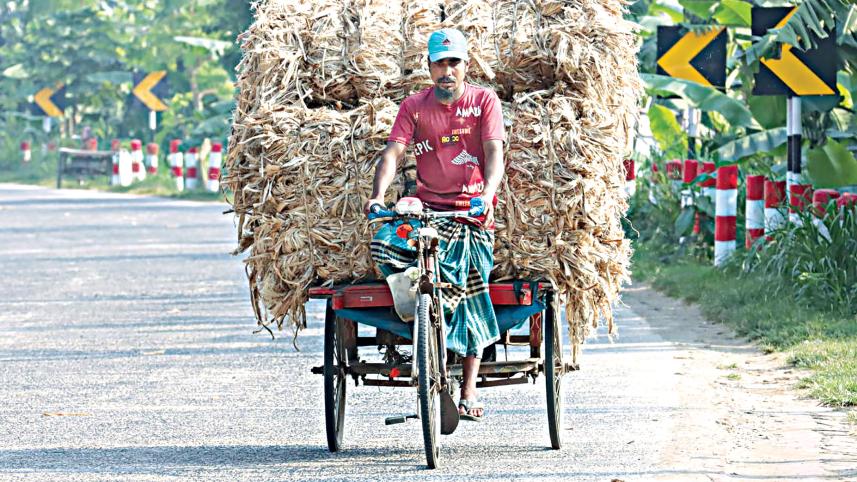
"Even though the government limited exports, prices in the market continue to rise," said Akhtaruzzaman Chan, a trader at Kanaipur market in Faridpur.
LOW PRODUCTION, TIGHT SUPPLY
Officials note that lower production this year has tightened domestic supply. Jute output fell 6.5 percent year-on-year to 89.5 lakh bales (one bale = 180 kg) in FY25 due to reduced acreage and unfavourable weather, according to Bangladesh Bureau of Statistics data.
"Due to low production, domestic supply is limited despite steady demand. This is why prices have not decreased even after export restrictions," said Shahadat Hossain, senior market officer at the Faridpur DAM.
Many farmers sold their jute early, expecting prices to drop because of the export restrictions. "Because of the export restrictions, we sold our jute quickly. Now we see prices rising. If exports had not been limited, we could have received better prices," said Anowar Molla of Jungurdi village in Faridpur's Nagarkanda upazila.
Lower yields compounded the problem. Moktar Molla, president of the Faridpur District Jute Farmers Association, said, "Cultivating one bigha costs Tk 40,000-Tk 42,000. We harvested only 5-6 maunds per bigha instead of the usual 10. After paying wages, many farmers are barely covering costs. Many thought prices would drop due to export limits, so they sold in September. But now, prices are increasing."
Medium-quality jute, used mainly for bags, sacks, hessian, and packaging, has declined modestly to Tk 3,600-Tk 3,700 per maund from around Tk 3,900. Md Omar Faruk Talukdar, assistant director at the Faridpur Jute Department, explained that high-quality fibre feeds export-oriented yarn mills, while medium grades cater to domestic demand, creating a natural price divergence.
HOARDING AND MARKET PRESSURE
Some traders point to alleged hoarding as another factor keeping prices elevated. "Hoarders are buying large quantities of jute and storing them to sell later at higher prices to mill owners. The government should take action against them," alleged Akand.
Talukdar noted, "Under government rules, anyone hoarding over 1,000 maunds of jute for more than a month is considered a hoarder, and action is taken. However, due to limited staff, not all cases can be addressed."
"This year, lower production has left demand in the market, pushing prices up. Without export restrictions, prices could have reached Tk 5,500, causing instability in the jute market," he added.
 For all latest news, follow The Daily Star's Google News channel.
 Raw jute exports declined following the restriction. During July-October of FY26, jute and jute goods exports together grew 4.7 percent year-on-year to $277 million, largely driven by yarn, twine, sacks, and bags. Raw jute shipments, however, remained lower.
The rebound comes after FY25, when exports of jute and jute goods fell to $820 million, the lowest in six years.
Farmers like Nab Kumar Kund of Raotara village in Magura Sadar describe a complex market. "Prices have increased mainly due to reduced production. We want prices high enough to encourage cultivation, but the government should ensure stability for all stakeholders," he said.
Comments