A cup of coffee, grown closer to home


In the morning rush, Omar pauses at a Dhaka coffee shop, drawn by the aroma of freshly brewed coffee. The first warm sip shakes off his sleepiness.
What he may not know is that the coffee may have travelled a surprisingly short distance -- from a hillside orchard in the Chittagong Hill Tracts (CHT), through a roastery in Rangamati or Dhaka, and finally to his cup.

Just two decades ago, coffee in Bangladesh largely meant imported instant granules or the occasional home brew. Today, more people drink coffee, and some of the beans are locally grown.
Unlike India, whose coffee history is linked to the tale of Sufi saint Baba Budan bringing seven beans from Yemen to Karnataka in the 17th century, Bangladesh has no dramatic origin story.
Cultivation began quietly in the CHT after farmers brought seeds and saplings from Mizoram, India.
Lama in Bandarban was the first known coffee-growing area, where cultivation began in the 1950s.
Government interest grew in the 1990s, followed by organised cultivation at the Khagrachhari Agricultural Research Station in 2001. Bandarban, Khagrachhari and Rangamati remain the main producing areas.
A NEW CROP FOR HILL FARMERS
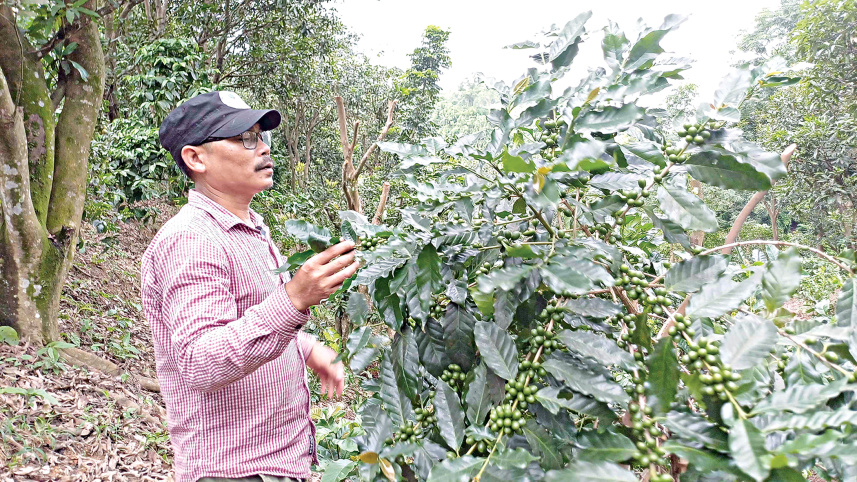
In Mrolong Para, a small Mro settlement near Bandarban town, coffee is becoming a new income source after years of poor returns from fruit farming and jhum cultivation.
Many of the 25 Mro families grow Arabica and Robusta beneath mango trees, boosting income without needing more land.
“Fair prices were never obtained for mangoes and other fruits,” said farmer Mangpong Mro. Unsold mangoes often “rotted right in the garden,” he said.
Three years ago, he planted 600 coffee saplings on half his mango orchard. His annual coffee income has since risen to nearly Tk 40,000, from Tk 2,500 in the first year.
Another farmer, Ritlang Mro, planted 700 coffee trees after receiving saplings from local organisations and government agencies. He ended up producing 20kg last year and expects at least one maund (37.3 kg) this year.
Entrepreneur Ching Aung Khumi helped push coffee cultivation forward in the hills. He explored its potential in 2014 and later received training in coffee-growing regions of India.
In 2016, 116 fruit farmers from 11 villages in Chimbuk received training and 200 Arabica saplings each. Field trials showed that Arabica adapted well, while Robusta was later introduced from Tripura, India.
Field trials found Arabica suitable, while Robusta was later introduced from India’s Tripura.
“Bandarban’s hilly areas are suitable for cultivating both Arabica and Robusta,” Ching said.
He now grows nearly 3,000 coffee plants across his five-acre mango orchard, while processing and selling beans from across the hills through his Furomon Coffee and Retail Shop in Bandarban.
“Our goal is not just to produce coffee but to build a sustainable market for hill farmers, so they can avoid the losses they faced with fruit and earn a stable income,” he said.
Bandarban produced around 16 tonnes of coffee in 2025, he added.
 For all latest news, follow The Daily Star's Google News channel.
 Abu Naeem Md Saifuddin, deputy director of the DAE in Bandarban, said the hills have suitable soil and climate for coffee, particularly when grown alongside mango trees.
“From 2021 to 2026, we distributed coffee saplings to around 2,000 farmers across the district. Ruma, Thanchi and the Chimbuk hills have recorded particularly good yields,” he said.

BEYOND THE HILLS
Coffee is spreading beyond the Chittagong Hill Tracts (CHT). Since 2021, farmers have commercially grown it on uncultivated hillocks in Sylhet’s Golapganj and Beanibazar. The crop is also taking root in the plains, with soils in Rangpur, Nilphamari, Madhupur Garh in Tangail and Sherpur proving suitable.
Production rose from 35 tonnes on 120 hectares in 2021 to 95 tonnes on around 2,000 hectares in 2025. At Tk 200 per kg, the 2025 harvest was worth nearly Tk 2 crore, according to the Department of Agricultural Extension (DAE).
The government aims to raise production to 1,500 tonnes by 2030, worth around Tk 30 crore, as it seeks to develop a $1 billion export market.
Driving the expansion is the agriculture ministry’s Tk 211 crore Cashew Nut and Coffee Research, Development and Extension Project, which is taking coffee farming to 45 upazilas in 19 districts outside the CHT.
The project provides improved Arabica and Robusta saplings, inputs and processing equipment, including depulpers and dryers. Farmers can earn Tk 350-400 per kg from raw coffee and Tk 1,200-2,000 from processed beans.
Around 49,500 farmers are receiving training, while marketing teams and cooperatives connect them with roasters and corporate buyers, reducing reliance on middlemen.
A MARKET TAKING SHAPE
The growing crop is attracting speciality cafes, roasteries, large business groups, food processors, wholesalers and NGOs. Yet domestic production meets only about 5 percent of demand, leaving considerable room for growth.
North End Coffee Roasters buys beans directly from CHT farmers, processes them and sells them as its ‘Hill Tracts Blend’ at Tk 890 for 250g and Tk 1,425 for 400g. Other Dhaka cafes and roasteries also buy and roast local beans.
Abul Khair Group sources coffee for its Ama Coffee brand, while PRAN-RFL Group and other food companies buy coffee and flavoured products from wholesalers and large farmers.
Middlemen and local wholesalers remain important for small farmers in remote parts of Bandarban and Khagrachhari. They buy fresh cherries and supply them to roasteries and processors.
NGOs such as Helen Keller International and PKSF also buy coffee from marginal women farmers and small growers at fair prices, helping them access larger markets.
Sharjeel Abdul Karim, proprietor of East Bengal Coffee Roasters, said Bangladesh’s coffee industry has grown significantly, with local coffee gaining traction among urban consumers over the past five to 10 years.
About 15 years ago, Rick Hubbard established North End and began roasting imported green beans. Other companies followed, while NGOs and the government helped introduce coffee farming in the CHT, he said.
East Bengal began roasting and supplying coffee more than three years ago and later launched its Bandarban Blend.
But local coffee remains scarce because production is still far below demand.
Karim said CHT coffee had now “come of age” and tastes good. Production is mainly Arabica, while Robusta has significant potential for expansion. Growing interest in coffee origins, speciality coffee and local produce is also driving urban demand.
Processing, however, remains below international standards. Karim sees huge potential over the next five to 10 years as farming becomes more organised.
At Baatighar, a book cafe in Dhaka, hill-grown beans have been used since 2022, with no negative customer feedback so far.
“We mostly use Arabica beans from Bandarban, with Robusta making up about 30 percent of the blend. Demand is increasing day by day,” the cafe’s manager told The Daily Star.
The cafe collects green beans from Bandarban and has them roasted by a company in Gulshan.
“Friday and Saturday are our busiest days. We sell around 70 to 80 cups of coffee made from hill-grown beans each day, and sometimes the number reaches 100 cups,” he said.
A regular cup costs Tk 50, while large cups cost Tk 190 to Tk 270.
“The hill-grown beans are slightly smaller, and weather-related problems also affect production. So, it is somewhat challenging,” he said.
JOBS BEYOND THE FARMS
Coffee cultivation and processing are creating thousands of jobs. More than 2,000 marginal farmers now earn from coffee orchards, giving hill communities a more permanent income source and an alternative to jhum farming. Orchard maintenance also provides work for agricultural labourers.
Harvesting, sorting and sun-drying create further jobs, particularly for women.
Investments of nearly Tk 250 crore by BSRM and Kazi Group in cashew and coffee processing plants have created an estimated 2,000 to 3,200 factory jobs.
At the consumer end, the nearly Tk 600 crore domestic coffee market is growing by about 56 percent a year. This is fuelling speciality cafes and creating opportunities for young people as baristas, cafe managers, roasters and supply-chain workers.
Md Shahidul Islam, director of the DAE’s Cashews and Coffee Research, Development and Extension Project, said coffee cultivation is growing rapidly because of rising domestic demand, government support and favourable climates in both hilly and plain areas.
Once an expensive, import-dependent beverage, coffee has become a profitable cash crop as lifestyles and coffee culture have changed, he said.
Bangladeshi coffee has promising taste, quality and natural diversity comparable to international standards when properly processed, although the country still faces limitations in competing with the world’s top-quality coffee.
Coffee may also boost tourism. The Bangladesh Tourism Board is developing a ‘Tea and Coffee Tourism’ model to support rural economies and diversify tourism. While Sreemangal is famous for tea, coffee plantations in the CHT and northern Bangladesh are attracting adventure and agrotourism enthusiasts.
“Coffee farming is also helping reduce deforestation linked to jhum, or slash-and-burn cultivation, and tobacco farming in Bangladesh,” Shahidul said.
A CROP WITH CHALLENGES
Climate change remains a major long-term threat. Changing temperatures and rainfall patterns are affecting yields and quality. Premium Arabica grows best at 18-22°C, but rising temperatures and extreme heat are increasingly affecting the plants.
Farmers also face a three- to four-year wait for the first harvest, making small and marginal growers hesitant to replace crops that provide quicker returns.
Many lack modern skills in pruning, irrigation and pest management. There is also no dedicated coffee quality-grading institution, affecting quality and yields.
In remote hill areas, inadequate processing and roasting facilities pose another challenge. Coffee cherries must be depulped and dried quickly to preserve flavour and aroma, but delays can damage bean quality.
Market access remains difficult. Farmers have limited direct links with major roasters and brands in Dhaka and Chattogram and often depend on traders and middlemen. This weakens their bargaining power, creates price uncertainty and can prevent them from receiving fair prices.
Still, for farmers such as Mangpong and Ritlang, coffee is no longer an experiment. It is becoming a crop that can offer something their orchards often could not: a more dependable income --and perhaps a place in the morning cup of Bangladesh’s growing number of coffee drinkers.

Energy crisis squeezes apparel margins as Christmas airlift looms

CETP crisis threatens leather export ambitions

Spotlight / BB eases payment rules for hi-tech park firms

Spotlight / Govt links 12,000 institutions to broadband

BB to offer young entrepreneurs Tk 20 lakh in loan, grant
A Bangladesh lesson that made a Japanese billionaire

Why oil importers are learning to live with longer trade routes