


Energy crisis squeezes apparel margins as Christmas airlift looms

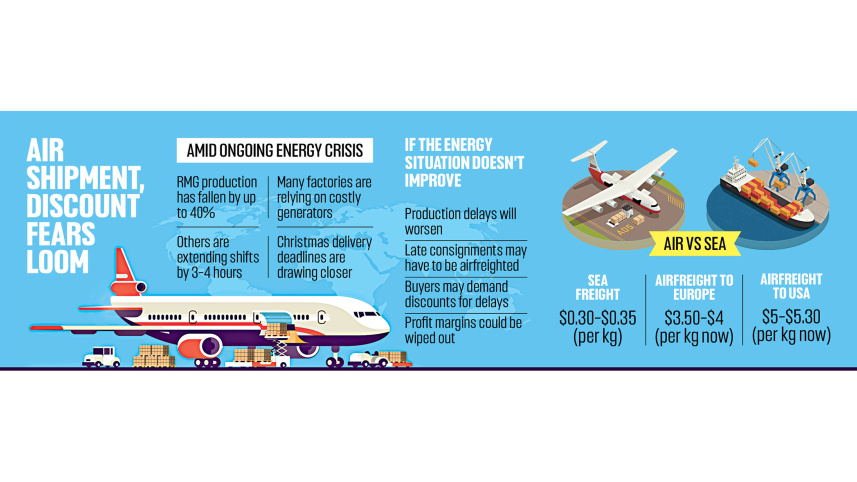
Local apparel exporters are fearing expensive airfreight and discounts from international clothing retailers and brands because of delays in production and timely shipment of goods due to the current energy crisis.
The suppliers are now scrambling to complete production and ship goods on time, as July to the first week of December is the peak period for Christmas shipments.

“Buyers have been asking for timely shipment as many are lagging behind in making the Christmas deliveries on time amid the energy crisis,” said Anwar-Ul-Alam Chowdhury (Parvez), chairman and managing director of Evince Group, whose clients include Levi’s, Armani, Zara and H&M.
Since the third week of July, the country’s apparel and textile industry has been facing worsening gas and power supplies following the disruption at a floating LNG terminal.
The gas shortage has pushed pressure at many factories below the level needed for smooth operations, particularly in textile, dyeing and finishing units. Factories that rely on gas for boilers and other production processes have been forced to cut operating hours or run below capacity.
The gas shortage has also affected gas-fired power generation, worsening electricity supplies to industrial areas. By early August, factories in major industrial belts reported production cuts of 30 to 40 percent.
For apparel exporters, the immediate concerns are delayed shipments, higher costs and tighter profit margins at a time when they already face intense competition in global markets.
Parvez said even local textile mills are struggling to supply fabrics on time because of the energy crisis.
He said that international buyers have so far stayed with the local suppliers.
After more than one month of the floating terminal glitch, the shortages show no sign of improving soon as the war in the Gulf has jeopardised LNG cargo deliveries from the Middle East.
According to apparel makers, if the crisis continues for another month, readymade garment exporters could face further problems.
From November, sea freight will no longer be a viable option for some delayed Christmas deliveries.
Local manufacturers will have to opt for expensive airfreight or offer discounts to compensate for delays.
“The airfreight will be a major challenge for the delay in production. And of course, air shipment is very expensive making profit through almost impossible,” said Parvez.
Regular sea shipments from Chattogram to Europe and the US cost 30 to 35 cents per kg, or even less.
By contrast, air cargo costs $3.50 to $4 per kg to Europe and $5 to $5.30 per kg to the US, according to Kabir Ahmed, former president of the Bangladesh Freight Forwarders Association.
During peak seasons such as November and December, the rates rise to $6 per kg to Europe and $7 to $7.50 per kg to the US, he said.
Amid the prolonged energy crunch, some manufacturers have resorted to costly diesel-fired generators to keep their production lines running.
Shovon Islam, managing director of Sparrow Group, a garment exporter, said he has been continuing production with diesel-run generators to meet tight production and shipment deadlines.
“Big factories are able to run their units with the diesel generator though the cost of production increases. But the small and medium units are facing difficulties,” Shovon said.
 For all latest news, follow The Daily Star's Google News channel.
 Sharif Zahir, chairman of Ananta Group, a garment exporter, said production and shipments have continued on time because he is using diesel generators to run the factories.
“But the cost of production has been rising because of the energy crisis,” he added.
Meanwhile, two big garment exporters, speaking on condition of anonymity, said they are struggling to ship goods on time because of the scale of their operations.
They said it has become difficult to meet delivery commitments on time. They also feared having to airlift goods from Dhaka to Europe and the US at much higher costs to meet deadlines for buyers.
Mohammad Hatem, president of the Bangladesh Knitwear Manufacturers and Exporters Association (BKMEA), said buyers are sending messages warning of discounts and expensive air shipments.
“The buyers are also not placing full volume of work orders for the next seasons as they are also observing the situation,” Hatem said.
Mahmud Hasan Khan, president of the Bangladesh Garment Manufacturers and Exporters Association (BGMEA), said local garment exporters have been covering 30 to 35 percent production losses by using diesel-run generators.
“Until now, the local exporters are maintaining the production and timely shipment of goods with the diesel run generators. In near future, it is expected that the energy crisis will end,” he said.
The BGMEA president also said many factories have already extended working hours by three to four hours, using diesel-run generators, so they could ship goods on time.
“All these have increased the cost of production, but still committed to timely shipment,” he added.
Comments