


5 key developments in economy last week
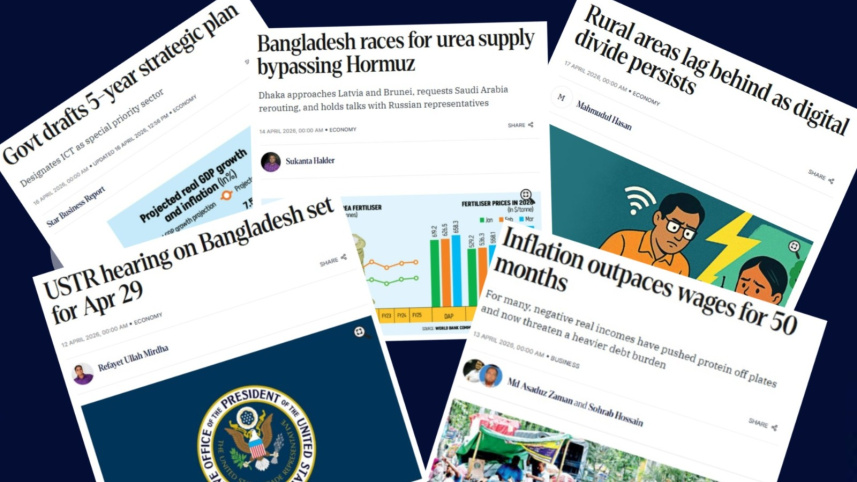
Looming international trade investigations, a persistent cost-of-living crisis, and the urgency to secure agricultural inputs dominated Bangladesh's economy last week.
Amid all the pressure, long-term strategic growth planning, and a widening technological gap between urban and rural populations also came to the limelight.

The following is a recap of those major stories as covered by Star Business.
USTR hearing on Bangladesh set for Apr 29 (April 12)
The United States Trade Representative (USTR) will hold a hearing on April 29 regarding investigations into alleged overcapacity and forced labour in Bangladesh. Launched under Section 301, the probe examines whether trade policies harm US manufacturing and reshoring efforts.
Inflation outpaces wages for 50 months (April 13)
Inflation has outpaced wage growth for 50 consecutive months up to March, driving real incomes down for four years. According to the Bangladesh Bureau of Statistics (BBS), the March wage growth of 8.09 percent trailed the 8.71 percent inflation rate by 0.62 percentage points.
Bangladesh races for urea supply bypassing Hormuz (April 14)
Bangladesh is scrambling for urea imports after a recent tender failed to attract bidders ahead of the June Aman planting. The urgency follows the shutdown of five urea factories due to gas concerns linked to the US-Israel war on Iran and the consequent closure of the Strait of Hormuz-- a key artery for global fertiliser trade.
Govt drafts 5-year strategic plan (April 16)
The government has drafted a five-year strategic framework targeting a trillion-dollar economy by 2034. The plan designates ICT as a priority sector, aims to send 20 lakh workers abroad annually, and projects real GDP growth to reach 8 percent.
Rural areas lag behind as digital divide persists (April 17)
A BBS survey revealed a 32.1 percentage point gap in internet use between rural (43.6 percent) and urban (75.7 percent) populations. High equipment and subscription costs remain significant barriers, leaving nearly half of the country offline despite high mobile penetration.
 For all latest news, follow The Daily Star's Google News channel.
Comments