


Asian stocks find footing
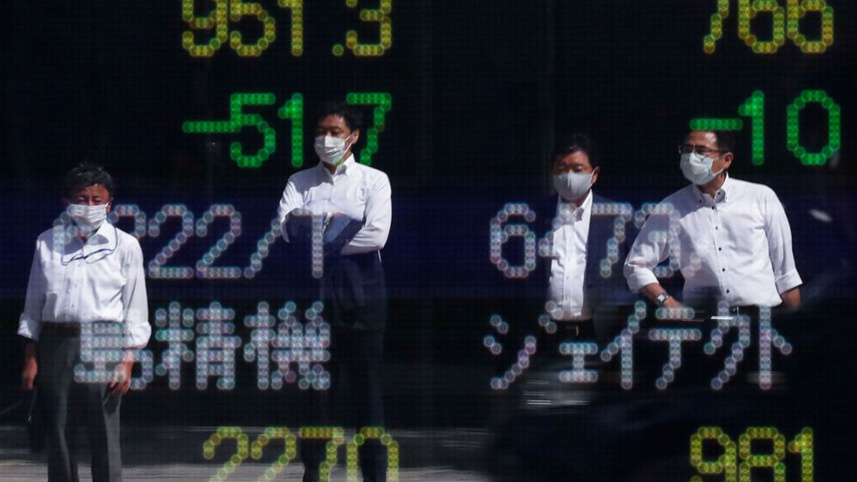
Asian shares managed to claw back some of this week's heavy losses on Thursday but were headed for their worst quarter since the pandemic hit, while the dollar held near a one-year high, helped by broad safe-haven demand and US rate hike prospects.
US and European stock futures were also higher with S&P 500 e-minis rising 0.8 per cent, the pan-region Euro Stoxx 50 futures gaining 0.76 per cent and FTSE futures advancing 0.54 per cent.

MSCI's broadest index of Asia-Pacific shares outside Japan gained 0.33 per cent, but was still set for a 4.4 per cent monthly decline and a 9.3 per cent loss on the quarter.
That would be the benchmark's worst quarter since the first three months of 2020, as Covid-19 raged across Southeast Asia and investors worried about slowing global growth with China a particular concern.
China's economy has been hit by regulatory curbs in the tech and property sectors and is now grappling with a power shortage.
Data published on Thursday showed China's factory activity unexpectedly shrank in September, but services returned to expansion as Covid-19 outbreaks receded.
However, analysts say slowing growth would pressure authorities to ease policy.
That provided battered Chinese markets with some respite with blue chips rising 0.6 per cent and the Shanghai Composite Index gaining 0.7 per cent.
"We think China is at the inflection point of more cyclical policy easing amid ongoing rapid growth slowdown," wrote analysts at Morgan Stanley in a note.
Elsewhere, the Hong Kong benchmark shed 0.3 per cent, hurt by declines in Chinese tech names while Australia gained 1.9 per cent and Korea's KOSPI gained 0.3 per cent.
The other main drag on investor sentiment in greater China was embattled developer China Evergrande, whose shares swung back and forth, and were last down 4.2 per cent.
The company missed paying bond interest due on Wednesday, two bondholders said, missing its second offshore debt payment in a week, although the cash-strapped company is scrambling to meet its obligation in its home market.
The Nikkei lost 0.31 per cent a day after Japan's ruling party chose softly spoken consensus-builder Fumio Kishida as its new leader and the country's new prime minister.
In currency markets, the dollar held onto recent strong gains in Asian hours, with the dollar index - which measures the US currency against six major currencies - at 94.304, just off a year-high hit overnight.
"(The dollar) is breaking key levels and there was no real resistance to the break so that tells you there was real underlying strength to that," said Chris Weston, head of research at Melbourne brokerage Pepperstone.
"Sometimes, it can become somewhat of a magical currency," he said, pointing to the fact that it was supported by both global investors seeking safety and the Fed inching closer to reducing its massive asset purchases.
In addition, "the ongoing US debt ceiling stand-off could briefly amplify financial market jitters and support the USD in the short-term," said analysts at CBA in a note.
US lawmakers continue to wrangle over funding the government but face a Friday deadline to prevent a shutdown approached, something that also capped gains in US equities overnight.
The yield on benchmark 10-year Treasury notes was 1.5167 per cent, little changed on the day, having risen sharply earlier in the week.
Oil prices edged lower, extending losses after official figures showed an unexpected rise in US inventories, reversing a run of recent gains.
 For all latest news, follow The Daily Star's Google News channel.
 Brent crude was down 0.5 per cent to $78.25 a barrel while US crude dipped 0.24 per cent to $74.65.
Spot gold traded at $1,731.99 per ounce, edging off its seven-week low, but still constrained by a strong dollar.
Comments