


Bad loans fall by Tk 87,298cr in three months

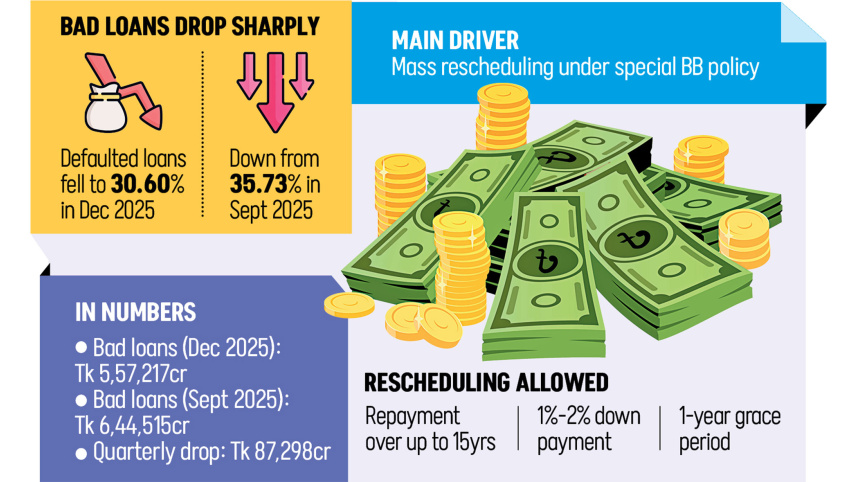
Defaulted loans in the banking sector fell to around 31 percent at the end of last year, down from around 36 percent three months earlier, following large-scale loan rescheduling under a special policy support of the central bank.
At the end of December 2025, defaulted loans stood at Tk 5,57,217 crore compared with Tk 6,44,515 crore at the end of September, according to the latest data from Bangladesh Bank (BB).

Within three months, the volume of bad loans dropped by Tk 87,298 crore.
Bankers said widespread rescheduling and restructuring under relaxed terms caused the sharp decline in non-performing loans at the end of the December quarter.
At the end of 2024, bad loans stood at Tk 3,45,764 crore, or 20.20 percent. On a year-on-year basis, defaulted loans rose by Tk 2,11,452 crore, marking a 61 percent increase.
Despite the drop in bad loans, bankers said actual cash recovery remained weak. Some banks had to reschedule loans following the central bank’s instructions.
In January last year, BB formed a five-member committee to provide policy support for restructuring corporate borrowers affected by macroeconomic stress and political instability.
On September 16, the central bank introduced a unified special rescheduling policy aimed at sustaining economic activity and helping borrowers who defaulted due to circumstances beyond their control.
Under the policy, some borrowers were allowed to regularise loans for up to 15 years with a down payment of just 1 percent or 2 percent and a one-year grace period.
During the first nine months of last year, more than 300 companies, including large defaulter conglomerates, applied for rescheduling or restructuring facilities worth around Tk 2 lakh crore.
Bad loans surged to a historic high of 36 percent at the end of September last year after big borrowers such as S Alam, Beximco, AnonTex and Sikder Group defaulted following the fall of the Awami League government in August 2024.
Regarding the reduced figures in December last year, Mati ul Hasan, managing director of Mercantile Bank PLC, said that while defaulted loans have declined, cash flow has not increased.
As many factories and industrial units remain shut, borrowers have been given a one-year grace period. This means banks will not be able to recover funds during this time.
“The true picture will emerge in 2027 when repayments resume,” the senior banker told The Daily Star.
He also said the new government and the central bank governor are encouraging efforts to boost employment and reopen closed factories.
“It remains to be seen whether the coming days will bring positive outcomes,” he added.
Meanwhile, Masrur Arefin, chairman of the Association of Bankers Bangladesh (ABB) and managing director of City Bank, said four factors drove the decline in non-performing loans at the end of December.
Many banks partially wrote off large volumes of bad loans, with some writing off between Tk 300 crore and Tk 1,500 crore.
The second factor was the BB policy support, Arefin said. “Policy support played a role but was not the main driver.”
“Only about 42 percent of the policy support was implemented. In other words, if policy support worth Tk 100 was approved, only around 42 percent was actually executed,” said the ABB chairman.
 For all latest news, follow The Daily Star's Google News channel.
 He labelled recovery drives by banks in December last year as the third factor, which he said helped banks claw back a large chunk of loans.
Besides, he said some loans could not be classified as default due to court stay orders, which also contributed to the decline.
At the end of December last year, bad loans at state-owned banks stood at Tk 1,46,107.59 crore, or 44.44 percent of their total disbursed amounts, according to BB data.
Private commercial banks recorded Tk 3,89,579 crore in non-performing loans, equivalent to 28.25 percent of disbursed loans. Foreign banks held Tk 2,983.77 crore, or 4.51 percent, according to BB data.
Specialised banks reported Tk 18,546.47 crore, or 39.74 percent, in bad loans.
Moinul Islam, former professor of economics at University of Chittagong, said rescheduling loans on overly easy terms is not a lasting solution for reducing bad loans.
The economist said that while such measures may temporarily reduce reported figures, they do not actually solve the underlying problem.
“Strict measures must be taken against defaulters. Separate tribunals should be formed for the top 10 defaulters of each bank in order to recover their defaulted amounts,” he suggested.
After the rescheduling and restructuring, the banking sector now faces a provision shortfall of Tk 1,91,441 crore.
In 1999, bad loans in the banking sector stood at a record 41.1 percent. The ratio gradually declined and reached 6.1 percent in 2011.
Comments