


World to remain unequal without structural change: Rehman Sobhan
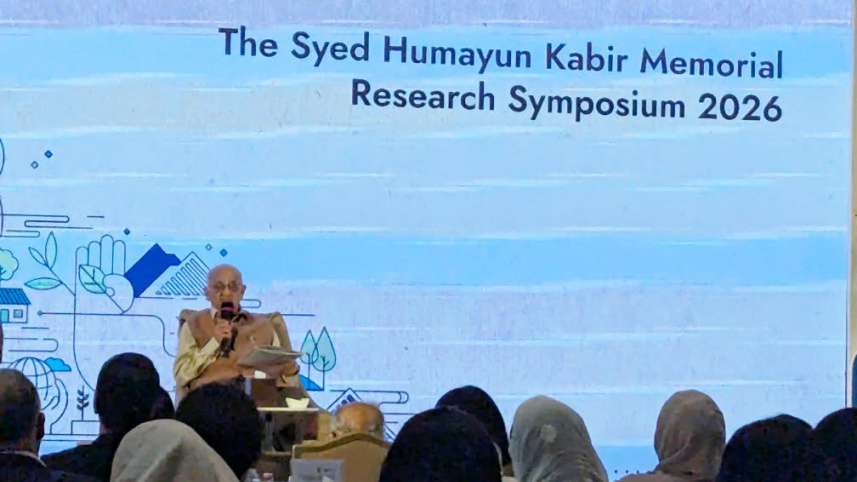
Professor Rehman Sobhan said today that the world will remain "unequal and unjust" unless the structural flaws in the current development model are addressed.
“We are going to go on living in an unequal world, in an unjust world, in which power, not just economic but political, is concentrated in the hands of a few people,” he said.

The chairman of the Centre for Policy Dialogue was speaking at the Syed Humayun Kabir Memorial Research Symposium 2026, organised by Sajida Foundation at a hotel in the capital.
Prof Rehman said the capability approach, pioneered by Amartya Sen and later developed by Martha Nussbaum, had broadened the concept of wellbeing beyond income poverty to include health, education and other dimensions of human capability.
He pointed to social-democratic systems in parts of Europe, where high-quality public education and universal healthcare were widely available.
Such systems, he said, enabled children from deprived backgrounds, including those of workers and bus drivers, to receive quality education, attend university and develop the capabilities to become “prime ministers and Nobel Prize winners”.
Prof Rehman said organisations such as Sajida Foundation, BRAC and Grameen Bank had improved lives and expanded opportunities, but had not addressed broader structural issues.
“If you are looking at the structural issues, then you have to look at the nature of the state, the nature of the economy,” he said.
Unacceptable levels of inequality, he said, were built into the development model still in place, with a very small proportion of people controlling a large share of wealth both globally and within countries, including Bangladesh.
He also criticised the continuing dominance of gross domestic product as a measure of economic progress.
The World Bank’s development model had emphasised GDP, he said, while macroeconomic stabilisation programmes in countries such as Bangladesh were essentially built around maximising GDP.
Referring to earlier work by Amartya Sen, Joseph Stiglitz and Jean-Paul Fitoussi on broader measures of economic and human progress, Prof Rehman said the World Bank, IMF and other institutions continued to rely on GDP-centred measures.
He said policymakers should instead assess performance through improvements in healthcare, quality education, nutrition and inequality, as well as the broadening of economic ownership.
“When the finance minister gets up and delivers his budget in parliament, instead of talking about the rate of GDP growth,” he said, the discussion should include improvements in healthcare and education, nutritional standards and measures of inequality.
He also called for the democratisation of ownership, saying corporate enterprises could include ownership by workers and wider sections of society.
Prof Rehman described the Renata-Sajida model developed by Syed Humayun Kabir as a sustainable approach in which corporate profits could finance public services through a foundation.
He said Humayun Kabir should not be recognised merely as a philanthropist, but as someone who demonstrated an “enlightened form of corporate capitalism”.
For businesses serious about improving conditions for deprived people, conventional corporate social responsibility was not enough, he said.
Sajida model, he added, offered an indigenous source of sustainable financing while addressing broader aspects of human capability and wellbeing.
However, he said such models alone could not overcome structural inequality, which required changes in economic opportunity and ownership.
 For all latest news, follow The Daily Star's Google News channel.
Comments